
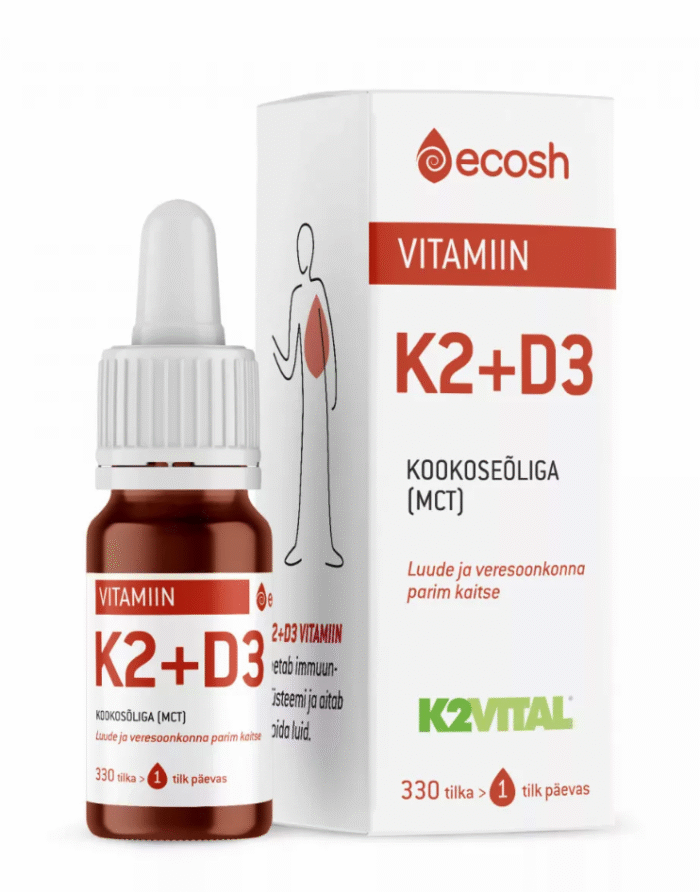
Vitamin D with K2 and magnesium
Vitamin D levels tend to run low in Estonia, even when summer seems sunny. For D3 to do its job in your body, you also need to consider vitamin K2 and magnesium. The simple truth is that one tablet cannot solve everything if the rest of the system is struggling.
Why do vitamin D levels drop so easily in Estonia?
We live at a latitude where sunlight cannot support vitamin D production all year round. In autumn, winter and early spring, UVB radiation is low, and your body cannot produce enough vitamin D in your skin. Summer offers better conditions, but the time of day, cloud cover, clothing and sun protection still matter.
The original article highlighted a 2009 University of Tartu study that found nearly 73% of Estonians were deficient in vitamin D by the end of summer. It also cited a 2024 doctoral thesis from the University of Tartu, which found deficiency among 96% of military conscripts in autumn and 84% in spring. These figures need to be considered in context, but the message is clear: even young, active people can have low levels.
In the gym, this can show up in familiar ways. Your training stalls, recovery takes longer, your mood is low, and tiredness starts to feel like a normal part of life. The truth is, you quickly get used to it. Only a blood test can show whether your vitamin D level might be the reason or whether you need to look elsewhere.
How does vitamin D become active in your body?
Vitamin D is often discussed as a single substance, but the form matters in supplements. D2 is plant-derived, while D3, or cholecalciferol, is the form your body generally uses more effectively. That is why many supplements contain vitamin D3.
Still, D3 should not be seen as a solo hero. D3 helps improve calcium absorption, but that calcium needs to reach the right places. This is where vitamin K2 comes in, particularly the MK-7 form, which the original text also discussed. D3 without K2 may be an incomplete solution for your body, because directing calcium into your bones and teeth requires support.
Another important part is magnesium. Magnesium is involved in activating vitamin D in your liver and kidneys. If you are low in magnesium, taking vitamin D may not make you feel the way you expect. That does not mean everyone needs to start taking large amounts straight away. It means you need to take a more informed look at the whole picture.
What can a deficiency feel like?
Typical signs can include muscle weakness, bone pain, fatigue, low mood, frequent illness and slower recovery. These symptoms alone do not prove vitamin D deficiency, as sleep, stress, iron deficiency or an excessive training load can cause the same symptoms. So what is actually going on? Without a test, you are left guessing.
Practical choices for K2 and magnesium
The most sensible starting point is a 25-OH D blood test. You can ask your family doctor for one or pay for testing at a laboratory or private clinic. In Estonia, results are often reported in ng/ml or nmol/L, so it is worth discussing your result with a doctor rather than simply checking an online chart.
If your level is low, D3 is usually a practical choice. Adding K2 makes particular sense if your aim is to support bone health and calcium metabolism. For magnesium, the original article mentioned glycinate and citrate as forms that are well absorbed. Many people find that taking magnesium in the evening works well, as it may support relaxation and sleep.
Do not base your entire health on a supplement. Oily fish, eggs, dairy products, regular physical activity, enough sleep and sensible sun exposure matter too. In spring and summer, be sensible about spending time in the sun and avoid burning your skin. In autumn and winter, however, it is quite common in Estonia for food and time outdoors alone to be insufficient.
From a training perspective, the aim is simple: keep your body in a condition where strength, recovery and immunity are not held back by an avoidable deficiency. Low energy levels get in the way of everything.
FAQ: vitamin D, K2 and magnesium
Is vitamin D useless on its own?
No, it is not useless. But D3 works better in your body when you have enough magnesium and your calcium metabolism is supported. That is why D3, K2 and magnesium are discussed together.
Should you get tested before taking supplements?
Yes, that is the most accurate approach. Fatigue and weakness can have several causes. A 25-OH D test helps establish whether your vitamin D level really is low.
When should you check your level again?
Once you have been taking a supplement for a while or have changed your dose on your doctor’s advice, it is worth arranging a repeat test. That way, you do not have to rely on how you feel to guess whether your approach has worked.
References
- University of Tartu’s 2009 study on vitamin D levels, cited in the original Fitness.ee article.
- 2024 doctoral thesis from the University of Tartu on vitamin D deficiency among military conscripts, cited in the original Fitness.ee article.
Come and train! ArtGym




