Romanian deadlift vs. stiff-legged deadlift
The Romanian deadlift and the stiff-legged deadlift both work your lower back and hamstrings. The exercises look similar, and the differences in technique are subtle. Once you understand those differences and pay attention to them, though, they can feel quite distinct. In addition to muscle building, both are effective assistance exercises for improving your squat and deadlift performance.
Stiff-legged deadlift
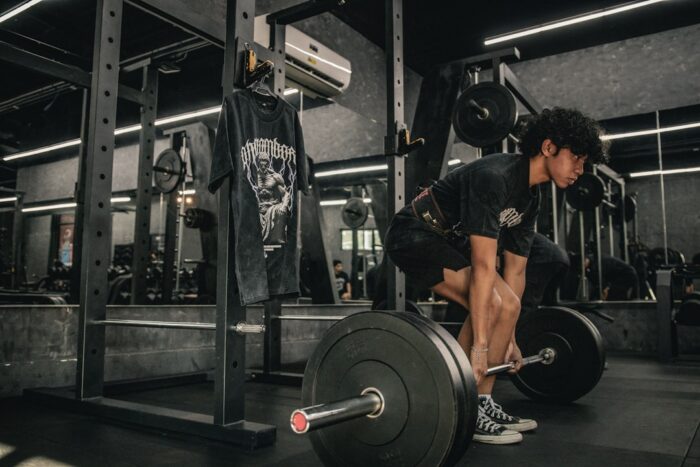
To perform this exercise, hold the barbell with an overhand grip and keep your arms straight. Bend your knees very slightly—just enough to avoid locking them. Without bending your knees any further, lower the bar either almost to the floor or until you feel your back beginning to round. From there, straighten up to return to the starting position. You can certainly perform this exercise for 20 reps per set, but during longer sets, take particular care to keep your technique from deteriorating. You can also use dumbbells, although this means using an even lighter weight than you would with a barbell. The stiff-legged deadlift works the hamstrings particularly intensely.
Romanian deadlift
The Romanian deadlift is an exercise developed by Romanian weightlifter Nicu Vlad to help develop the pulling phase before the clean and the jerk. The technique is very similar to that of the stiff-legged deadlift, but there are some differences. Unlike in the stiff-legged deadlift, you should push your hips well back as you lower the bar, keeping it as close to your body as possible. Your torso reaches a position parallel to the floor sooner in the Romanian deadlift than in the stiff-legged deadlift. Once the bar has passed your knees, straighten your knees and begin pulling the bar back to the starting position. The Romanian deadlift is used to develop power in the pull leading into the clean, which is among the pulls with the highest power output.
Watch the video: [url=http://youtu.be/QR6HDEmBQNo]Romanian Deadlift Vs Stiff Leg Deadlift- What’s The Difference?[/url]
Differences in the muscles worked
Both deadlift variations place considerable demands on your lower back and hamstrings. However, pushing your hips back during the Romanian deadlift increases hip joint rotation, which in turn means greater hip flexion and greater glute involvement. You bend your torso further forward in the Romanian deadlift, so both your glutes and erector spinae are more active during the pull than in the stiff-legged deadlift. Whether hamstring activation is higher or lower in either variation has not been established experimentally.
When to use each exercise
If your goal is to train your lower back, hip extensors and hamstrings, the stiff-legged deadlift works well. If you want to improve the pulling phase leading into the clean in Olympic weightlifting, the Romanian deadlift works well because it resembles the initial phase of the clean.
Author: Grey Evans, Janar Rückenberg (translation)
Come train with us! ArtGym