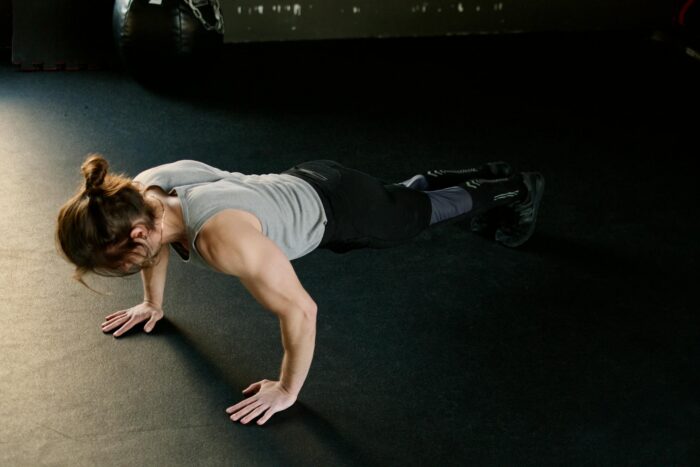
Push-ups: tips and mistakes
What are push-ups?
Push-ups may seem straightforward, but many people do not distinguish between the bench press and push-ups. Even when the visible differences are clear, fewer people understand how the two exercises differ anatomically.
Push-ups are a closed kinetic chain exercise (the distal ends of the limbs are fixed in place). The bench press, by contrast, is an open kinetic chain exercise (the ends of the limbs farthest from the body are not fixed in place during the exercise).
Why this matters:
In open kinetic chain movements, all the joints involved can also function separately, independently of one another. In closed kinetic chain exercises, however, moving one joint automatically causes all the joints in the working limb to move simultaneously.
In simple terms, this means that open kinetic chain movements allow you to isolate one part of the overall movement. Closed kinetic chain exercises engage the entire movement chain at once: bones, joints and muscles.
A good example is what happens to your shoulder blades during the bench press and push-ups. During the bench press, your shoulder blades stay relatively fixed against your back (or at least they should) and barely move (meaning you can press without moving your shoulder blades). During push-ups, however, your shoulder blades move across your back.
From a functional perspective, this also explains why closed kinetic chain exercises are more functional. They force you to coordinate the movement as a whole, whereas open kinetic chain exercises require less of this coordination.
How do you do push-ups correctly?
Neither age nor sex should be an excuse for not doing push-ups or being unable to do them. This is primarily because you are working with your own body weight. Of course, the usual problem is simply a lack of strength, nothing more.
What to keep in mind when doing push-ups or learning how to do them:
- In the starting position, and at the beginning and end of each push-up, your arms should be fully straight at the elbows. The balls of your feet should rest on the floor. Your body, back, hips and legs should form one straight line.
- A common mistake is not lowering your body far enough at the bottom of the movement.
- To check your depth and technique, ask someone to place their fist on the floor beneath your chest with their thumb pointing up. At the bottom of the movement, your chest should touch their raised thumb.
- Do not do push-ups with a partial range of motion; this is incorrect.
- If you cannot sustain a longer set of push-ups, this is usually due to a lack of muscular endurance. The only way to improve this is through practice, including other upper-body strength exercises.
Source
- To do push-ups, get into a high plank position. Place your hands on the floor slightly wider than shoulder-width apart.
- Rest the balls of your feet on the floor.
- Your body should form one straight line, with your torso, buttocks, thighs and lower legs more or less aligned.
- You can keep your feet together or slightly apart, depending on what feels more comfortable.
- Before bending your arms, check that your core and abdominal muscles are engaged and tighten them. Keep your abdomen lightly engaged and drawn in slightly rather than letting it hang loosely.
- Keep your core controlled and engaged throughout every push-up repetition.
- Hold your breath during the push-up and exhale at the end of each repetition, once you have pressed back up. Alternatively, inhale as you lower yourself and exhale as you press up.
- As a general rule, avoid fully locking out your elbows at the top (this keeps tension on the working muscles).
Source
My experience with push-ups. As a physical education teacher, I require my students, both boys and girls, to do push-ups in class and for assessment. I assess their push-ups at least a couple of times during the school year. Students know several months in advance exactly what they will need to do and how many repetitions are required. I usually announce as early as September, and post a reminder, that push-ups will be assessed at the end of the second term (Christmas). That gives them roughly 3.5 months, or 14 weeks, to practice. I start assessing students in grades 5.-6. (depending on the year group’s overall ability), and I assess both girls and boys. The only difference is that girls have a 15 cm block beneath their chest and boys a 10 cm block, which they must touch during each repetition. Both have the same time limit of 60 seconds. Of course, I also check their technique (body position, etc.). And they manage: those who want to, who practice and who make an effort can do it. Naturally, though, there are also plenty who just cannot manage it. For the most part, these are the same students, year after year and term after term, who simply cannot be bothered to make an effort.
I am also one of those people who sees no reason why girls should do push-ups on their knees. There is no justification for it. After all, you are working purely with your own bodyweight. I do make an allowance for depth: girls can stop 5 cm higher than boys. What is more, we cannot ignore the fact that girls also gain quite a significant advantage from their bust. So, when it comes to depth, some get away with barely moving.
But why do I require push-ups at all? The reason is simple. Of course, if you arbitrarily insist that someone “just has to complete a certain rep count within a minute,” that particular number serves no real purpose in itself. But my experience shows that students who earn a four or a five on the push-up test have significantly fewer problems with parallel bar skills, handstands, headstands and so on. In other words, a certain level of push-up ability is both a prerequisite and a good indicator of being able to perform the other gymnastics skills (and activities) in the school curriculum to a satisfactory or good standard. Students who earn fives in push-ups, sit-ups and pull-ups rarely struggle with any assessment in physical education. Students who pass the tests that assess general physical fitness are simply stronger, with better balance, strength and coordination. Of course, every now and then there are people who complain without understanding or ask questions such as, “Why does my Ants have to do these push-ups when he cannot manage them at all?” But these are lazy people who look for excuses and have a limited ability to make connections.
I have also put together a program and posted it on eKool, showing how regular practice can take you from virtually no push-up ability to at least a four (and usually a five). It works: those who put in the work improve, and those who practice develop the ability and strength.
Tips and mistakes
- If you cannot do a single push-up, your first step is to practice holding a proper high plank (the starting position for a push-up). My experience shows that, alongside weak pressing muscles, many people also struggle with very weak core muscles (the entire front of the torso, the rectus abdominis, the transverse abdominis and all the other small muscles at the front of the torso that help stabilize the body). You can also practice these holds in sets, even every day. A typical starting point might be to try holding the position for 5-6×20-30 seconds. To progress, gradually increase the duration of the holds. Where and how you start depends largely on your current ability. Practicing the forearm plank also helps you learn and achieve a proper high plank position.
- Do not do push-ups with your feet against a wall. Holding a plank without external support and performing push-ups in that position are part of what makes this exercise beneficial and gives it its training effect. It is a little like performing a press with the help of a crane.
- As the Estonian name for push-ups suggests, this is an exercise in which you bend your arms. A major mistake many people make is to move their hips and stomach up and down instead of lowering their chest toward the supporting surface, with very little movement of the arms at the shoulders and elbows.
- In the high plank position, place your hands on the floor slightly wider than shoulder-width apart, with your fingers spread slightly and the index fingers of both hands parallel. Many people like to turn their fingers inward to face each other when doing push-ups; this is also incorrect.
- As with the bench press, the narrower your hand placement in a push-up, the more emphasis bending your arms places on the triceps. Placing your hands wider apart, with your upper arms flared out in line with your shoulders, puts more emphasis on your chest muscles. Although many articles consider this push-up technique a risk for shoulder injuries, I do not see it as a particular problem in push-ups, where you are working with your own bodyweight. In the bench press, however, I do.
- Another major push-up mistake is letting your body move in a wave. Your upper body rises before your legs, and only then do your legs come up—or your legs barely move at all.
- At the bottom, your chest should almost touch the floor, and the angle between your forearm and upper arm should be at least ninety degrees.
- To improve your push-ups, you can do them quite frequently, even every day for periods of time.
- Try long sets, timed sets and sets that emphasize the lowering phase; perform isometric holds halfway through the range of motion, vary your hand spacing and so on.
- Push-ups work very well alongside pull-ups in the same workout. Try pairing these two exercises in supersets during a workout.
- If you are doing a long set and want to rest partway through, I recommend lifting your bottom and hips during the break (for the sake of your lower back), rather than letting your lower back sag and your stomach and hips hang down.
- I do not recommend clapping push-ups. They are very hard on your joints!
Author: translated and compiled by Janar Rückenberg
Come and train! ArtGym