
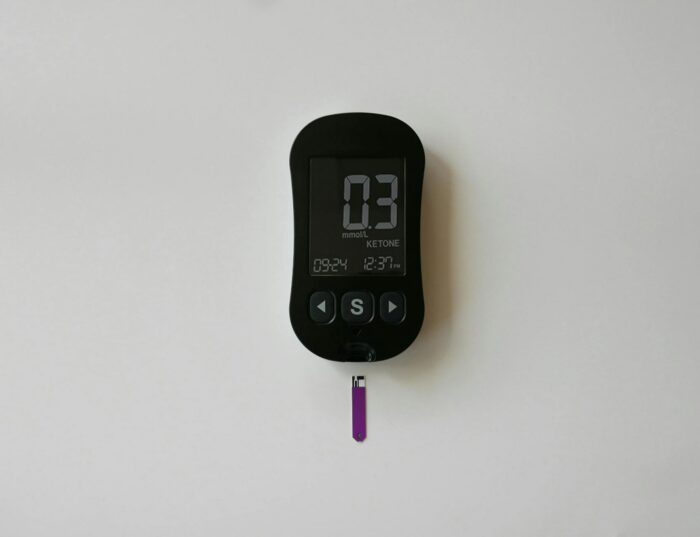
Measuring ketosis is easier than many people think — with two home testing methods and about 4 days to adapt, you’ll know exactly whether it’s working. Below, we explain how the cyclical ketogenic diet takes effect in your body, how to check your results and how to load up on carbohydrates while keeping fat burning going.
What is ketosis, and why does measuring it matter?
Ketosis is a state in which carbohydrate levels are low and your body produces ketone bodies — beta-hydroxybutyrate and acetoacetate — to meet its energy needs. The concentration of ketone bodies in your blood rises above that of glucose, and they become the main fuel for your brain, heart and muscles.
Initially, ketone bodies meet about 75% of the energy needs of your brain, heart and muscles. After 1–2 weeks, your brain adapts fully and uses ketone bodies for 100% of its energy — at that point, the brain fog and weakness of the first few days also disappear.
Low blood glucose means low insulin. Low insulin, in turn, raises levels of growth hormone, catecholamines and glucocorticoids — all of which promote fat burning. Glucagon, the hormone that opposes insulin, peaks at this point and releases fatty acids for energy. This is precisely why measuring ketosis is useful: the reading shows whether your hormonal state is actually where you think it is.
Getting started — nutrition and measuring ketosis at home
To reach ketosis, reduce carbohydrates to a minimum — no more than 30 g per day — and increase your fat intake. A practical ratio is 1.5 g of fat for every 1 g of protein, which means about 75% of your calories come from fat and 25% from protein. Eating this way brings your body into ketosis in about 4 days.
For example, if your daily requirement is 2000 kcal, you should consume approximately 165 g of fat, 125 g of protein and 0 g of carbohydrates. Fat is the most ketogenic nutrient — only 10% is converted into glucose, compared with 58% of protein and 100% of carbohydrates.
To confirm your results, there are two simple ways to measure ketosis:
- Blood glucose meter — measures glucose in your blood. In ketosis, your level should drop at least as low as 50–60 mg/dl.
- Ketostix test strips — measure ketone bodies excreted in your urine. Simple, inexpensive and easy to use at home.
Frankly, test strips are enough for most people. A blood glucose meter gives a more precise picture, but a urine test will clearly show whether you’re on track by the end of the first week.
Effects on muscle mass and safety
A ketogenic diet generally does not reduce quality muscle mass. In fact, it preserves muscle even better than a high-carbohydrate diet — stores of ketone bodies and fatty acids are so large that your body has no need to break down muscle to obtain amino acids for energy. Growth hormone levels are also high during the depletion phase, which further protects muscle tissue.
One important distinction: ketosis is not the same as ketoacidosis. Ketoacidosis occurs in people with diabetes whose bodies cannot use ketone bodies for energy — their blood sugar rises from the normal 80–120 mg/dl to 300–2000 mg/dl, pH drops and the situation becomes life-threatening. A healthy body simply excretes excess ketone bodies in urine.
Carbohydrate loading on a cyclical keto diet
The cyclical ketogenic diet alternates between about 5 days of ketosis and 2 days of carbohydrate loading. Loading is necessary for two reasons — strength training requires some glycogen, and periodic depletion and loading doubles your muscles’ capacity to resynthesize glycogen. Under normal conditions, the muscles of a 90 kg man store about 350 g of glycogen; after a depletion phase, this rises to nearly 700 g.
Before loading, do a full-body depletion workout — this depletes glycogen in all your major muscles and enhances supercompensation. Most glycogen resynthesis takes place within the first 24 hours, so carbohydrate intake is higher on the first loading day.
A practical breakdown for a 90 kg man (muscles can hold 11–15 g of carbohydrates per 1 kg of muscle tissue, totaling 1000–1400 g over two days):
- First day: 700–1000 g of carbohydrates from foods with a high glycemic index.
- Second day: 300–400 g of carbohydrates from foods with a low glycemic index that are rich in dietary fiber.
Make sure you drink 2–3 l of water on loading days. The reason is simple: 1 g of glycogen binds 2.7 g of water. The amount of fluid in your muscles can rise from a normal level of about 1400 g to almost 3800 g, creating visibly greater muscle size in the mirror.
Drawbacks to consider include fatigue and weakness during the first couple of weeks while your brain adapts; so-called keto breath (a slight metallic taste in your mouth); and a possible rise in cholesterol, which makes more frequent blood tests worthwhile. Since carbohydrate-rich foods are off the menu, you also miss out on some micronutrients — a multivitamin and minerals are practically essential.
FAQ — measuring ketosis and the cyclical diet
How quickly does ketosis begin after you restrict carbohydrates?
If you keep carbohydrates below 30 g per day and increase your fat intake, your body enters ketosis in about 4 days. The first few days are the hardest — your brain is still adapting.
What is the best way to measure ketosis at home?
Urine test strips (ketostix) are suitable for beginners — inexpensive and simple. If you want precision, buy a blood glucose meter and check that your blood sugar stays within 50–60 mg/dl.
Is cyclical keto suitable for everyone?
No. It is an extreme approach, and if a less restrictive diet is already working, there is no reason to try it. You need to plan for health monitoring throughout.
Translated by Janar Rückenberg
Source: WHO – healthy eating.
Come and train! ArtGym




