
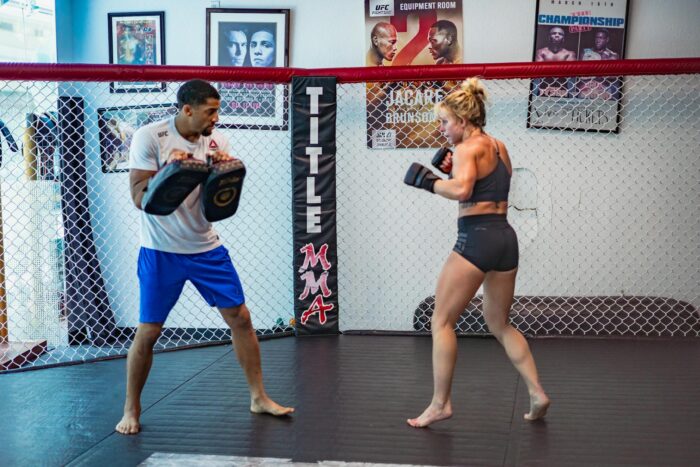
Interview: MMA coach Jorgen Matsi
This interview with Jorgen Matsi explores the early days of MMA in Estonia, coaching and how fighters actually develop. Jorgen was also known in the community at the time as jrx, and his insights remain surprisingly practical: less posturing, more consistent work.
Why does this interview matter for Estonian MMA?
Around 2007, MMA in Estonia was not yet a sport that every other gym was making a big noise about. The community was smaller, training opportunities were fewer, and people had to figure out much of it themselves. That is precisely what makes Jorgen Matsi’s perspective interesting: he speaks as an athlete, a coach and someone who is still learning.
Jorgen Matsi was studying for a master’s degree in psychology at the University of Tartu. He worked as a laboratory assistant at the university’s Institute of Sport Pedagogy and Coaching Sciences and also helped with teaching. He began martial arts at 16 with aikido. At 20, he took up ground fighting and Brazilian jiu-jitsu, later adding boxing, wrestling and elements of MMA.
He says his first truly systematic MMA training began in the summer of 2006, when he trained in England for 3 months. That experience gave him a clearer understanding of how to bring the different disciplines together into a coherent training approach.
Why MMA? Jorgen’s answer is simple: it offers variety. There is technique, strategy, individuality and physical effort. As a competitive sport, there is something very honest about fighting another person. As a form of training, it allows all sorts of people to come to the gym, learn, work hard and leave their everyday worries at the door for a while.
The heart of the interview: training must be a partnership
Jorgen does not describe coaching as a chain of command. For him, the training process is always a partnership. A coach can be a guide, but athletes need to understand where they are going and why.
That may sound gentle, but it is actually quite a demanding principle. A coach needs to listen to what someone says and pick up on what they leave unsaid. Some athletes are strong but struggle with recovery. Some learn quickly but are afraid of making mistakes in sparring. Others want to compete but are not yet ready to make the daily choices that competition demands.
At the time, one of Jorgen’s goals was to bring together people who wanted to compete in MMA. The plan was to get them training systematically in both Tartu and Tallinn, find opportunities to compete and prepare for competition as thoroughly as possible. It was not a project built on grand statements. It was more about practical work: who would turn up to training, who would compete, who would help and how to prepare.
On the competition front, Jorgen and Ott were invited to the Finnish Open Amateur MMA Championships, held on 6.-7. October. The Estonian Student Judo Championships followed a week later. That choice of events neatly illustrates his own approach: MMA was his main focus, but judo and Brazilian jiu-jitsu also offered valuable experience.
Ott here refers to Ott Tõnissaar, one of Estonia’s most active MMA competitors. Jorgen was often the person who helped fighters get into competition shape and supported them in their corner. He was modest about it: the team was small, and decisions were made democratically. Presumably, the fighters felt comfortable having him in their corner.
How does an MMA coach approach weight, food and training?
Jorgen was quite direct about making weight. He dislikes the idea of an athlete losing well over 10% of their body weight by the time they step on the scales, with recovery becoming a skill in its own right. The simple truth is that this has little to do with fighting.
Still, an athlete has to work within the existing rules. If the weigh-in is immediately before the competition, he tries to cut as little weight as possible, particularly water weight. If it is on the morning of the competition, several hours before the fight, methods can be combined. If the weigh-in is the day before, losing water weight sometimes has to be considered too. He aimed to bring his body fat percentage down to around ten or below before competing.
He had no hard-and-fast rules about nutrition. Much depended on how close a competition was and whether his weight was going up or down. He avoided meat products that contained more fat than protein by weight, limited hydrogenated fats and white sugar, and did not eat much potato, white pasta or rice.
Vegetables were an important part of his diet, both for their health benefits and because you can learn to make delicious meals with them. At the same time, he did not pretend that pizza or chocolate was forever off limits. Outside competition periods, if you feel like it, you can eat a large pizza or a bar of chocolate. If the same craving lasts for more than two days in a row, though, it is worth looking at what is actually wrong.
One of his most important principles was to avoid eating until he felt uncomfortably full. By that point, you have often already eaten too much. If you really need to feel full, that fullness should come from vegetables and low-fat, protein-rich foods. He generally saved meals higher in carbohydrates for after training.
Jorgen was very specific about fluid intake. Drinking 2 liters during the day and another 2 liters during training was normal for him. He noticed a real drop in performance if he went a couple of days without making himself drink enough. His view was simple: by the time you feel thirsty, you have already left it too late to drink.
When it came to training, he preferred to fit in as many sport-specific sessions as possible. Ideally, he would have liked to train 5-6 days a week, 2 times a day. In practice, he was happy if he managed 7 workouts a week. That is a very relatable gap between plans and reality.
He liked his strength training simple, fast-paced and varied. He rarely did pure strength training. Instead, he favored circuit training with medicine balls, resistance bands, dumbbells or a barbell. He mentioned a routine in the style of the Team Quest workout, wrestling routines and free weights. As a matter of principle, he did not use machines for strength training.
The aim was to establish a routine with strength training 1-2 times a week. One session would develop strength endurance and lactate tolerance, drawing on Liam “Taku” Bauer’s endurance program, while the other would focus on explosive power and maximal strength.
When it came to aerobic training and HIIT, he was firmly in favor of interval training. He had achieved good results with Taku’s HIIT program and other routines inspired by it. His preferred weekly schedule was 1-2 strength training sessions, 2 HIIT endurance sessions and at least four sport-specific sessions. He considered aerobic training alone a poor option for most people, unless the goal was to build a beginner’s base for a long-distance sport.
Among supplements, he mentioned vitamins C and B and fish oil, occasional courses of glucosamine, isotonic recovery drinks during intense training periods, and protein and carbohydrates after training when needed. That summer, he completed his first creatine cycle, using monohydrate to gain mass, and his verdict was brief: it worked. He also planned to try creatine ethyl ester later.
Lessons from the interview for anyone training today
What does this old interview still offer anyone training today? A surprising amount. First: training does not have to be fancy, but it does have to be consistent. If you have sport-specific training, recovery, sensible strength work and a clear goal in place, you are already in a better position than someone chasing every new program.
Second: variety helps, but it needs direction. Jorgen enjoyed different sports, including judo, boxing and BJJ. He recognized that this could dilute his performance as a competitor, but that broader experience gave him a better eye as a coach. It all depends on the goal.
Third: a good coach does not sell ready-made answers. They look at the individual. Jorgen named Karl Tanswell and Gavin Boardman from the UK, Matt Thornton from the USA, John Kavanaugh from Ireland, and Estonia’s Priit Mihkelson and Indrek Reiland as role models. At the same time, he said frankly that he did not really consider people he had never interacted with directly to be role models. That is a sensible filter.
His build meant that his preferred fighting approach was to take the fight to the ground, stay on top and work toward a joint lock or choke. Since he was quite short for his weight class but physically strong, this was a logical choice. He also wanted to develop his technical boxing skills. His old maxim sums up the strategy well: box a wrestler and wrestle a boxer.
In his view, the basic strategic principle of MMA was this: whoever is better in two of the three ranges generally wins. Those three ranges are stand-up fighting, the clinch and ground fighting. This also explains why MMA training cannot focus on just one thing. If one area is strong but two fall apart, your opponent will find that gap.
The end of the interview also revealed the team’s affiliation at the time. The Estonian team “Scared & Paranoid” was part of the international MMA gym called Straight Blast Gym, or SBGi for short. If you saw someone wearing a hoodie with SBGi on it, it signaled that they shared the same training lineage.
FAQ
Is this interview still useful?
Yes, if you read it for its training principles rather than as current news. Competitions and teams have changed over time, but the ideas about cooperation, recovery, versatility and an honest work ethic hold up well.
What can a beginner learn from this MMA coach?
As a beginner, the most important thing is not to chase everything at once. You should build a foundation: regular sport-specific training, technique, simple strength work, sleep, food and enough fluids. Only then is it worth adding more complex programs.
Is HIIT suitable for every fighter?
HIIT can be very useful for a fighter, but it needs to fit your training phase and recovery. If you are doing a lot of sport-specific training, excessive interval training can do more harm than good.
Author: MEE
Come train with us! ArtGym




