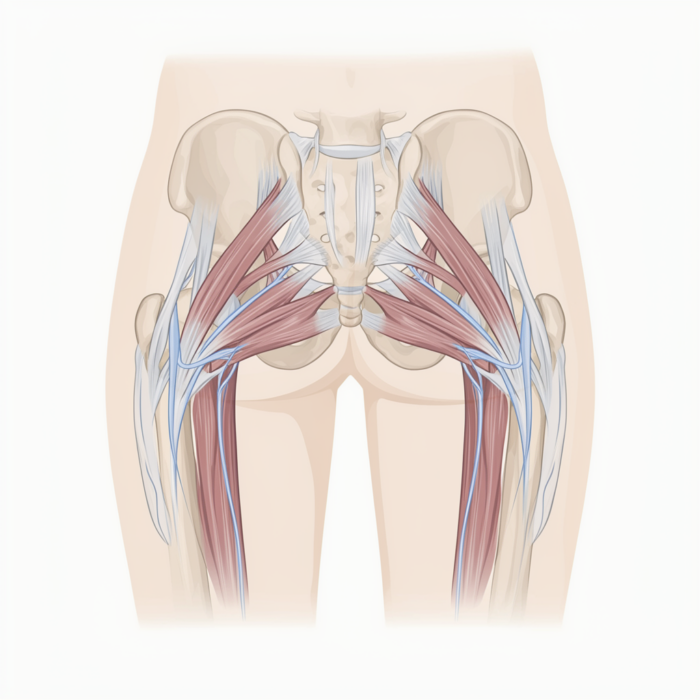
Biceps femoris: the keys to training it
For many people, the biceps femoris comes last in training: a couple of quick sets of leg curls and that’s it. In reality, the back of the thigh needs the same deliberate work as the front, because it is involved in both knee flexion and hip extension.
Here is an old but practical idea in plainer terms: how to do leg curls more smartly, why foot position matters and how to keep the inner and outer sides of the hamstrings in balance.
Why the biceps femoris needs separate attention
The muscles at the back of the thigh are not just a single “rear leg” block. The biceps femoris, the semimembranosus and the semitendinosus work together there. When needed, the gracilis joins in as well.
When these muscles are strong, your hip extension, knee control and overall lower-body strength improve. When they lag behind, the body often starts to compensate: the lower back takes over, the knees move poorly, or during leg curls the calf muscle (gastrocnemius) ends up doing a large share of the work.
A simple truth: your hamstrings won’t develop well if all they get is a couple of lazy sets at the end of your workout, when you’re already tired.
Biceps femoris and foot position
During leg curls, foot position changes how the exercise feels quite a lot. When your toes are pointed, i.e. in plantar flexion, the role of the gastrocnemius is reduced. This helps direct more of the training load to the hamstrings.
When your toes are pulled up, i.e. in dorsiflexion, the gastrocnemius is already stretched and tends to contribute more to the leg curl. That isn’t wrong, but the goal changes. If you want to hit the back of the thigh specifically, it’s worth trying the pointed-toe variation.
At first, this technique can feel like cramping. That often happens because the gastrocnemius tries to stay involved out of old habit. One practical solution is to do the concentric phase with your toes pulled up and the eccentric phase with your toes pointed.
Because a muscle is stronger in the eccentric phase than in the concentric phase, the hamstrings get more work on the way down. That is where this technique can give the best feel: the weight moves down under control and the hamstrings can’t escape the work.
How to do leg curls more smartly
Stretching your quadriceps between sets of leg curls can help you activate the hamstrings better on the next set. The reason is simple: the quadriceps is the antagonist of the biceps femoris. When the front relaxes, the back can contract better.
It doesn’t have to be a long stretch. A calm, controlled stretch between sets is enough. The goal isn’t to stretch until you’re loose, but to reduce excess tension in the front of the thigh.
The hamstrings also respond well to heavier weights and shorter sets. The original emphasis was that longer sets may not always be the best choice here. If you train your hamstrings with sets longer than 8 repetitions, you are probably using a weight that is 70% or less of your 1RM for that exercise.
That 70% and 8 repetitions is the lower limit that can still properly stimulate strength and hypertrophy. A comparison was given as an example: on the bench press, many people can do 1012 repetitions at 70%, but on the leg curl they can manage only 78 repetitions at 70%.
If you do long sets of 1520 repetitions for the hamstrings, you are probably using a weight of 5055% of your 1RM. It may burn, but for developing fast-twitch muscle fibers it is often too light.
Biceps femoris, eccentric work and balance
The hamstrings contain a lot of fast-twitch muscle fibers. That is why eccentric training, i.e. an emphasized lowering phase, also suits them well. In the lowering part of the exercise, rely on control, not momentum.
The example is simple: long jumpers and triple jumpers often have very strong hamstrings, because on landing this area takes a heavy eccentric training load. In the gym, you can apply the same idea by lowering more slowly during leg curls.
To assess balance, choose a leg curl weight at which you reach your limit around the sixth repetition. Start with a neutral foot position. If on the last repetitions your feet start to turn inward or splay outward, that gives you a hint about which side of the hamstrings is working more.
If your feet drift closer together, i.e. medial rotation, the semimembranosus and semitendinosus may be stronger and the biceps femoris weaker. If your feet turn outward, i.e. lateral rotation, the biceps femoris may be the stronger side.
Practical tricks for your training
Variation really matters here. If your gym has three leg curl variations, for example standing, seated and lying face down, then together with the foot positions they give you 9 different options.
Use a neutral position, then turn your feet slightly inward, then slightly outward. Don’t change everything at once. Pick one exercise and one technical cue, and check whether you feel the work where you should feel it.
The summary is still the same: train the hamstrings both as hip extensors and as knee flexors; train the hamstrings separately, one leg at a time; let the hamstrings go into a proper stretch when doing knee flexion; stretch the quadriceps between sets; do leg curls with your toes pointed (plantar flexion); use heavier loads and shorter sets too; use negative repetitions too; try to train the different parts of the hamstrings in a balanced way; vary your training!
FAQ: biceps femoris
Should the foot be extended during knee flexion?
If the goal is to emphasize the back of the thigh and reduce the involvement of the gastrocnemius, then yes, an extended foot, i.e. plantar flexion, can help. Do it in a controlled way and don’t let a cramp ruin your technique.
Are long sets suitable for the hamstrings?
Long sets can work as additional volume, but for strength and muscle mass it’s worth using heavier, shorter sets too. The principle in the original article was that beyond 8 repetitions the weight may end up too light.
How can you tell whether your hamstrings are balanced?
During knee flexion, watch what your feet do on the last hard repetitions. Internal and external rotation give a hint as to whether the medial or the lateral side is stronger.
Translated by Janar Rückenberg
Source:Turg.Fitness.ee
Come and train! ArtGym