Healthy carbohydrates for muscle mass
Healthy carbohydrates don’t just mean oat flakes and brown rice. It’s more a question of timing, amount and how the body uses carbohydrates around training.
This article is based on a text published in the March 1999 issue of “Flex”, but the idea is still familiar to every gym-goer: how to build mass without accumulating too much fat. If you ask 20 different bodybuilders how they use carbohydrates, you’ll probably get 20 different answers. Here is a simpler, more modern summary.
Why healthy carbohydrates matter if you train
Carbohydrates are the fuel for strength training. The body stores some of them as glycogen in the muscles and liver. When a workout is hard, it is exactly this reserve that gets used. When glycogen runs low, strength drops, sets turn into a grind and recovery can stay incomplete.
When you’re building mass, carbohydrates should supply a large share of your daily energy, especially when your training volume is high. The original text recommended multiplying body weight by 6.7 for men and by 3.4 for women to estimate the amount of carbohydrates in grams. For a man weighing 90 kilos, that would mean about 600g a day. This isn’t a rule that suits everyone, but it gives you a picture of how high the amounts can go in bodybuilding.
A simple truth: carbohydrates are not automatically good or bad. The same potato can help you recover after a workout, but eaten as a big portion late in the evening, it may fit your goal less well. Context is what matters.
How to spread healthy carbohydrates across the day
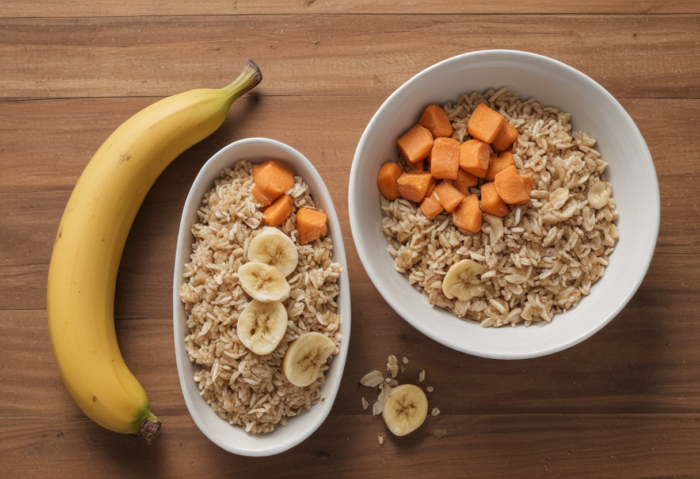
The first principle is to get most of your carbohydrates from unprocessed sources. Potatoes, whole grain products, oat flakes, oat porridge and brown rice are generally digested more slowly than sugar-rich foods. They help keep blood sugar steadier and provide energy for longer.
The second principle is to spread the amount across the day. If you eat your entire carbohydrate amount at once, it’s harder for the body to put it to sensible use. The original recommended splitting carbohydrates across six meals. This suits those who eat a lot during a mass-gaining phase and don’t want to force one huge plate down at a time.
The third key moment is the post-workout meal. After training, muscle glycogen stores are depleted and the body makes better use of carbohydrates for recovery. The original recommended taking about 25% of the daily carbohydrate allowance at this meal. Faster-absorbing sources such as honey, sugar, white bread or white rice can also fit here, but they shouldn’t become the staple choice for the whole day.
Breakfast is another good time for a carbohydrate-rich meal. Overnight, blood sugar is lower and muscle glycogen levels may have dropped. If a workout or an active day is ahead, a proper breakfast gives your body a better start.
Practical carbohydrate tips
- Eat complex carbohydrates. Make potatoes, oat flakes, whole grain products and brown rice your staples. They provide steadier energy than sweet snacks.
- Eat foods rich in dietary fiber. Beans and oat porridge are good choices. Dietary fiber supports digestion and helps fill you up better at a meal.
- Don’t eat a large amount of carbohydrates at once. If the goal is to build mass while keeping fat under control, it’s better to spread the amount across the day.
- After training, use simpler carbohydrates sensibly. Honey, sugar, white bread and white rice can fit the recovery window, but you don’t need them at every meal.
- Eat the largest amount after training. If you take 25% of your daily carbohydrate allowance after a workout, a large part of it goes toward restoring glycogen.
- Put breakfast to work. A carbohydrate-rich breakfast helps you start the day, especially if you train in the morning or around midday.
- Be precise with supplements. The original named 200 micrograms of chromium, 4 grams of omega-3 fatty acids and 100 milligrams of alpha-linolenic acid. If you use supplements, always look at your own menu and needs as a whole.
- Don’t overdo fruit while dieting. Fruit is rich in vitamins but contains fructose. For a bodybuilder on a diet, a large amount may be a poorer choice than starchy carbohydrates.
- Keep amounts in check in the evening. If your metabolism isn’t extremely fast, a big late-night portion of potatoes may not support your goal.
- Combine carbohydrates and protein. Protein helps balance the meal, while carbohydrates help amino acids reach the muscles.
- Vary the amounts. If your usual amount is 600g, you can try 50%, or 300 g, less for two days, then 600g again for two days, and then 30% more, or 900g, for two days.
So what actually happens when you cycle your carbohydrates? On lower-intake days, muscle glycogen levels drop and the body has to draw more on its fat stores. On higher-intake days, insulin levels rise, which can help preserve muscle mass. Your weekly carbohydrate total can stay the same, but the distribution gets smarter.
Healthy carbohydrates: what to watch on your plate
Start with the timing of your training. If you work out in the evening, a larger carbohydrate intake may suit the meals just before and after the workout. If you train in the morning, it’s worth planning your breakfast and post-workout meal more carefully.
Pay attention to how you feel, too. If you get sleepy after a big portion of rice, the amount may be too large or the timing poor. If you run short on strength in the gym, you may be eating too few carbohydrates. Honestly, this is where a log helps more than yet another theory.
Write down your body weight, your training weights and roughly what you ate. A pattern will emerge within a couple of weeks. Some people stay in better shape on a higher carbohydrate intake, while others need to limit their evening portions. Both can be right.
FAQ: healthy carbohydrates
Do carbohydrates make you fat?
Not on their own. Fat gain depends on your total energy intake, movement, training and timing. Eating too much, too often, can however work against your goal.
When is the best time to eat carbohydrates?
The safest bets are in the morning and after training. That’s when the body makes better use of carbohydrates for recovery and for refilling its energy stores.
Are low-carbohydrate days right for everyone?
Not necessarily. If your training volume is high or your recovery is poor, too low a carbohydrate intake can quickly affect your strength and mood. Start with small changes.
You can find the carbohydrates you need here: https://turg.fitness.ee/et
Author: FLEX, translated by K.Pinka
Source: WHO – physical activity.
Come and work out! ArtGym