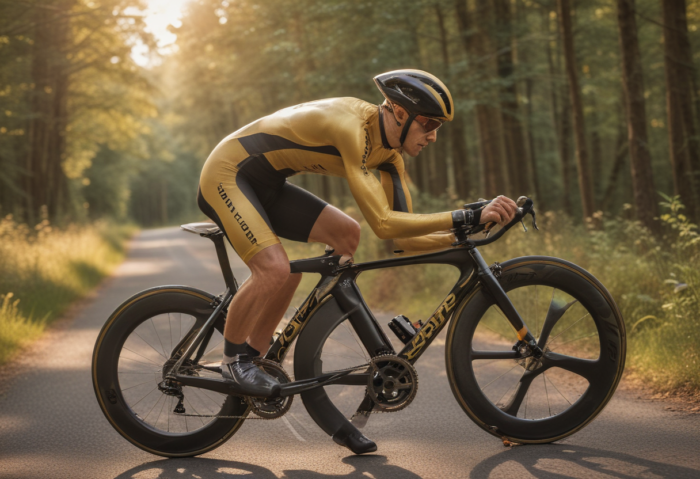
The 1994 Estonian cycling time trial championships on the Piibe road. There is a bustle of activity around the support cars — some riders are warming up, others are still tinkering with their bikes. Meanwhile, an unknown bearded man on a Start Shossee takes his place at the starting line, undaunted by the country’s best time trial machines lining up alongside him. The younger riders crack jokes. Indrek Otsus is back in cycling — and this time, nobody will be laughing.
Indrek Otsus at the starting line: a story still told today
Only Urmas Karlson, head coach of the Estonian junior track cycling team, allows himself a slight smile and makes a suggestion: boys, anyone who gets beaten by Otsus rides home and does another forty-kilometer loop. Everyone agrees. After the bearded man finishes, the air fills with foul language and fumbling excuses — yes, just an off day today. Five young cyclists set off toward Tallinn, seething with rage. Along with the man responsible.
That is how I might describe my first real encounter with the bodybuilder — or time trialist — Indrek Otsus. Cyclists know him as a formidable time trial specialist; bodybuilders know him as an established competitor in their sport. In terms of achievements, bodybuilding undoubtedly carries more weight, but there simply is no other Estonian bodybuilding champion who also shines among that company of road cyclists.
From bodybuilding to the saddle
Indrek was already involved in bodybuilding back in Soviet times. The sport was hugely popular then, and the standard of competition was high. He was among the first allowed to compete internationally, at least in the socialist countries. In 1979, 1980 and 1981, he competed in Czechia and Hungary, on a couple of occasions alongside the Czech bodybuilders who held European titles at the time. He usually came home with first-place finishes — by his own reckoning, second and third places were failures.
Soviet athletes had no chance of traveling any farther, beyond the Iron Curtain. In 1983, Indrek stopped competing actively — his motivation had run out. He had reached the ceiling in both the Soviet Union and Estonia. On top of that, there were attempts to ban bodybuilding as a decadent remnant of the West.
He took up cycling around the same time. In 1979, he acquired his first racing bike, and initially cycling was simply part of his bodybuilding training program. In 1983, during a break from professional sport, he began entering races at other people’s urging. At his first races organized by the ETKVL Construction Department, he finished in the middle of the field, but iron determination and persistent training paid off. By 1985, nobody at those races could match him.
That period also marked the start of the boom in mass-participation road cycling events that continues to this day. Indrek Otsus is one of those who have taken part in every Tallinn Rattaralli. It was triathlete and time trial specialist Jaan Pehk, who has since passed away, who encouraged him to try time trials. They were well matched as training partners: both devoted fanatics in their sports, both more than a little mad. It was hardly unusual for the two friends to set off on a hundred-and-fifty-kilometer loop in torrential rain and wind while their rivals tinkered with their bikes or waited for the rain to ease. “Oh, there go those madmen again. All that riding won’t do them any good anyway,” many told themselves for comfort. There was still a long way to go before 1995.
Indrek Otsus returns to bodybuilding
In the autumn of 1988, Indrek happened to watch the Lithuanian bodybuilding championships. To his surprise, he saw fellow competitors from his earlier days taking top places. “Why couldn’t I give it a try?” The thought kept pounding in his head. After a couple of days of intense deliberation, the bodybuilding demon had its way. The next morning, Indrek was already in the gym, working on the machines. His ambitions grew further when it was announced that the USSR team would also begin competing at the World Championships. To get there, though, he had to win the USSR title — and that was far from easy.
As in other sports, only the strongest possible credential could earn an Estonian a place on the Soviet team: a national title. Second and third places counted for nothing. When former cyclists recall their days on the Soviet team, the management’s reasoning almost always sounds the same: “But what happens if you’re just as weak at the Olympics and fail to come first?” The rule in most USSR teams was that a Soviet athlete had to be in form at all times. Riho Suun has described spring training camps where they had to ride up to two hundred kilometers a day, whatever the weather. Nobody cared whether it was raining or sleeting. The planned economy governed sport, too.
For four years, Indrek Otsus put his heart and soul into trying to win that title. Yet, as if to spite him, every competition — whether the USSR Cup or the national championships — yielded only silver and bronze medals. The army of bureaucrats remained unmoved: to make the team, he would have had to win everything. In 1991, he finally managed to win the ILBB league championships in Italy. In 1992, Estonia competed at the European Championships as an independent team. Joining Indrek were Ain Paavo, Jevgeni Selnihhin and Aleksander Jemeljanenkoff. At the competition in Ostrava, he was the highest-placed Estonian man, finishing in the top fifteen. It was also his last major bodybuilding competition.
Indrek Otsus gets serious about time trials
A stubborn, restless athlete, Indrek now decided to take cycling more seriously. His fellow cyclists were astonished when the mad bearded man took his bike down from its hook again and began diligently clocking up kilometers on the Keila-Klooga loop. This time, there was no question of riding aimlessly. His target was a top-ten finish at the Estonian time trial championships. Friends and acquaintances tapped their temples in disbelief. But what did Indrek care? The other cyclists were only flesh and blood, too. Given that time trials and road racing were popular then, and all the top riders, including Aus and Kirsipuu, were ready to challenge, the doubters had every reason to be skeptical.
Indrek finished twelfth at the 1993 Estonian Championships. He considered the attempt a failure. But for someone who had only just retired from bodybuilding, competing against riders who had been training systematically for years, it was a more than respectable result. Especially given a fact that emerged almost by chance during our conversation: ever the conscientious cyclist, Otsus had tried riding a 50 km time trial the day before to see how he would do. Several times. Riders generally take it easy before a tough race, with just a little work on their pacing — but Otsus had been going flat out in the days before the start. Naturally, there was no question of him arriving rested and sharp.
He learned a great deal from that race. In 1994, Indrek finally achieved his goal, charging across the finish line in seventh place at the Estonian Championships. After that, he was no longer treated as some unknown outsider. The riders respected Indrek Otsus as an equal — an exceedingly rare honor in cycling circles. For us young riders, this naturally caused a little resentment. Almost every time we complained, the coaches would reply: “Then how does Otsus manage it?” or “Look at that old clunker Otsus rides faster than you!” At times, you felt like giving the troublesome old man a good thumping.
Things got really out of hand in 1995. The field at the Estonian Championships was strong — all the riders racing for foreign clubs were there. Average speeds in the time trial were already reaching around 44.5 km/h. The weather was challenging, with plenty of wind. Indrek had timed his peak form perfectly. He was feared as a potential rival, but no one dared predict a podium finish. You should have seen the faces of the veteran cycling coaches when the news came from the halfway turn: “Indrek Otsus is currently leading, ten seconds ahead of Janek Ermel.” In the end, Otsus narrowly lost to Ermel, who has been regarded as one of Estonia’s most talented young cyclists of all time. Who knows what Janek might have gone on to achieve had he not been killed in a car accident while training.
From that moment on, coaches stopped berating their riders for getting beaten by the athlete in time trials. Indrek Otsus had become a time trial specialist to be reckoned with. In 1997, he rode to bronze; in 1999, he finished 16th. These are remarkable achievements, given that Otsus is old enough to be the father of most of the riders he competes against.
Training volume, pacing and Estonia’s time trial legacy
As we talked about sport and cycling, his training volume also came to light: 22,000 km and 1000 hours of training a year. Those are figures you would expect from an average professional cyclist. What makes them particularly staggering is that every kilometer was ridden in Estonia, rather than southern Spain. Given our weather, those numbers are quite something.
Indrek knows more about time trials and timed track events than some cycling coaches. In fact, I can’t think of anyone here with such a thorough knowledge of the subject. With the internet at your fingertips, why not? Although I believe it really comes down to attitude. Time trialing is one of the toughest disciplines, and for years it has been drummed into everyone that individual and team time trials are the preserve of the Eastern Bloc and the Russians. Baffling stuff. Take even a brief look at the statistics, and the results sheets from major races turn up names such as Tõnu Roosmäe, Oleg Ljadov, Aivar Murd, Lauri Aus and many others — all Estonian cyclists.
Football coach Roman Ubakivi once faced the same objection when he took on a group of little boys known as the Lõvipoisid, or Lion Cubs. Estonians simply couldn’t play football, people said. Ubakivi’s response was logical: “What do you mean they can’t? They’ve done it before!” Looking back, the stubborn coach had a point. Mart Poom, Marko Kristal, Martin Reim and other leading footballers of today all came from that very same Lõvid team.
Indrek thinks it was a crime to let the once-popular 100 km time trials in Kuremaa fall by the wayside. “Now that would have been a chance to really go flat out,” he sighs to himself. Perhaps the reasons also lay in the times — it was a period of transition, the Soviet national team ceased to exist, and all the riders were chasing contracts with foreign clubs. It might even be worth trying again now. Whether anyone apart from Indrek Otsus and the current secretary general of the Estonian Cyclists’ Union, Urmas Karlson, would be crazy enough to line up at the start is another matter.
I also tentatively ask whether the Terror of Cyclists is thinking of throwing in the towel yet. “Not a chance.” Instead, the conversation turns to reducing his training load and specializing a little. “Sean Kelly won the Tour de Suisse at 42, after all,” Indrek points out. “Well, we’ll see in the spring. Listen, I’d better get going — the asphalt is drying out and it’s warm enough,” (it’s 1 °C outside!) “I still need to stop by Reval, and then I can get the bike out of the shed,” Otsus says, hurrying me along. We say our goodbyes, adding the customary cyclists’ farewell: if we don’t see each other before then, we’ll see each other at the start.
Saturday morning. I turn up the car heater and look with sympathy at the people huddled at the bus stop. I need to hurry; my students are waiting for their spinning class to begin. On Paldiski Road, just before Status Club, a familiar rider in warm clothing and a cycling cap comes toward me from the Klooga roundabout. I wave, and Indrek waves back. I park outside the club and abandon any thought of ever beating Otsus in a time trial again.
FAQ about Indrek Otsus
Who is Indrek Otsus?
An Estonian bodybuilder and road cyclist who was already one of Estonia’s leading bodybuilders in the Soviet era and later became a serious time trial specialist in middle age. In 1991, he won the ILBB league championships in Italy, and in 1997, he took bronze in the time trial at the Estonian championships.
How much training did Indrek Otsus do each year?
Around 22,000 km and 1000 hours of training a year — a volume on par with that of an average professional cyclist, made especially remarkable by the fact that all of it was done in Estonian weather, rather than in a warm southern country.
Why is Indrek Otsus’s story extraordinary in cycling circles?
Because no other Estonian bodybuilding champion has reached the same level as professional cyclists riding for foreign clubs in another demanding endurance discipline — time trialing. And he did so at a mature age, without a foundation in the sport built in his youth.
Author: Urmas Tölp
Source: WHO – physical activity.
Come work out! ArtGym