
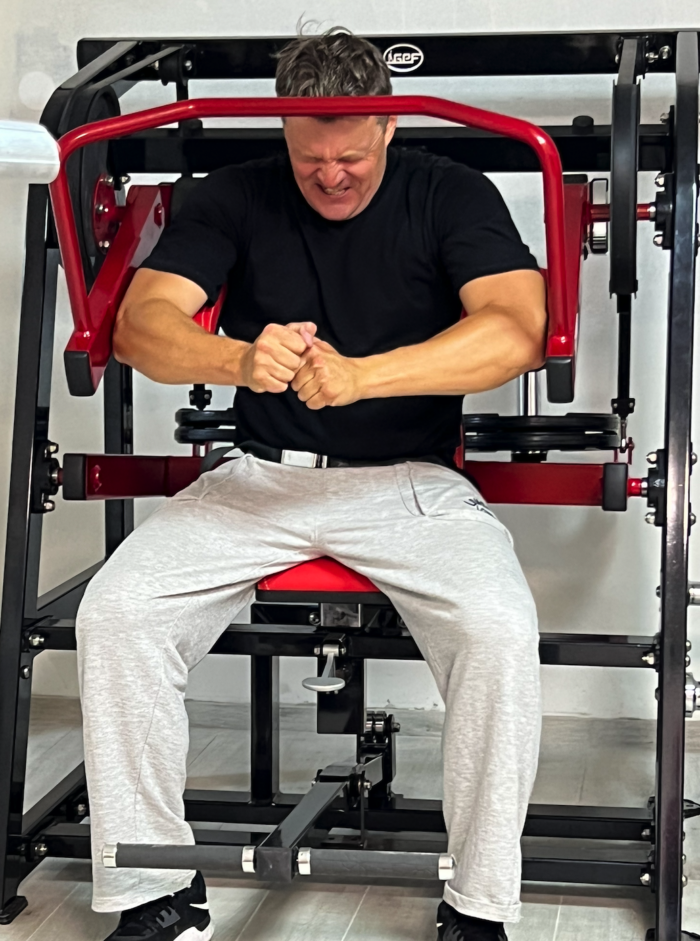
Dumbbell pullover: the forgotten favorite exercise
The dumbbell pullover is an exercise that Arnold and many other bodybuilders of the 1970s golden era put on a pedestal. Today it’s almost forgotten — sometimes mistakenly, because the exercise still holds great potential for progress. Here’s why it’s worth bringing back into your program and how to do it right.
Why the pullover faded away
Honestly, the dumbbell pullover will probably never become as popular as the bench press or biceps curls. But it once stood right alongside them — and then it disappeared. There are several reasons. New machines offer more comfortable alternatives. “New era” training philosophies point the spotlight toward compound exercises, whose technique seems more straightforward to a beginner. Swinging an old dumbbell back over a bench simply doesn’t fit that picture.
My own theory is a bit ironic: maybe the dumbbell pullover is simply too effective. It works the chest muscles, lats, abdominal muscles and triceps all at once. When a single exercise hits such a large part of the upper body, people often don’t know where to put it in their weekly split. Training lats and chest on the same day isn’t the norm for many. The confusion is understandable — and unfortunately, confusion often leads to the exercise being left out.
What the pullover actually trains
The cross-bench pullover became popular during bodybuilding’s golden era in the 1970s, when Arnold often used it as the finishing exercise of his workout. He spoke about it with enthusiasm and credited it with the ability to expand the rib cage. Whether that part of the claim holds up is a matter of belief — an adult’s skeleton no longer expands significantly.
But that doesn’t make the exercise worthless. Performed correctly and with a good feel for the movement, it puts the chest muscles, lats, abdominal muscles and triceps to work under training load. And it does so in a way that no other exercise affects them. The stretching movement at the bottom is something that the bench press and barbell rows don’t offer in that form. It’s exactly this combination of stretch and training load that makes the pullover such a valuable tool.
How to do the pullover correctly
In my own program, this exercise works well on chest day. The rep count is relatively high: I work in the range of 12-20 repetitions and usually do 3-4 sets. Execution is slow and controlled — I properly feel the stretch in the muscles being worked. Rushing is the biggest enemy of this exercise.
What to keep in mind:
- Many people who experiment with the pullover tend to perform the movement too fast. The stretched position is never reached or felt. In my opinion, most of the benefit of this exercise depends on achieving that stretch.
- Keep your hips and head low throughout the movement. This helps ensure you’re not simply swinging the weight through the air but actually working the target muscles. Keeping your hips low also helps you find the feel in the lats.
- When you do the exercise correctly, you feel the muscle work in the upper abdominal muscles, lats, chest and triceps. You get an upper-body pump that many other exercises can’t deliver. It’s a good sign that your technique is on point.
On my own physique, over the years this exercise has brought out details that other exercises wouldn’t. The serratus anterior stands out, and the grooves between the serratus muscles have become deeper. Deep grooves and distinct striations have appeared along the outer edges of the lats. These changes started to show up just when I added the pullover to my program — I can’t attribute it to anything else.
Whatever your reason for not doing the pullover, it isn’t a good enough reason to skip the exercise. Put it in your program and give it a couple of months. The visual results will soon speak for themselves.
FAQ
Does the pullover widen the rib cage?
In childhood and adolescence, while the skeleton is still growing, any training load can affect shape. In adults, the pullover expands the muscular rather than the skeletal dimensions. The visual effect on the breadth of the upper body is still real.
Which training day should you put dumbbell pullovers on?
For me it works on chest day, at the end of the workout. Some prefer back day, because the lats are also actively involved. Either choice is right — pick whichever fits more naturally with your weekly split.
Should you use a dumbbell, a barbell or a machine?
The dumbbell gives the most natural stretch and the greatest range of motion — it’s the classic and my preference. A machine (if your gym has one) works if you want to increase the weight in a more controlled way. I find the barbell pullover less comfortable, because the wrist angle becomes awkward.
References
This article is based on: muscleandstrength.com — Arnold’s Dumbbell Pullover
Author: Janar Rückenberg
Come and train! ArtGym




