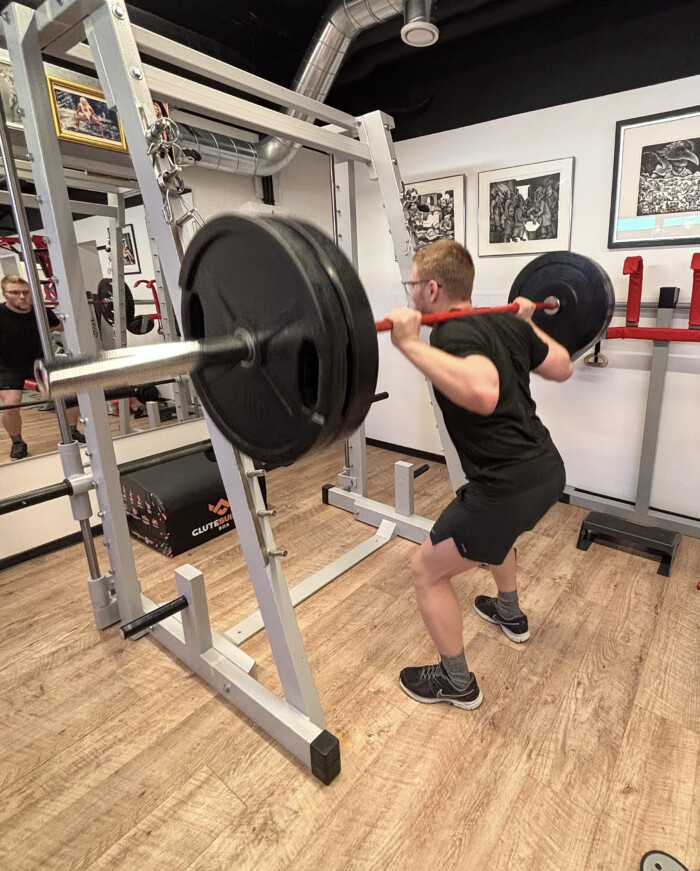
Muscle growth: 10 tips for building mass
Muscle growth doesn’t happen by chance. It’s the combined effect of training, food and rest, where every detail counts. Below are ten practical tips for building mass — tricks that work both for beginners and for those whose progress has stalled in the gym.
Why muscle growth stalls
A typical problem: you go to the gym three times a week, eat well, yet the scale doesn’t budge. The cause is usually one of three — your training intensity is too low, your calorie intake doesn’t cover your expenditure, or your body simply can’t recover between two workouts. Mass only comes once all three are in place at the same time.
10 tips for faster muscle growth
- Emphasize the negative. Muscle grows in both the contraction phase and the stretch phase. When you lower the weight slowly and under control — so that the muscle is stretched out yet under tension — you trigger hypertrophy that the positive phase alone doesn’t deliver.
- Eat fatty fish. Salmon and other fatty fish provide omega-3 fatty acids. These make muscles more sensitive to insulin and help maintain the body’s glutamine stores.
- Don’t be afraid of salt. Salt is a mineral that speeds up amino acid absorption and improves muscle insulin sensitivity. If you sweat a lot in the gym, your need for it is even greater.
- Skip long aerobic training. Long cardio works against mass — it interferes with strength gains and burns branched-chain amino acids (BCAA). More muscle mass raises your resting metabolic rate, or RMR, so your body burns more calories anyway and it’s easier to avoid unwanted fat.
- Train at the limit of your abilities. The strength a muscle puts into an exercise is directly proportional to how much mass you add. The last repetition has to feel hard — an easy set gives the muscle no stimulus.
- Go on a three-day calorie surge. If your usual daily intake is 3000 kcal, raise it to 4500 kcal for three days in a row — about 50% more. This gives the body a strong anabolic signal with minimal fat gain.
- Take rest seriously. Many bodybuilders progress slowly not because of a lack of training, but because they don’t recover. A few completely free days help refill glycogen stores and bring testosterone and cortisol back into a healthy balance.
- Eat at night too. At night the muscle is at rest and growing. One protein shake with glutamine and BCAAs before bed keeps the body in an anabolic state overnight.
- Train like a powerlifter for a couple of weeks. Muscle responds to training in three ways. More than 15 repetitions mainly builds endurance, without noticeable gains in strength or mass. 6–12 repetitions is the classic bodybuilding range — this is where both strength and mass come from. 2–4 repetitions is powerlifters’ territory, which builds pure strength but adds less mass. If you work through a couple of weeks of low repetitions and then return to sets of 6–12 stronger, that is a much better stimulus for muscle growth.
- Use the big three. In addition to protein, take creatine, glutamine and BCAAs. By now probably everyone knows how creatine and glutamine work, and the importance of BCAAs has also been explained repeatedly in separate articles — these three supplements are the best-researched for muscle growth.
How to keep muscle growth consistent
One of the most common mistakes is constantly changing your program. A new split every month, a new exercise order every week. Muscle needs repetition in order to progress — the same exercise, with gradually increasing weights, for six to eight weeks in a row. Write down in your training log how many kilos you lifted, and make sure that number quietly keeps rising from week to week.
Food is the other half of the equation. If your weight stays flat for two weeks, add 200–300 kcal a day. If fat starts coming on too quickly, pull back a little. A small rise in body fat percentage is also normal while building mass — nobody puts on mass completely fat-free.
Honestly, many people underestimate recovery the most. Seven to nine hours of sleep every night is not a luxury, but part of the program. If you sleep badly, the weights in the gym won’t grow well either.
Frequently asked questions
How quickly can you expect visible muscle growth?
For a beginner, the first changes are visible after eight to twelve weeks. For an advanced lifter, the same result often takes half a year or more — the closer you are to your genetic ceiling, the slower the progress.
Does cardio completely ruin mass-building training?
Moderate cardio twice a week, 20–30 minutes, does no harm and keeps your heart in shape. The problem arises when you do long cardio sessions three or four times a week — then it starts competing for recovery time and dietary energy.
How many grams of protein per kilogram of body weight do you need?
The general recommendation during mass-building training is 1.6–2.2 grams of protein per kilogram of body weight per day. Less holds muscle growth back; more brings no additional benefit.
Come and grow your muscles! ArtGym
Author: Mikk-Alvar Olle ref. Flex
Source: WHO – physical activity.