
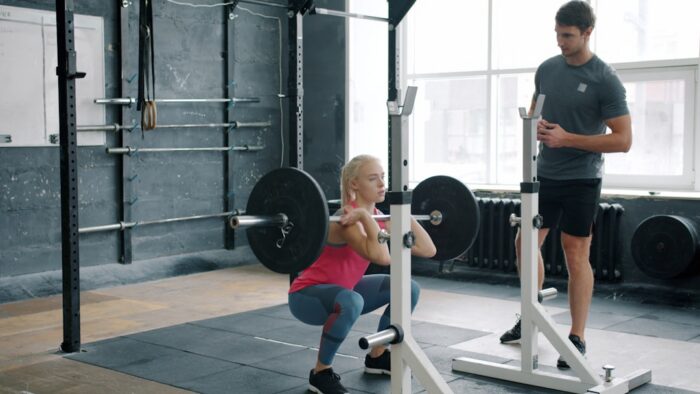
Training split for women: how to choose the right one
A training split for women is simply a way of spreading the week’s muscle-building workouts across the days. There is no universal winner — the best choice depends on your schedule, your experience and what you want to develop in your body. This article will help you choose.
Training split for women: three questions before you choose
How many times a week can you realistically get to the gym?
Be honest with yourself. In a burst of enthusiasm you promise yourself five times a week, but reality may be two. No big deal — two workouts a week is always better than zero, and your plan should be based on what actually happens, not on what you wish would happen.
How experienced are you?
For a beginner, two or three workouts a week are enough. An advanced lifter needs more to hold on to results and keep progressing — more like four to five times.
What do you want to develop?
Different splits develop different body parts with different intensity. The classic squat-push-pull plan builds a strong upper body, but the legs often end up undertrained. If your goal is shapely glutes and strong legs, your plan has to reflect that.
A few basics before you dive into a plan
Good news: the same rules that build muscle in men work for women too. Muscle doesn’t know whether its owner is a man or a woman — it responds to training load.
Growth requires progression. Over time, your training volume, intensity or frequency has to increase. Without that, the body simply adapts and stays where it is.
The reason a woman’s plan often differs from a man’s isn’t biological — it’s the goal. Most women want a stronger lower body and shapelier glutes, while many men want a bigger chest and shoulders. The plan’s main emphasis shifts accordingly, not the method itself.
The classic body-part training split for women
It’s known as the bro split — each day is dedicated to one muscle group. One version looks like this:
- Monday — chest
- Tuesday — legs
- Wednesday — back
- Thursday — shoulders
- Friday — arms and abs
- Saturday and Sunday — rest
Pros: it’s easy to follow, and each muscle group gets plenty of attention on its day.
Cons: the lower body gets training load only once a week. Muscle recovers in roughly 24–36 hours and is then ready for a new training load. Waiting seven days for the next leg day means most of the week goes by without a growth stimulus.
Why this training split for women often doesn’t work
One study looked at how often and how much women should train their lower body to gain muscle and strength. The result: for shapely legs and strong glutes, it makes sense to train the lower body two to four times a week, with a total of about 250 repetitions per week, divided between the fronts and backs of the thighs, the glutes and the calves.
250 repetitions in a single workout is brutally exhausting. The same volume spread over several days is much easier to tolerate and gives better results.
More generally, the recommendation is 10–20 working sets per week for each larger muscle group (a working set is one taken close to failure — warm-up sets don’t count). That kind of volume is hard to fit into a classic bro split, unless you want to spend the whole day in the gym.
How to adapt a training split for women if you’re advanced
If you’ve trained regularly for at least a year, it’s worth restructuring your split so that the lower body gets training load at least twice a week. One simple option:
- Monday — legs and glutes
- Tuesday — chest and back
- Wednesday — legs and calves
- Thursday — shoulders, arms, abs
- Friday — legs and glutes
- Saturday and Sunday — rest
Three leg days may seem like a lot at first glance, but the volume gets spread out and each day focuses on slightly different movements. One day has more hip thrusts and glute work, another has Romanian deadlifts and calf work.
If you’re a beginner, you don’t need to worry about this — in the first year almost any plan works, including the classic bro split. Progress comes from consistency, not from the nuances of the plan.
FAQ
Is a high repetition count with light weights better for women?
No. For building muscle, both higher (12–20) and moderate (6–12) repetition ranges work — what matters is that your sets are taken close to failure. Light weights alone won’t deliver results.
How long should one workout last?
Usually 45–75 minutes. If you go well beyond that, either your focus or your recovery often suffers.
Do I need at least one rest day a week?
Yes. Muscle grows on rest days, not during the workout — constantly adding training load without recovery has the opposite effect.
Author: Susie
Come and work out! ArtGym




