
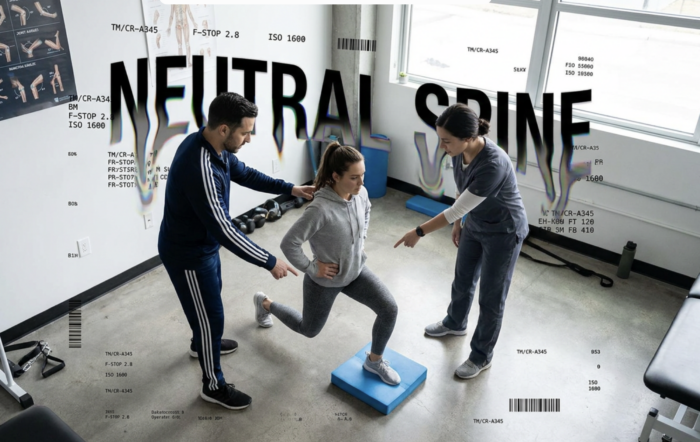
In short:
- Do the Bulgarian split squat with bodyweight first and add training load only once your knee, hip and torso stay under control.
- The most common risk points are a stance that is too long, pressing the rear leg too hard into the bench and losing control of the front knee.
- Pain, instability or breakdown of technique is a sign that the weight, depth or rep volume needs to be reduced.
Bulgarian split squat safety is first of all about fitting the exercise to a person’s mobility, strength and balance, not the other way around. The Bulgarian split squat is a single-leg-focused exercise that can strengthen the hip and thigh muscles, but a poor setup quickly makes it uncomfortable for the knee, hip or lower back. If you want broader context on squat patterns, Squat, squat, squat, squat, squat is also good background reading.
How does Bulgarian split squat safety start with the right stance?
Bulgarian split squat safety starts with where the front foot is placed. The whole sole of the front foot should stay on the floor, and your center of mass should travel in a controlled way through the middle of the foot. The rear leg on the bench or box is there as support rather than as a source of power. If you feel more pressure in the instep or shin of the rear leg than in the thigh and glute of the front leg, your stance is usually too narrow, too high or too tense.
A good starting point is a stride length at which, at the bottom, the front knee can travel in the direction of the toes without caving in, and the hip can drop straight down or slightly back. A study on split squat stride length showed that different stride lengths change joint motion, joint moments and muscle activation in the lower limb, so you should choose the setup according to your goal and tolerance rather than copy a random social media example (Song et al., 2023). In practice that means: if your knee signals a problem, shorten the range of motion or shift the foot so that control improves.
The bench height should be such that the rear leg doesn’t pull the hip into a strong extension or twist the knee. A support that is too high often forces the lower back to arch and turns the exercise into more of a stretch position than a strength exercise. If the goal is to learn a safe single-leg pattern, start with a lower support or a regular split squat before moving on to the rear-foot-elevated variation.
How to avoid knee pain in the Bulgarian split squat?
To avoid knee pain, watch three things: knee direction, tempo and training load. The front knee should travel in the same direction as the toes. That doesn’t mean the knee may never move past the toes; the problem is rather uncontrolled collapse inward, dropping sharply to the bottom or pushing through pain.
A biomechanical comparison showed that the Bulgarian split squat and the back squat differ in how joint load is distributed, and that the Bulgarian split squat can be a hip-dominant way to train the lower body with lower knee demand than some two-leg squat variations (Mackey and Riemann, 2021). That doesn’t automatically make the exercise knee-friendly. If the front foot is too close to the bench, you often get the feeling that the knee has to do all the work. If the stance is too long, the hip may work more, but balance and lower back position get worse.
Use a controlled tempo on the way down and stop before the moment when the pelvis rotates, the knee loses its line or the heel wants to leave the floor. The ACSM position stand on strength training emphasizes that increases in training load, volume and complexity must take into account training status, goal and recovery (Kraemer et al., 2002). So safe technique isn’t only the “right angle” but also the right dose.
Which technique mistakes increase the risk of injury?
The first mistake is adding weight before you have mastered balance. The Bulgarian split squat demands more stability than a two-leg squat because the base of support is narrower and the work is done mostly through the front leg. If the dumbbells force your torso to rotate, your shoulders to rise or you to bounce at the bottom of the repetition, the weight is too heavy.
The second mistake is using an unstable surface simply because it looks harder. In a study comparing the squat and the Bulgarian split squat on stable and unstable surfaces, the training load used on the unstable surface decreased, and the Bulgarian split squat produced different activation in certain muscles than a regular squat (Andersen et al., 2014). In another study, suspension, vibration and unstable conditions added changes in muscle activation, but that doesn’t automatically mean better or safer training (Aguilera-Castells et al., 2019). From a safety standpoint, a stable floor is usually the better choice, especially when you are learning.
The third mistake is using the rear leg as an anchor. If you press the rear foot hard into the bench, the knee or hip can take unnecessary stress. Think of it this way instead: the front leg does the work, and the rear leg helps hold the position.
The fourth mistake is doing the exercise through sharp pain. The effort of training and muscle burn are not the same as joint pain, stabbing pain or radiating nerve-type pain. In that case, end the set, reduce the range of motion and, if needed, temporarily pick another exercise, such as the Jefferson squat or a squat variation with lower balance demands.
How do you choose training load and reps safely?
Start with a variation that you can do with similar control on both legs. If one side caves in more, loses balance or fatigues noticeably earlier, it makes sense to base the set on the weaker side. Add training load when the repetitions are calm, the depth is repeatable and the last repetition doesn’t turn into a jump or a partial descent.
A practical progression is: bodyweight, light dumbbells at your sides, heavier dumbbells, then, if needed, a barbell or special variations. Dumbbells at your sides are often easier than a barbell on your back because your arms help you sense balance and the center of mass stays lower. If your upper body position or thoracic control is your limiting factor, it is also worth comparing the principles of the Upper body squat, because torso position affects the whole squat pattern.
In terms of placement within a training day, the Bulgarian split squat often fits after the main exercise or as a standalone lower-body exercise, but not when you are already so tired that your balance is gone. Nutrition and recovery don’t replace technique, but too large an energy deficit can make concentration and work capacity worse; for background on this, read How to avoid feeling hungry.
When should you modify or avoid the Bulgarian split squat?
Change the exercise if pain shows up in the same spot on every attempt or if correcting your position doesn’t help. Reduce your depth, use a lower support for the back foot, do a regular split squat, or hold on to something for support. Holding on isn’t cheating; it can be a sensible way to reduce balance wobble and focus on knee and hip control.
If you have a recent injury, are recovering from surgery, or have unexplained swelling or pain that won’t go away, ask a physiotherapist or doctor for advice. From the standpoint of general physical activity guidelines, the WHO physical activity fact sheet stresses that muscle-strengthening activity is part of good health, but a specific exercise has to suit the person’s abilities. The Bulgarian split squat is a tool, not a mandatory test.
A good final criterion is simple: after a set, you should feel the work mainly in the thigh and glute of the front leg, not sharp pain in the knee, lower back or the hip flexor of the back leg. If the exercise gives you a strong training effect without pain and without losing control of your technique, you have Bulgarian split squat safety in practice.
References
- Andersen, V., Fimland, M. S., Brennset, O., Haslestad, L. R., Lundteigen, M. S., Skalleberg, K. and Saeterbakken, A. H. (2014). Muscle activation and strength in squat and Bulgarian squat on stable and unstable surface. International Journal of Sports Medicine. PMID: 25254898. DOI: 10.1055/s-0034-1382016
- Aguilera-Castells, J., Buscà, B., Morales, J., Solana-Tramunt, M., Fort-Vanmeerhaeghe, A., Rey-Abella, F., Bantulà, J. and Peña, J. (2019). Muscle activity of Bulgarian squat. Effects of additional vibration, suspension and unstable surface. PLOS One. PMID: 31449568. DOI: 10.1371/journal.pone.0221710
- Mackey, E. R. and Riemann, B. L. (2021). Biomechanical Differences Between the Bulgarian Split-Squat and Back Squat. International Journal of Exercise Science. PMID: 34055144. DOI: 10.70252/CIYT8956
- Song, Q., Ma, M., Liu, H., Wei, X. and Chen, X. (2023). Effects of step lengths on biomechanical characteristics of lower extremity during split squat movement. Frontiers in Bioengineering and Biotechnology. PMID: 38026855. DOI: 10.3389/fbioe.2023.1277493
- Kraemer, W. J., Adams, K., Cafarelli, E., Dudley, G. A., Dooly, C., Feigenbaum, M. S., Fleck, S. J., Franklin, B., Fry, A. C., Hoffman, J. R., Newton, R. U., Potteiger, J., Stone, M. H., Ratamess, N. A. and Triplett-McBride, T. (2002). American College of Sports Medicine position stand. Progression models in resistance training for healthy adults. Medicine and Science in Sports and Exercise. PMID: 11828249. DOI: 10.1097/00005768-200202000-00027
Frequently asked questions
Is the Bulgarian split squat dangerous for the knees?
Not in itself. The risk goes up when the knee loses its alignment, the weight is too heavy, or the exercise is done through pain.
Can the knee move past the toes in a Bulgarian split squat?
Yes, as long as the movement is pain-free and controlled. What matters more is that the knee tracks in the same direction as the toes and doesn’t collapse sharply inward.
Should a beginner do the dumbbell Bulgarian split squat?
Usually not right away. It’s worth learning the bodyweight version first and adding dumbbells only once your balance and depth are stable.
What should you do if the hip of the back leg hurts?
Use a lower support, shorten your stance, or temporarily do a regular split squat. If the pain persists, ask a specialist for advice.
Come and train! ArtGym




