
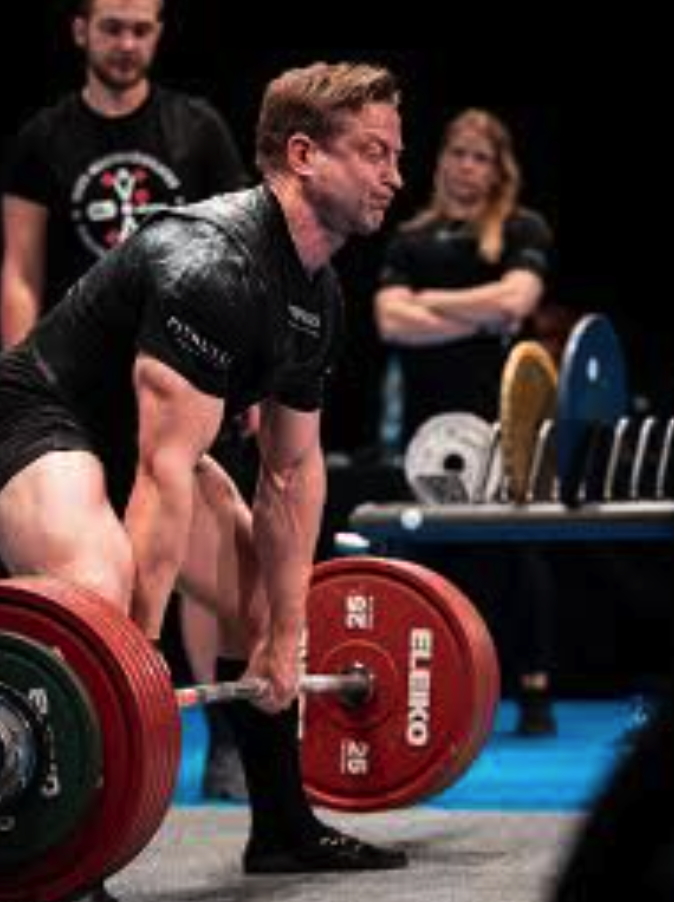
Margus Silbaum: World silver in the deadlift
On March 30–31, Tartu hosts the Estonian Powerlifting Championships. On Sunday, Margus Silbaum steps up to the barbell, and a win would give him yet another gold, his tenth counting his junior years. I caught the man from Peetri (Järva County) at home two hours before his midday workout. Silbaum, a world silver medalist in the deadlift (320 kg), told me he is in good form and is already in the middle of the traditional two-year competition cycle. Which understandably means he takes the domestic tests of strength calmly; his sights are set on the European Championships in May and the World Championships in November.
This year, sports fans have already seen Margus on stage in his home region. In January, Paide Health Center hosted a meet-up with both powerlifter Silbaum and top bodybuilder Ott Kiivikas. Both men, who have World Championship experience, talked about their sports, answered questions and signed autographs. Since Ott has already featured on our website for a while, this time I’ll focus only on 25-year-old Margus Silbaum.
When did you discover the sport?
“My father Heino called. It was November 1994, and he had just read in Spordileht that such-and-such results were Estonian records, and that I might have prospects in the squat and the deadlift,” Margus recalls of the beginning. At the next year’s men’s championships, he turned up on the platform after a whole winter of training. From March ’95, ten Estonian junior records went under his name. He especially remembers doing the barbell squat. After all, it was the opening lift. Plenty of nerves. His legs were shaking. After the press, the tension had been worked off by the final lift, the deadlift. A new powerlifter had been born, one who for seven years now has been the star of his fellow competitors’ bad dreams.
His father coached him for two years. After that came the years of the self-taught trailblazer. “I think it’s partly thanks to this that I’ve gotten results, ordinary country boy that I am,” Margus reflects without false modesty. Coaches would have needed a salary, so he decided to find his own trainees. What he has read and studied helps coach Silbaum teach strength sports to others too, in Kareda Parish since 1995.
No other job?
“We’ve been selling log houses on a small scale. All my money goes on sport; just the right food alone costs five thousand kroons a month,” says Margus. “We push together. My brother Marek, a salesman at a publishing house, has come along with me to competitions. My other brother Rein owns that publishing house. Sulemees will soon be 10 years old. We’ve made school supplies, calendar notebooks and other useful things. Evidently the right ones, since interest has come from beyond South Estonia too.”
1996, the junior European Championships in Prague. Margus had to settle for 14th place. “The worst thing that has ever happened to me. But on the other hand, if I hadn’t gone there, I would never have made it to a world silver,” he recalls. He says this with a conviction he has long kept to himself. Next he talks about two-year training cycles. The current one, for example, began last December, after the medal in Sotkamo, and runs until November 2003, when the World Championships are held in Denmark. This May, though, the European Championships are in Sweden, and in November the World Championships are in Slovakia. If no medals are awarded for individual lifts in Sweden, a competitor in his class can hope, at best, for a top-six finish overall. That takes a total of over 800 kilos.
Right now, Silbaum’s best and the Estonian record are both 790 kg. At the World Championships, the goal can be to top last year’s silver medal. Will he manage it? No, he doesn’t shrug. A man who spends 4-6 hours a day training is focused and convinced that it has to work. He says the conditions for training are good: in the Peetri Cultural Center, in the gym. Good for tinkering away on your own.
The last day of March 2002, and Tartu in holiday season. Body weight up to 100 kilos (he has usually been in the lighter category)? The only thing we don’t know right now is the results. For us, it is still the 27th. The midday workout is done, the evening one lies ahead, a few hours away. On my powerlifting notebook page I have written down what was recorded at the powerlifters’ annual meeting: the top three of 2001 were the University of Tartu Sports Club, Ai-Petri (Silbaum’s home club) and Tartumaa Jõud.
Why such an odd club name? Darn, that’s exactly what I forgot to ask Margus. There’s something new for the next story.
Author: Aare Kreilis
Source: WHO – physical activity.
Come work out! ArtGym




