
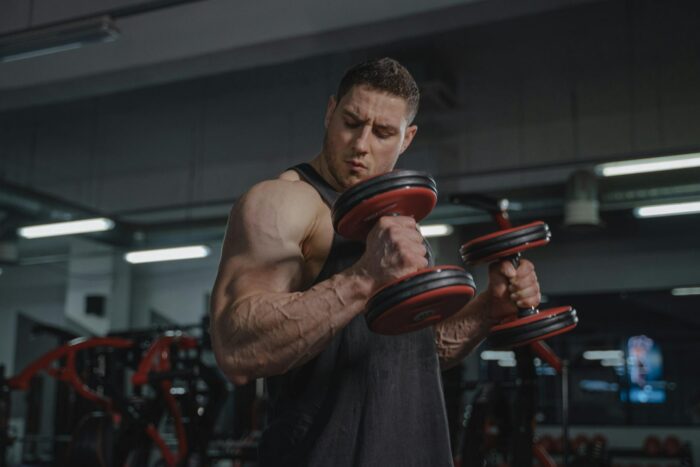
Ronnie Coleman’s biceps workout: 3 exercises
Ronnie keeps his advice on biceps straightforward: a good-looking arm doesn’t come from heavy weight alone, but from consistent work. His aim is to build moderately large, well-shaped biceps that make a double biceps pose look powerful on stage.
What makes Ronnie’s biceps workout interesting?
One thing often stands out about old-school bodybuilding: the men weren’t just chasing measurements. They wanted shape. Ronnie Coleman usually brings enormous muscle mass to mind, but this brief look at his approach to training reveals a subtler detail. His biceps had to be full, tall and long, not simply as big as possible.
He says his number one preference is training biceps. He usually trains them 1x a week. That’s a useful reminder for the average gym-goer, too: constantly tiring a muscle out isn’t all it takes to make it grow. Sometimes it’s better to do one solid workout, recover, then repeat that work to the same high standard.
There were also times when he trained his biceps only once a month because he felt they were one of his strongest body parts after his back. That doesn’t mean everyone should do the same. It simply shows that your training needs to suit your body. If one muscle develops quickly, you don’t need to push it with the same volume as a weaker body part.
How do you actually make your biceps do the work?
The simple truth is that control matters when training biceps. If your body sways, your lower back helps out and momentum carries the dumbbell upward, the work ends up half-done. In Ronnie’s view, hard work and consistency matter, but the weight shouldn’t stop you from feeling the muscle work.
His favorite biceps exercise is the one-arm bent-over dumbbell curl. He performs it with a moderately heavy dumbbell or uses a cable machine for the movement. Another option is two-arm curls with a narrow grip. These choices aren’t random. The bent-over position and the constant tension from the cable help keep the training load on the biceps rather than the shoulder or back.
So what’s actually happening? Some exercises put more emphasis on the upper part of the biceps, giving it height. Others help you feel the lower part, near the elbow. Bringing those two sensations together improves the overall look of your arms: more height, more length and a stronger pose.
He likes to work in the 10-12 rep range. That’s a practical range for bodybuilding. The weight is heavy enough to give the muscle a strong stimulus, while the number of reps allows you to maintain strict form and keep the muscle under tension for longer.
Ronnie’s program: 3 exercises for biceps
Below is Ronnie’s biceps program, keeping the same approach but spelling it out more clearly. Don’t treat it as a magic formula. Treat it as a simple plan in which every exercise has a job to do.
- 1.One-arm bent-over dumbbell curls 3×12
- 2.Standing cable curls 3×12
- 3.Seated machine biceps curls with a barbell (leaning forward) 3×12
In the first exercise, keep your shoulder still and control the movement of your arm. The aim isn’t to throw the dumbbell upward. It’s to feel your biceps pulling your forearm up and staying under tension as you lower it.
In the second exercise, the cable provides constant tension. This is useful if your form tends to break down when you use a regular barbell or dumbbell. Standing cable curls may seem simple, but only if you’re choosing the weight for your ego rather than your muscles. Choose a weight that makes the final reps hard without compromising your technique.
The third exercise, seated machine biceps curls with a barbell while leaning forward, keeps your body more firmly in place. This helps reduce cheating and directs the work where it belongs. If you feel it more in your wrists or shoulder than in your biceps, the weight is too heavy or your position is wrong.
What can you take from Ronnie’s biceps workout?
Honestly, most recreational lifters don’t need a complicated arm day. What they need is good technique, an appropriate weight and patience. If you train your biceps 1x a week, make that workout count: warm up your elbows and wrists, choose exercises that let you feel the muscle working, and don’t rush your rest between sets so much that the next set becomes little more than flailing your arms around.
If your biceps are a strong point, you don’t need to keep adding volume indefinitely. If they’re a weaker body part, you can follow the same program for a while, but keep an eye on your recovery. Elbow pain, persistent fatigue or a drop in the weights you can lift are signs that the training load isn’t right for you. In bodybuilding, the person who can train intelligently over the long term ultimately wins.
Good biceps don’t come from just one exercise. They come from performing clean reps over and over again. That’s what this old idea of Ronnie’s reminds us of best.
FAQ: Ronnie and biceps
Do you need to train your biceps 1x a week?
Not necessarily. Ronnie followed that schedule because it suited his body and his goal. A beginner or intermediate lifter may need a different training volume, but one solid, well-executed biceps workout a week is a perfectly workable starting point for many people.
Are 10-12 reps suitable for muscle growth?
Yes, 10-12 is a practical rep range if the weight is heavy enough and you maintain strict form. If every rep feels too easy, the muscle isn’t getting enough work. If your form breaks down right from the start, the weight is too heavy.
Should your biceps be as big as possible?
Not in Ronnie’s view. He preferred moderately large, well-shaped biceps. The aim was a powerful appearance, height and length, rather than simply getting enormous arms at any cost.
Author: joker : From Ronnie Coleman’s website
Source: WHO – physical activity.
Come train with us! ArtGym




