
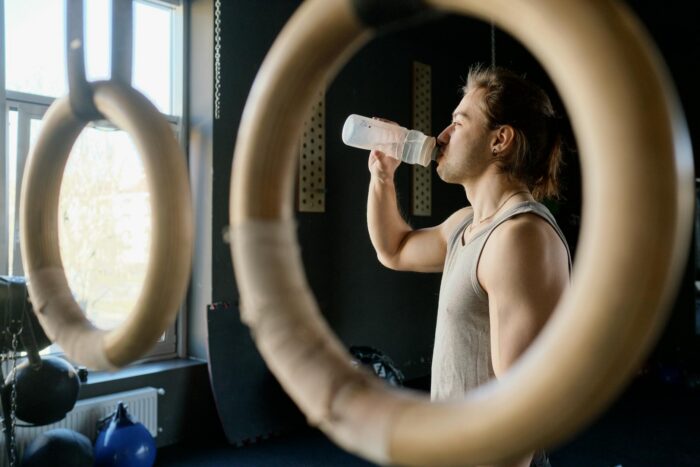
Protein shake: faster results from your training
A protein shake is one of the simplest tools a serious lifter can add to their arsenal — especially if you want to build muscle mass and cut fat at the same time. Here’s why it works and how to get the most out of it.
Why calorie restriction eats muscle — and how a protein shake prevents it
When the average bodybuilder trains at full throttle, they need about 4000 calories a day — protein, carbohydrates and fat in the right balance. That kind of regimen keeps glycogen levels up, muscle mass is preserved and strength doesn’t drop from one workout to the next.
But what happens when you start a diet and cut your calories in half?
Glycogen stores run out. Muscle performance drops. The body starts making up for the energy shortage by breaking down muscle tissue. The result is a negative nitrogen balance — you give away the size you’ve spent months building. This is the classic diet trap that many beginners, and even experienced lifters, fall into.
The simple truth: the problem isn’t calorie restriction itself, but exactly where the calories come from. If you cut mainly from fat while keeping protein high, the body is much better at sparing muscle tissue, even in a deficit.
The protein shake as a solution: 2000 calories, spent wisely
Imagine your daily calorie allowance is cut to 2000. If those 2000 calories come from a high-quality protein source — whey powder, casein or a blended protein matrix — the outcome is quite different from when the same number of calories comes from mixed food with a big serving of fat.
A high-quality protein shake is digested more efficiently, delivers amino acids to the muscles faster and helps maintain an anabolic environment even in a noticeable calorie deficit. That means cleaner muscle mass — in other words, exactly what you actually want: fat goes down, muscle stays.
Honestly, a protein shake is not a magic fix. But it is one of the few supplements backed by both clear physiological logic and a long track record of practical use.
How to use a protein shake in practice
A few principles that help you get the most out of a protein shake:
- Time your intake wisely — a protein shake within 30–60 minutes after training does the most for muscle recovery, when the demand for amino acids is at its highest.
- Choose the right type for your goal — whey protein suits fast absorption after training; casein, with its slow release, is better before bed if you want to supply amino acids through a long night.
- Don’t replace whole food — protein shakes are a supplement, not a substitute. Most of your daily protein should come from whole foods: eggs, meat, cottage cheese, legumes.
- Keep an eye on amounts — most adult trainees need 1.6–2.2 g of protein per kilogram of body weight per day. A protein shake helps you hit that target without tracking your food precisely.
- Read the ingredients carefully — choose a product with minimal added sugar and fillers. The shorter the ingredient list, the better.
FAQ
Is a protein shake also suitable for people who don’t do strength training?
Yes. A protein shake is useful for anyone who wants to meet their daily protein requirement — whether an endurance athlete, someone looking to lower their body weight, or simply a person whose diet is consistently short on protein. Protein supports the immune system and tissue recovery, not just muscles.
How many times a day does it make sense to drink a protein shake?
For most people, one to two servings a day is enough. More isn’t necessarily better — the body can digest and use only a certain amount of amino acids at a time. The rest is broken down, so excessive amounts simply give no added benefit.
Do protein shakes cause fat gain?
Not in themselves. Fat accumulates when total calories are too high — regardless of whether they come from protein, fat or carbohydrates. A protein shake alone won’t make anyone fat, but excessive amounts in a calorie surplus certainly can.
Author: Troy Zuccolotto/Flex
PS You can find more protein here: https://turg.fitness.ee/et
Source: WHO – physical activity.
PS Come and train! ArtGym




