
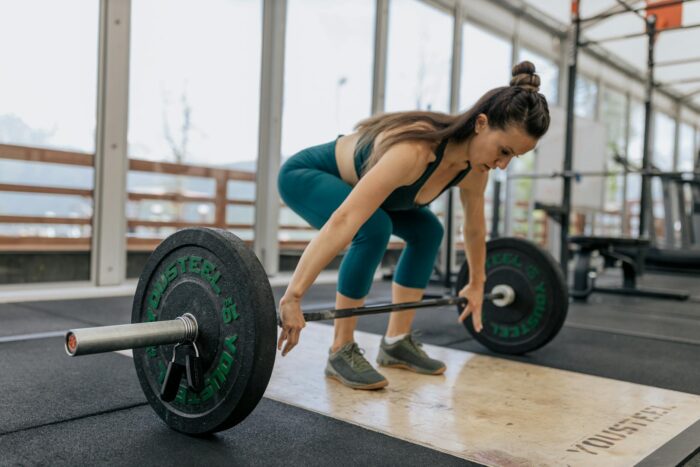
Women and strength training: 20 differences
Women and strength training is a topic people talk about a lot, but often inaccurately. Here are 20 specific differences between women and men in the gym — anatomical, physiological and psychological.
Women and strength training: anatomy and physiology
1. Bodyweight exercises are harder. Performing exercises with your own body weight is considerably harder for women than for men — this comes down to differences in both strength level and body composition.
2. The Q-angle and the knee joints. Because women have wider hips and, as a result, a larger Q-angle at the knee joints, a single-leg squat is much harder for them. The same anatomy makes women’s knee joints more vulnerable to injury.
12. Muscle strength per unit of cross-sectional area is equal. Women’s muscles are just as strong as men’s per unit of cross-sectional area. The absolute strength gap comes from the fact that women’s overall muscle mass is much smaller — muscle mass makes up 18–22 kg of women’s total body mass.
13. Mobility is better, but not always. In most women, the mobility of the hip joint, spine, shoulder joint and pelvis is better than in men. Ankle mobility is similarly poor in both sexes. Women also have more joint hypermobility.
14. The core muscles are weaker without training. Before they start training, women’s core muscles are usually less developed than men’s.
Strength level and recovery: what the numbers say
6. The strength gap differs between the upper and lower body. Women’s upper-body strength averages about 40–60% of men’s upper-body strength; for the lower body, the gap is 70–75%. If we assume the average man bench-presses 100 kg, the average woman’s figure is approx. 40–60 kg. If the average man squats 100 kg, the average woman can squat 70–75 kg.
3. Women tolerate dense training well. Women in the gym tolerate high-density training sessions noticeably better than men — they don’t actually need rest breaks between sets as long as men do.
8. A higher training frequency suits the upper body. In strength training, women generally tolerate a higher training frequency than men, especially for upper-body exercises. This probably stems from the fact that a lower strength level places a smaller training load on the nervous system.
9. Technique gets more respect. Women respect correct exercise technique and execution more than men do. That is a clear plus.
Women and strength training: behavior and habits
4. The posterior chain isn’t engaged enough. When they start strength training, most women are quadriceps-dominant. In certain lower-body exercises, they simply don’t know how to consciously engage the posterior chain — glutes, hamstrings, calves and lower back. This also often comes from wearing high heels, which promote ankle stiffness.
5. The weights are too light. In strength training, women tend to use training weights that are too light, while men tend to overdo it. There is a half-joking saying that all men should reduce their weights by 10% and all women should increase theirs by 10%.
7. Isolation exercises and the burn. Women often cling to isolation exercises and always try to achieve the so-called burn. That isn’t always wrong, but it is often done for the wrong reason — people believe they are burning fat locally from that particular body part.
10. Variety is more appealing. Women prefer variety and diversity in training. Men tolerate routine better — a male lifter needs only a barbell and a couple of pairs of dumbbells. Female lifters prefer a little of this, a little of that, and then a third exercise.
11. The burning sensation from lactate. Women tend to complain more than men about the burning sensation caused by lactate during training. The claim that women have a higher pain tolerance and a higher pain threshold has not found scientific confirmation.
15. Gratitude toward coaches. Women are more grateful to their coaches and instructors than men are.
16. Women like strength too. Contrary to popular belief, women also enjoy strength and being strong. Women can also be very good motivators and supporters.
17. Everyday problems affect training more. Women tend to bring their everyday problems to training more than men do — all kinds of quarrels and relationship issues affect women more than male lifters when they train.
18. They don’t look in the mirror. Unlike men, women don’t tend to look at themselves in the mirror while performing exercises.
19. Consistency is harder. Women are not able to stay as consistent with a training program as men. Keeping training logs doesn’t come as easily to them either.
20. The menstrual cycle affects training. The menstrual cycle has a major impact on women’s training. It affects motivation, moods, irritability, fluid retention and self-esteem.
FAQ
Should women train differently from men?
In many ways, yes. Women’s anatomy, hormones and muscle composition differ from men’s enough that coaches should take these differences into account, especially when it comes to lower-body mobility, rest periods and weight selection.
How big is the strength gap between women and men?
The gap is larger in the upper body: women’s upper-body strength averages 40–60% of men’s. In the lower body the gap is smaller, at 70–75%. Per unit of area, muscle strength is the same in both sexes.
Does wearing high heels affect your gym training?
Yes. High heels contribute to ankle stiffness and make it harder to consciously engage the posterior chain, a common problem in lower-body exercises such as the squat.
Author: Janar Rückenberg (translation)
Source:Turg.Fitness.ee
Come and train! ArtGym




