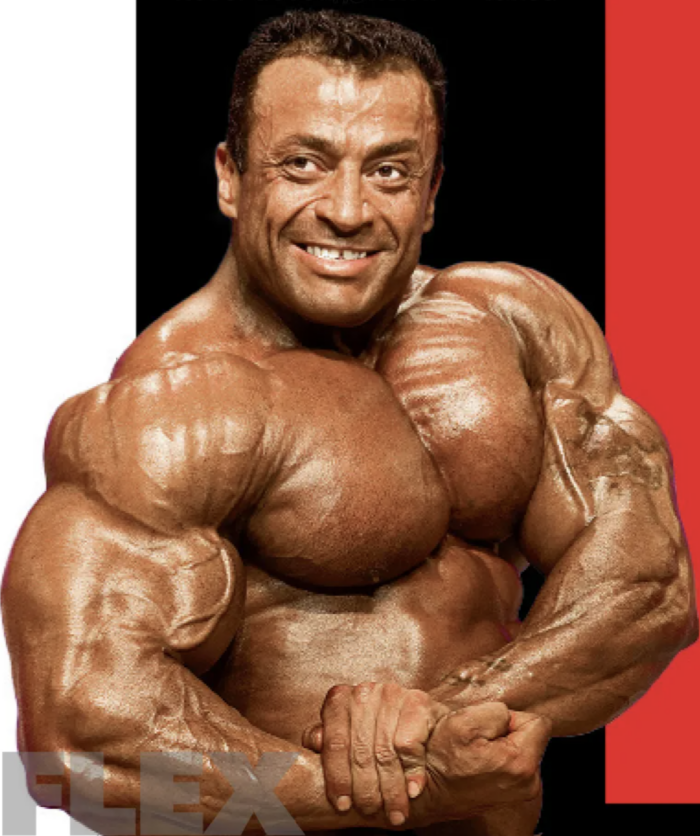
Big arms: Mustafa Mohammad and biceps training
Big arms come from more than lifting a heavy barbell. They also depend on how well you feel your biceps working, control them and maintain tension throughout the movement. Mustafa Mohammad used a different approach before competition: more repetitions, stricter technique and a strong pump to make his arms look sharply defined on stage.
This is not a first arm workout for a beginner. It is an example of how a professional bodybuilder refined his biceps before competition. Flex featured programs like these with that very idea in mind: different styles work differently for different people, but they are worth trying sensibly and for a defined period.
Why do big arms need more than heavy weights?
In the gym, it is easy to think that a bigger dumbbell means a bigger arm. Sometimes it does. But the biceps is a small muscle, and ego can quickly ruin the exercise. If your back, shoulder and momentum do the work, your arm may be moving, but the muscle itself is not getting the same training load.
Mustafa Mohammad emphasized control. His point was simple: cheating or sloppy movement blurs the detail in the biceps. Before competition, mass is not the only goal. Shape, muscle separation, vascularity and the feeling of tension in the muscle from start to finish matter too.
Honestly, this is a useful reminder for recreational lifters too. If you want your arms to grow, picking up a heavier dumbbell every week is not enough. You need to check whether your biceps are doing the work or you are simply moving a weight from point A to point B.
How did Mustafa Mohammad train his biceps?
Mustafa Mohammad described this as his pre-contest program. His goal was to bring out every detail, make the veins stand out and pump his biceps full of blood until they were rock-hard. That sounds intense, but this kind of language is common in bodybuilding: it is about how the muscle looks on stage, not just in the mirror after a workout.
He went hard from the very first exercise. Underhand pull-ups work the biceps differently from a standard dumbbell curl because, in addition to working your arms, your body has to stabilize the entire movement. In his own words, after the pull-ups he felt like screaming in pain.
In the off-season, he used lower reps. This program, however, used high reps because the goal was better muscle separation and shape. That is an important distinction. If you are building mass, heavier work and longer recovery may have their place. When you are refining your contest condition, the mind-muscle connection, tempo and how much blood you can get into the muscle also become important.
Supersets played an important role here. They help keep tension high and give the biceps a strong pump. The simple truth is that when you perform two exercises back to back without letting the muscle properly rest, your technique needs to be especially strict. Otherwise, hard work becomes little more than swinging weights around.
- Bodyweight pull-ups: 5 x max
- Standing dumbbell curls as part of a superset
- Seated dumbbell hammer curls: 4 x 15
- Standing dumbbell hammer curls: 1 x max
DURATION four months. That is a long period, especially for an intense program. This is why you should not treat it as a permanent training plan. Think of it as a block with a specific goal, after which you honestly assess whether your arms developed, whether your elbows stayed healthy and whether your recovery was adequate.
Big arms and technique: what should you watch for?
The first thing is wrist and elbow position. If your elbow moves back and forth with every repetition, some of the tension shifts elsewhere. Keep your upper arm as still as possible. The movement does not have to be robotic, but you need to stay in control.
The second thing is tempo. Do not simply let the dumbbell drop. Lowering it is half the repetition, and often the part that gives the muscle a good stimulus. If you are doing 4 x 15, there is no point rushing through the first ten reps and somehow surviving the last five. Every repetition counts.
The third thing is choosing your training load. If the goal is shape and a pump, every set does not have to be a record attempt. Choose a weight you can control throughout the movement. The last repetition can be hard. It should be. But if your body starts relying on momentum by the third repetition, the weight is too heavy.
So what does this look like in practice? Good biceps training brings together lots of small decisions: a good grip, a controlled movement, a full range of motion, sufficient effort and sensible recovery. That is how you start building big arms without cursing your elbows at the end of every workout.
Big arms: FAQ
Is this program suitable for a beginner?
It would not be the first choice. A beginner should first learn strict curl and pull-up technique, along with the basics of recovery. Once you have that foundation, you can try this pre-contest style in a shorter block.
Do you always need to train your biceps with a high rep count?
No. Mustafa Mohammad used lower reps in the off-season and high reps in this program. Both have their place. It depends on the goal: mass, strength, shape or pre-contest detail.
Why are underhand pull-ups good for your biceps?
An underhand grip makes the biceps work harder than many other pulling variations. You also train your back and grip at the same time. This makes the exercise demanding but very effective, provided your technique stays strict.
Author: joker
Source: WHO – physical activity.
Come and train! ArtGym