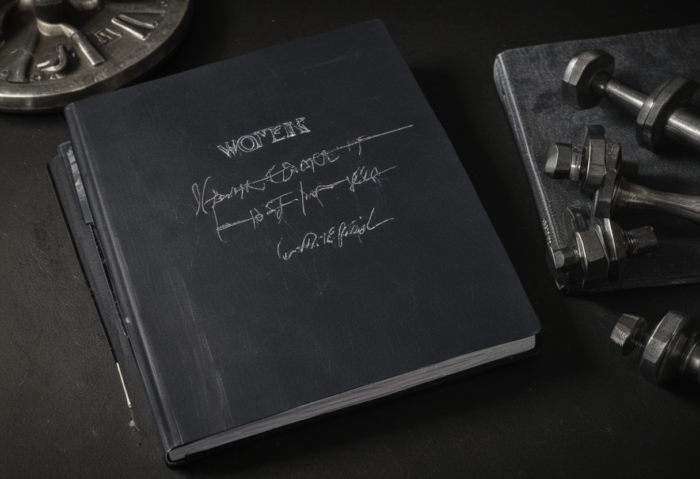
Training log: a lesson from Dorian Yates
A training log is a simple thing: a notebook where you honestly write down what happened in your workout and on your plate. Dorian Yates didn’t build his physique on guesswork. He looked at the facts, repeated what worked and fixed what lagged behind.
Why a training log really matters
Memory is deceptive in the gym. One day it feels like the chest press went easier than ever. A week later you can’t remember whether the weight was the same, whether you got more repetitions, or whether you simply rested longer between sets.
This is where a training log comes in. It isn’t a fancy system or compulsory homework. It’s your own feedback. The date, day of the week, time, exercises, sets, repetitions and weights show very quickly whether you’re moving forward or stuck in place.
Dorian Yates was known for approaching training soberly and with great precision. If something worked, there had to be a reason. If a body part lagged behind, the reason had to be found. The same mindset suits the ordinary gym-goer who simply wants to get stronger, look better and not start from zero every month.
How a training log brings clarity to your workouts
Write down everything that happened in the session. Put your entries in chronological order: date, day of the week and time. Record the exercises in the order you did them. For each exercise, add the sets, repetitions and the weight you used.
This may sound dry, but in practice it takes little time. After a set you jot down the number and move on. Later it’s worth more than any foggy feeling that it probably went well.
Keep a separate tally of your best performances. If your rep count goes up or the weight moves up, check the log to see what was behind it. Did you come to the workout rested? Had you been away from the gym for a while? Did you raise the intensity? Did you rest longer than usual between sets?
Clues like these aren’t minor details. They help you understand which exercise technique and which habits work better for your body. For some people, longer rests between heavy sets work best. Others progress when the training is shorter and sharper. The log reveals the pattern.
Weak body parts show up quickly
If your shoulders aren’t developing at the same pace as the rest of your body, or they tire too early, don’t guess blindly. Look at your entries. If you train chest and shoulders on the same day, the culprit may be the incline press or another pressing exercise that loads the shoulder before the actual shoulder workout even begins.
The fix may be simple: take turns putting the shoulder workout and the chest workout first. That way you can compare whether the order changes the feel, the weights and the repetitions. Without notes, it remains only a guess.
What a training log should include
A good log isn’t limited to weights. Make tables for both quantitative and qualitative progress. In plain terms: what weights you train with and how many repetitions you can do cleanly with that weight.
You don’t need to increase weights for the sake of ego. But if your training load stays in the same place for a long time, progress can stall. The log helps you notice whether the problem is a tempo that’s too fast, wrongly chosen weights, or putting too much emphasis on one muscle.
If your training has become drawn-out and the weights are too light, make the work more intense. If your body is tired and your results are dropping, a short break may be needed. A simple truth: recovery is part of progress, not a sign of laziness.
Also write down food amounts and nutrients. Note protein, carbohydrates, calories and fats. If your training suddenly gets better or worse, check whether the change came from your diet. Did you add a new supplement? Did the share of some nutrient group grow? These answers shouldn’t be left to gut feeling.
Once a week, record your body weight. Use the same scale and weigh yourself in the morning, after using the toilet and before breakfast. That reduces the chance that the reading changed simply because of fluid you drank or food you ate.
Practical tips for using a training log
Choose a log with room for plenty of information. Even for logbooks the saying holds: bigger is better. If you can add pages, that’s especially handy. The more workouts you have in one place, the easier they are to compare later.
Don’t make the system too complicated. If after every workout you feel you have to fill out a report, you’ll soon give up. A clear pattern is enough: date, exercise, sets, repetitions, weight, and a short note on how you felt.
Honestly, consistency matters most. A poor note is better than no note at all. If you wrote down only the essentials, you still benefit. If you leave it all to memory, half the information disappears before your next workout.
Keeping a training log may seem like a time-consuming chore at first. But if you believe a multiple-time Mr. Olympia, it pays off many times over. You just have to know how to use the log.
FAQ: training log
Is a training log suitable for beginners?
Yes. Beginners benefit especially, because progress is fast and mistakes are easily repeated. If you record your workouts, you’ll see early on what works.
Do I need to record my nutrition too?
If your goal is muscle mass, strength or a change in body weight, then yes. Food strongly affects the quality of your training. Without food notes, part of the picture is missing.
How often should I review my results?
A good rhythm is once a week. Look at your body weight, your best sets, how your rep count is trending and how you feel. That way you notice a change before a problem grows big.
Order a training log here: https://trykiviis.ee/tootekategooria/kirjastused/interneed/
Author: Mikk-Alvar Olle, translated by FLEX
Source: WHO – physical activity.
Come and work out! ArtGym