
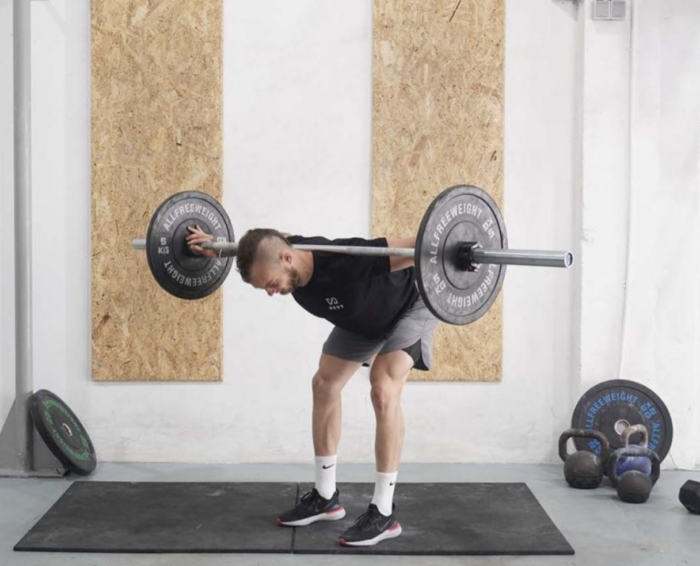
Do you want to squat and deadlift more? No, seriously, do you want to beat your deadlift and squat records? Yes? Then we need to address the weaknesses that limit your performance in these lifts. As we know, many conventional leg and back exercises do not really meet a powerlifter’s needs: they do little to improve the squat and deadlift significantly or effectively. So we need to find other options, other exercises. Both the squat and the deadlift depend heavily on the hamstrings, glutes and spinal erectors. For a powerlifter, it is not enough to find an exercise that simply works these muscles and makes them stronger. It also needs to work them in a way that resembles their role in the squat and deadlift.
In the squat and deadlift, the hamstrings and glutes extend the hips, while the spinal erectors extend the back, or spine. An assistance exercise should work these muscles in exactly the same way. This makes the assistance work as effective as possible and ideally suited to developing the movement components that so often limit squat and deadlift performance.
One of the best yet neglected exercises for improving your squat and deadlift is the “good morning.” This exercise places particular emphasis on the spinal erectors, but you can also perform and vary it to actively involve the glutes and hamstrings in exactly the same way they work during the squat and deadlift.
There are three good morning variations with completely different techniques:
1. Arched-back variation
2. Bent-over or rounded-back variation
3. Seated variation
I strongly recommend using one of these variations once a week on your squat or deadlift day.
Arched-back good morning
The arched-back good morning is performed almost like a squat. The bar sits in the same position across your upper back. Start with your feet well beyond shoulder-width apart. Your legs are straight at the start, and as you begin to lower yourself and lean forward, your knees move out to the sides just as they do in a squat. Keep your chest out and your back arched. To begin the exercise, take a deep breath and start lowering yourself slightly by bending your knees, as you would in a squat, but keep the knee bend shallow. As you bend your knees slightly, push your hips back and lean your upper body forward about 30 degrees. You should feel the effort mainly in your spinal erectors, though naturally your glutes and hamstrings will also be working to some extent. Make sure your shoulders do not drop and your back does not collapse or round during the movement. Keep your chest out and your shoulders back both at the start and throughout the exercise; your back must remain arched for the entire movement. Hold your breath as you lean forward and breathe out as you return to the starting position.
As with any exercise, proper technique matters, and you should not jump straight into heavy weights. This applies both within an individual workout and over the course of your training experience. I recommend starting very light and, as you improve, keeping your top sets to 3 4 sets of five repetitions, using 65 75% of the weight of your best set of five squats. I consider this one of the most effective exercises for increasing squat and deadlift strength.
“Good morning” with a forward lean or rounded back
Again, the starting position is the same as for a regular squat. In this variation, however, your feet are together. You can also choose whether to keep your legs straight as you bend forward or allow your knees to bend slightly. The straighter your knees remain during the movement, the more emphasis you place on the spinal erectors. Bending your knees brings the hamstrings into play alongside the spinal erectors.
Unlike the arched-back variation, this one is performed with a slightly rounded back. Take a deep breath, bend your torso forward as far as possible, pause briefly, then accelerate your torso back to the starting position as you breathe out.
Because this variation isolates the spinal erectors much more than the arched-back version, I recommend using a much lighter weight and performing higher-repetition sets. Start with a light weight for 3 x 12, and it is very impressive if you eventually manage this variation with 40 60% of your best deadlift.
“Good morning” seated
This variation is performed seated on a bench. The hamstrings and glutes are essentially inactive, and the spinal erectors work almost in isolation. To perform it, place the bar across your upper back and sit on a bench with your feet in your usual squat stance. While seated, keep your body braced, take a deep breath and lean as far forward as possible. Pause briefly, then straighten your torso back to the starting position as you breathe out. Your back is more rounded (straight) in this variation, much as it is in the second variation.
Because this variation completely isolates the spinal erectors and places them under considerable tension, start very light with 3 x 12 and gradually work toward heavier weights.
A final recommendation
Whichever variation you use, always have spotters assist you or perform the exercise in a power rack. Because all these exercises place a heavy load on the spinal erectors in particular, never train to failure. Always leave at least 1 2 repetitions in reserve. Keep the movement slow and controlled. Maintain tension in your body and muscles throughout the movement, and always perform this exercise, like any other, with proper technique. Increase the weights gradually and steadily; do not attempt weights that are clearly beyond your ability. A strong lower back will clearly help you improve your squat and deadlift records, but a serious injury will have precisely the opposite effect.
Train hard, but train smart!!!
Translator’s note: This is a truly remarkable article. The benefits of the good morning have long been known, but for some reason I had not previously recognized a clear connection between this exercise and the squat and deadlift. That connection is actually very strong. You could even say that, in many cases, the squat performed by big, heavyset powerlifters is nothing more than an arched-back good morning. Yet the good morning undoubtedly helps even when you maintain proper squat technique. I would go so far as to say that if you watch someone squat and analyze the movement, you can see, even with good technique, that the good morning is an important phase of the overall squat movement. Here is an example of the technique of young, 22-year-old Olympic weightlifter Eduardo Guadamund and the importance of the good morning in the squat. Watch this video.
He lowers himself, then uses his leg strength to rise through the first 2/3 of the range of motion from the bottom. At roughly a quarter-squat position, his legs seem to stop working for a moment. He then quickly drives his hips forward, powerfully engaging the spinal erectors, glutes and hamstrings. Technically, this brief movement within the full squat is nothing more than a good morning. Once his back and hips are straight, he uses his quadriceps again to complete the movement from the quarter-squat position.
And there is a reason Westside devotees value good mornings so highly. They clearly understand how this assistance exercise benefits the squat and deadlift.
Original article: “Squat and Deadlift Assistance Exercises: The Good Morning Tom McCullough
Illustrative image: Hevy.Com
Translated by: Janar Rückenberg
Come train! ArtGym




