
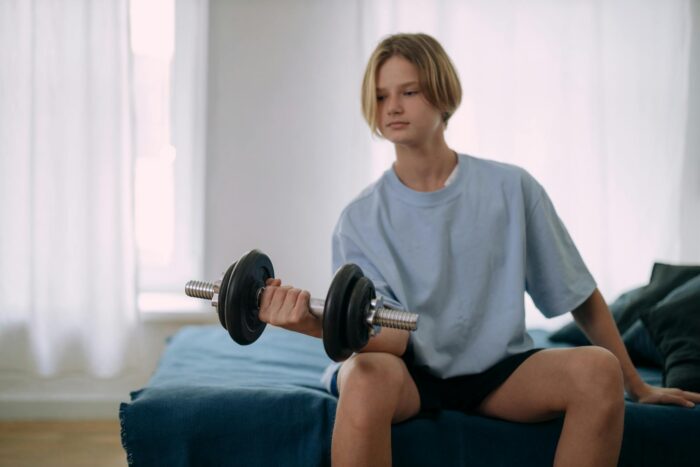
Sports for young people: why they matter
For a young person, taking part in sports is about much more than a sweaty workout or a PE lesson. It teaches you to make choices, stay focused on your goals and understand that every achievement comes at a price.
Honestly, the benefits of sports are sometimes discussed in very vague terms. People say sports are good for you, but ask exactly why and the answer often hangs in the air. Here, we take a straightforward look at what taking part in sports does for a young person’s character, habits and lifestyle.
Why do sports matter when you’re young?
Young people are still figuring out who they are. They test boundaries, look for a sense of belonging and want to feel they have genuinely improved at something. Sports provide a clear framework for that. There is training, there are repetitions, there is effort and, eventually, there is a result.
Sports don’t just develop your body. They also develop patience, communication skills and self-control. When you train regularly as a young person, you soon start to see the connection between actions and consequences. Missed training? Progress slows down. Put in the work? Something changes.
That is exactly how sports help young people grow. A child or teenager learns that success takes more than wishing for it. It comes from taking action consistently, even when you don’t really feel like it.
How do sports shape your choices?
Take one simple example from the gym. A young man tried the bench press at school and just about managed to lift 67.5 kg. His friend, who also weighed 80 kg and went to the gym three times a week, pressed 105 kg. It was a big gap, and it got him thinking.
That day sparked something in the weaker boy. He started training with his friend, and within a few months his personal best reached 100 kg. Naturally, his ambitions didn’t stop there: his friend had already moved on to 120 kg. Now he wanted to reach 120 kg too.
This is where real life comes into play. Once you have a goal, everything can’t carry on as before. If your weekends involve nightclubs, drinking, cigarettes and cannabis, at some point it starts to interfere with your training. In the fourth week, his progress on the program stalled. It was time to make some choices.
The young man was in grade 11 at the time. He wanted to make the top 3 in his school’s bench press rankings. Suddenly, that small goal mattered more than another party. A simple truth: sometimes what saves a young person is a goal that truly interests them, rather than a lecture.
A goal builds a sense of responsibility
When a goal matters enough, behavior changes too. A young person starts sleeping better, pays more attention to what they eat and avoids some foolish choices. Not because someone tells them to, but because they want the result themselves.
That distinction matters. Being told what to do works for a short time. Motivation from within lasts much longer.
What do young people take away from sports?
Sports teach young people to lose and try again. They learn to follow the rules, respect their opponents and listen to their coach. These skills aren’t just useful on the field or in the gym. The same habits carry over into school, work and relationships.
This doesn’t mean every young person who plays sports automatically becomes a role model. Real life isn’t that straightforward. Many start and then give up. Some train but still lead chaotic lives. Even so, sports have one major advantage: they give young people a chance to recognize that better choices are available.
The young man in the story chose a positive path. This happened 15 years ago. Today, he is Estonia’s third-best bench presser, has his own sports club and also throws the discus. He hasn’t smoked for 13 years, and his drinking is limited to a few beers on Midsummer Day and New Year’s Eve.
I know this because I made the story up myself. But the point still stands. A story like this could unfold in many sports, not just strength training. What matters isn’t the barbell or the personal best, but that a young person finds a reason to take better control of their life.
Of course, a positive path doesn’t always have to involve sports. Music suits some people, programming suits others, and art suits others still. The difference is that sports demand your physical presence. When a competition is coming up or you have a training program to follow, 2 or 3 beers every evening are no longer just a minor detail.
Youth sports and the parent’s role
As a parent, you don’t have to turn every child into an athlete. But you can give your child the opportunity to try. Sometimes all it takes is one good coach, one friend or one sport that really appeals to them.
What matters is that you don’t measure everything in medals alone. For a young person, coming home from training in a better mood, finding the courage to enter a competition or managing to show up consistently for a couple of months can also be a major victory.
If taking part in sports gives a young person discipline, friends and a reason to turn away from bad choices, that is already a big deal. Even if they never become a champion.
FAQ
Are sports suitable for every young person?
Yes, provided the sport and training load suit the child’s age, health and personality. Not everyone has to compete. Team sports suit some, the gym suits others, and swimming or athletics suit others still.
What should you do if a young person stops training?
The first step is to find out why. Perhaps the coach, group or sport wasn’t a good fit. Quitting doesn’t mean failure. Sometimes you simply need to find a new direction.
Do sports have to involve serious, goal-oriented training?
No. But a small goal helps. It could be better endurance, a stronger body, a first competition or simply getting into the habit of being active two to three times a week.
Author: Janar Rückenberg
Source:Turg.Fitness.ee
Come and train! ArtGym




