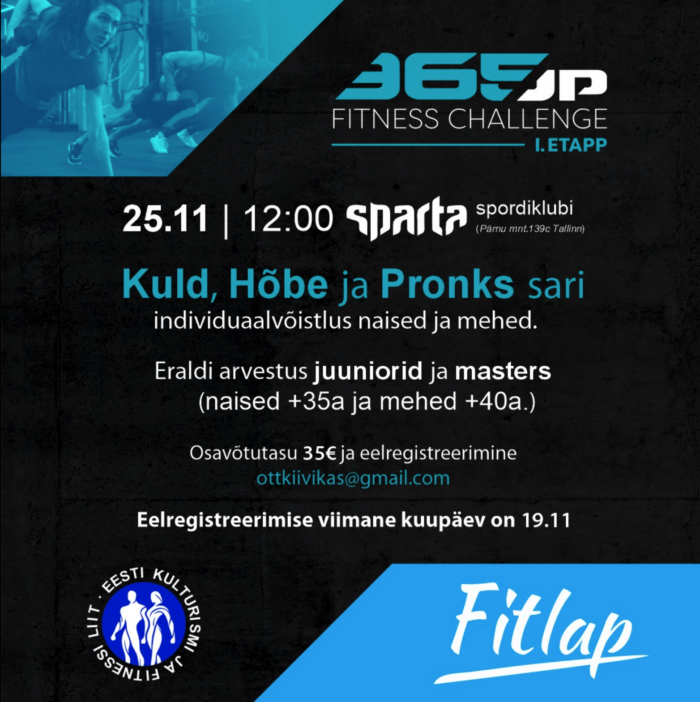
Fitness Challenge is a competition format of six exercises that tests your strength, endurance and technique all at once. The league runs in six stages across Estonia and ends with a final as part of the Valio Profeel Cup. Below is a summary of how the format works, what the exercises are at each level and what a first-time participant should know.
What is Fitness Challenge?
Fitness Challenge consists of six exercises. Each exercise lasts two minutes, followed by a two-minute rest. The goal is to perform as many clean repetitions as possible in each exercise. The competition is complete once all six exercises have been done.
The dress code is athletic wear, and footwear is mandatory. You may use wrist wraps, gloves, magnesium and knee supports. Competitions are run under IFBB rules, and the head judge is Argo Ader, a judge of international category.
The organizer is Ott Kiivikas, in cooperation with the Estonian Bodybuilding and Fitness Federation. Before the opening stage of the season, there is a two-day seminar covering both the rules and practical technique — how to perform each exercise correctly and how to train for it. Seminar information is shared through the federation’s channels.
Fitness Challenge exercises by level
The competition is divided into three difficulty levels: gold, silver and bronze. A beginner should sensibly start with bronze, while an experienced athlete can try gold. Age classes (juniors 16–23, men/women, masters 35+ or 40+) run within each level.
Gold level
- Hanging pull-ups to the bar
- Box jumps — women 50 cm, men 60 cm
- Dips
- Barbell lunges — women 30 kg, men 50 kg
- Sit-ups with a 10 kg plate, arms straight
- Cosmonaut (floor push-up + dumbbell press overhead) — women 2 × 10 kg, men 2 × 15 kg
Silver level
- Plank-position rows on a barbell, pulling to the chest
- Jefferson squat — women 40 kg, men 60 kg
- Dips with legs out in front on a bench
- Forward dumbbell lunges — women 2 × 10 kg, men 2 × 15 kg
- Abdominal sit-ups with a 10 kg plate on the chest
- Kettlebell snatch — women 8 kg, men 12 kg
Bronze level
- Plank-position rows on a barbell, feet on the floor
- Kettlebell squat — women 24 kg, men 32 kg
- Floor push-ups
- Reverse lunges holding a dumbbell — women 8 kg, men 12 kg
- Floor sit-ups for the abs
- Two-handed kettlebell swing — women 8 kg, men 12 kg
The technical execution of each exercise is strictly defined. You can find the exact rules in the IFBB Rule Book. I recommend reading it before you start training — many repetitions go uncounted at a first competition precisely because of technical errors.
How the Fitness Challenge league works
During the season there are six stages across Estonia — in Tallinn, Rakvere or Tartu, on Pärnu beach as part of Kevad Battles, at the Otepää Fitcamp, and finally at the Valio Profeel Cup final. That is one stage every two months.
An athlete’s five best stage results count toward the league table. Points are distributed as follows: 1st place 10 pts, 2nd place 8 pts, 3rd place 6 pts, 4th place 5 pts, 5th place 4 pts, 6th place 3 pts, 7th place 2 pts and 8th–10th place 1 pt. At the end of the year, the winner is whoever has the highest total number of points.
Pre-registration is done by email to ottkiivikas@gmail.com — include your full name, date of birth and the club you represent. Athletes who have not pre-registered will not be admitted to the competition. The entry fee for a regular stage is 35 € (cash on site). You also need a valid license from the Estonian Bodybuilding and Fitness Federation, which has an annual fee of 35 € as well. You can find license information on the federation’s website www.kulturism.ee.
Practical tips for first-time Fitness Challenge competitors
Honestly, the first Fitness Challenge stage feels a lot tougher than it looks on paper. Two minutes of pull-ups wears out your arms faster than you’d think. Here are a few things worth sorting out before the starting signal:
- Choose your level honestly. If you can’t perform 8 clean pull-ups under control, gold level is too early. Starting with bronze is nothing to be ashamed of — points are scored separately within each category.
- Train in the order of the exercises. Tired arms on the second and third exercise behave differently from fresh ones. Run a mock competition at the gym before the stage.
- Master the technique before the weight. The judge does not count unfinished repetitions. One clean repetition fewer is better than two half-done ones.
- Eat and sleep normally the day before. Don’t try anything new on the morning of the competition — have a light, familiar meal 2–3 hours before the start.
- Bring your extra equipment. Gloves, wrist wraps and knee supports must be presented at registration. Magnesium helps especially in the snatch and kettlebell exercises.
FAQ
Can I compete in more than one category?
No. A competitor registers in one category. Age-class scoring, however, runs in parallel — for example, an athlete aged 40+ earns points in both the overall ranking and the masters ranking.
What if I skip one stage?
Your five best stage results out of six count toward the overall league ranking. One missed stage doesn’t ruin the season — but it does reduce your room for maneuver if you have an off day at the later stages.
Where can I get more information?
The head organizer is Ott Kiivikas, email ottkiivikas@gmail.com, phone +372 5048898. You can find the rules and ongoing updates on the federation’s website and in the Facebook group.
Come train! ArtGym