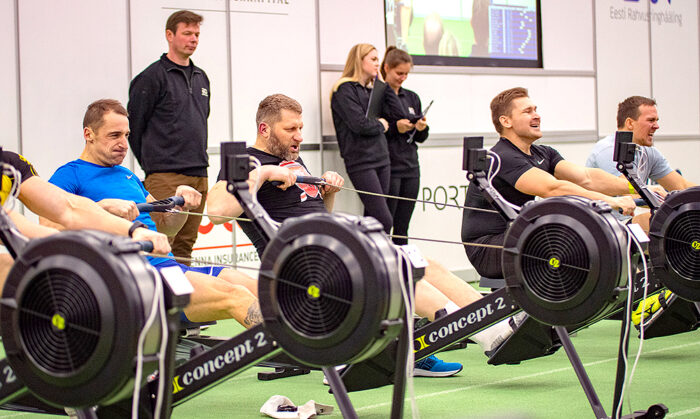
Indoor rowing is an Estonian winter tradition. Every year in the third week of January, the Audentes Sports Hall brings together more than 400 athletes and recreational rowers who take on the 1000 meter distance on Concept2 rowing ergometers. In this article we look at why the sport works so well in winter, how the Alfa race came about, and what goal to set yourself on the erg for the first time.
Indoor rowing — why it works in winter
In Estonia, rowing is an on-the-water sport in summer, but from November to March all training moves indoors. The rowing ergometer is not a substitute — it is a piece of equipment in its own right. A single stroke engages roughly 86% of your muscle mass: legs, hips, back, shoulder girdle, arms. All at once, in a controlled way.
What makes it so useful? Your joints take no impact. Unlike running, training load does not build up on the knees and ankles. That makes the rowing ergometer suitable for people recovering from obesity, for post-injury rehab, and for men aged 40 plus who want to train the heart without the pounding of running.
Winter brings one more reason: the sun sets early, the coach starts a new indoor training cycle, and a rowing ergometer fits into a corner where an ordinary treadmill would not.
The Alfa race and indoor rowing in Estonia
It has been more than three decades since the Alfa rowing race was first held. At the Audentes Sports Hall, the first starts of the day begin at 11 in the morning, the heats of the men’s main class take place in the afternoon, and the final traditionally starts in the evening at 18:30 — that is when the hall is at its sharpest and the spectators at their loudest.
Over the years, the title has gone to Estonia’s top rowers. Tõnu Endrekson’s name is the center of gravity of the entire men’s class — his records have long been the benchmark that younger rowers such as Allar Raja, Leo Muiste and Kaarel Kiiver measure their 1000 meter times against. 1000 meters is short, but sneaky. The first 250 meters run on adrenaline, the last 250 on pure willpower.
In two pandemic years the race was held virtually: everyone rowed in their own home or club gym, and the times flowed into a shared log. It worked, but the classic Alfa lives on shared breath. A hall where 45 men sit on ergometers at the same time and a monitor shows in real time who is ahead and who is behind — there is no real substitute for that.
Alfa is free for spectators. The starts are streamed on the race’s YouTube channel https://www.youtube.com/@alfaracevideo, where the finals of previous years are also still available. The start list and the exact schedule can be found in the shared spreadsheet from the organizers. More information about the race is on the website alfarace.ee.
How to prepare for a 1000 m row
If you have never rowed on an ergometer before, 1000 meters sounds short — a fit rower finishes in under 3:30, a recreational rower in 4–5 minutes. But those minutes are the kind where your lungs and legs burn through the last 200 meters. Your body has to be prepared for that.
Technique before pace
The first rule: the legs do the work, not the arms. The sequence of the stroke is legs → hips → back → arms to the chest. On the way back it goes in reverse: arms away, hips hinge, knees bend. If the arms start pulling early, the back gets overloaded and your pace drops. For the first couple of workouts it is worth rowing at a slow pace, watching your stroke on video from the side, and setting the drag factor between 110–130 (not cranked full blast to 200).
An eight-week plan
A simple framework: two longer sessions a week (5–8 km at a moderate pace), one interval session (for example 8 × 250 m, 1 minute rest) and one technique workout. If you have the energy, add one short test: 1 × 1000 m straight through, record the time, and compare it every two weeks. Don’t rush progress — taking 10 seconds off in two months is solid improvement.
FAQ
Is a rowing ergometer suitable for someone with knee problems?
Generally yes — the impact load on the joints is minimal. If your knee hurts to the point that the leg will not bend, you may need to shorten the stroke or consult a physiotherapist, but compared with running, the ergometer is much gentler.
What is the difference between Concept2 and other manufacturers’ ergometers?
Concept2 is the de facto standard both in competitions and in rehabilitation. Its PM5 monitor shows power in watts in real time, and with the same data you can compare yourself with another gym in another city. Other manufacturers also make good equipment, but races (including Alfa) are rowed on Concept2.
How often should you row on the ergometer?
For a beginner, two sessions a week are enough to see clear progress within a couple of months. For a fit recreational rower, 3–4 times a week; for competitors, up to every day — alternating long low-intensity work with short high-intensity work.
Come and train! ArtGym