Kaido Leesmann sets 310 kg Estonian bench press record
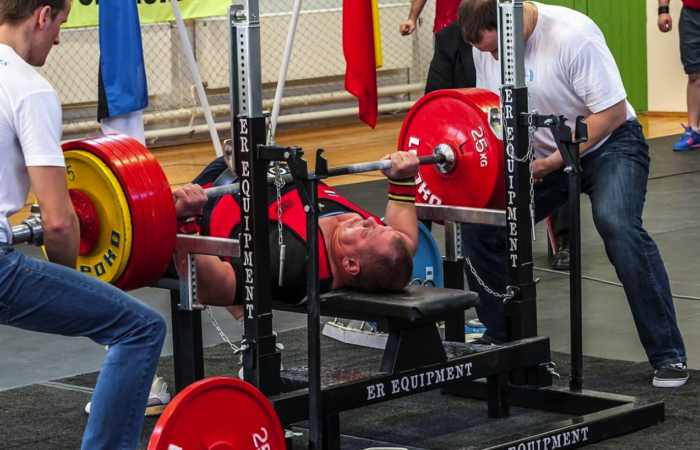
Kaido Leesmann bench pressed 310 kg in Kunda and moved the Estonian record to a new level. It wasn’t just a big number on the results sheet, but a result that made the whole competition revolve around a single attempt.
There was a familiar tension in the air at the Estonian Bench Press Championships in Kunda. The hall knows very well in moments like these when an ordinary good attempt is coming and when something bigger is. When 310 kilograms were loaded onto the barbell, it was clear that this was about Estonian bench press history.
Why Kaido Leesmann stood out with the record
Of the powerlifting disciplines, the bench press looks the simplest on the surface. You lie down on the bench, take the barbell, lower it to your chest and press it up. In reality, there is very little room for error. Wrists, shoulders, back, legs, breathing and the referees’ commands all have to come together at exactly the right moment.
Even before Kunda, Kaido Leesmann was one of the best bench pressers in Estonian history. The new result, 310 kg, raised the bar even higher. The previous Estonian record belonged to Siim Rast, who had earlier pressed 307.5 kg. That means Leesmann didn’t just secure a win. He took over the heaviest weight of all time.
One more detail makes the result special. Leesmann had turned 47 at the start of the year. At that age, strength sport is no longer only about the explosiveness of youth. What counts is years of work, recovery, technique and the ability to choose the right attempt on the right day.
How Kaido Leesmann won the overall standings
Leesmann also won the overall standings. These don’t look only at who lifted the heaviest weight. Results are calculated using the Wilks coefficient, which compares the weight lifted with the athlete’s body weight. A simple truth: a big man has to lift a great deal, but a lighter man with a strong ratio can also climb high in the table.
Second in the overall standings was Hjalmar Mäe, who won the men’s up to 105 kg class. His result was also an Estonian record: 265.5 kg. That is the kind of number that, in almost any other competition story, could easily be the headline of the day. In Kunda, however, it stayed in the shadow of Leesmann’s 310 kg.
Third in the overall standings was Siim Rast. His result this time was 295 kg. Rast was the record holder going into the competition, so there was plenty of tension in the men’s heavyweight class. When a record moves from 307.5 kilograms to 310 kilograms, it isn’t a big jump on paper, but in powerlifting 2.5 kg at the top is a very real difference.
Kaido Leesmann and the other class winners
Among the juniors, Kristo Krõlov won the overall standings from the up to 93 kg class. His result was 212.5 kg. Martin Vahtramäe from the 120+ kg class came second with 220 kg, and Karl-Michal Valk from the up to 74 kg class third with 160 kg. These results show well how different the same discipline can be at different body weights.
Among the youth lifters, the overall winner was Mihkel Ruut from the up to 120 kg class. He locked out 180 kg. Second place went to Andri Eric Külaviir from the up to 83 kg class, who set an Estonian youth record with 157.5 kilograms. Third was Kermo Pärn from the up to 66 kg class with 112.5 kg.
The masters classes featured strong names across several age groups. In the M1 age class, meaning lifters aged 40-49, Kaido Leesmann won. In the M2 class, for those aged 50-59, Kalev Martsepp was the best. In the M3 and M4 age classes, the winners were Raul Randmäe and Mihkel Laurits respectively.
In the women’s overall standings, Marianna Bogdanova won from the up to 57 kg class with 80 kilograms. Second was Carolin Siimenson from the up to 84 kg class with 92.5 kg, and third was Laura Lenbaum from the up to 72 kg class with 85 kg. Here, too, it is clear that the overall standings are not just about the heaviest weight, but about the result relative to body weight.
What Kaido Leesmann’s result teaches in the gym
You don’t have to. But Leesmann’s result is a reminder of something simple: strength grows over a long period of time. Not through one intense month, but through work done over years.
In the bench press, strong chest muscles alone aren’t enough. A strong back helps you hold the position. Your legs give you stability on the bench. Your shoulders and triceps have to withstand the training load. If one part stays weak, a heavy weight will immediately start exposing the flaws.
Honestly, the most useful thing about records is to look not just at the number but at the journey. Leesmann kept adding kilos to the barbell even at an age when many recreational lifters start thinking their best years are behind them. It’s a good reminder: in strength training, consistency, technique and a smartly chosen training load are what count.
If you train the bench press yourself, it’s worth adopting the same logic on a smaller scale. Write down the weights of your working sets. Don’t change your program every two weeks. Keep your shoulders under control and learn to build a strong position on the bench. A record isn’t made only on record day.
FAQ: Kaido Leesmann and the 310 kg record
How much did Kaido Leesmann press in Kunda?
Kaido Leesmann bench pressed 310 kg. With that, he set a new Estonian record, surpassing the previous record of 307.5 kg.
Who was second in the overall standings?
Second place went to Hjalmar Mäe, who won the men’s up to 105 kg class with a result of 265.5 kg. That, too, was a new Estonian record.
Why is the Wilks coefficient used?
The Wilks coefficient helps compare athletes of different body weights. This makes it possible to judge, in the overall standings, whose result was the strongest relative to body weight.
Author: EJTL
Come and train! ArtGym