Siim Rast: Estonian bench press record
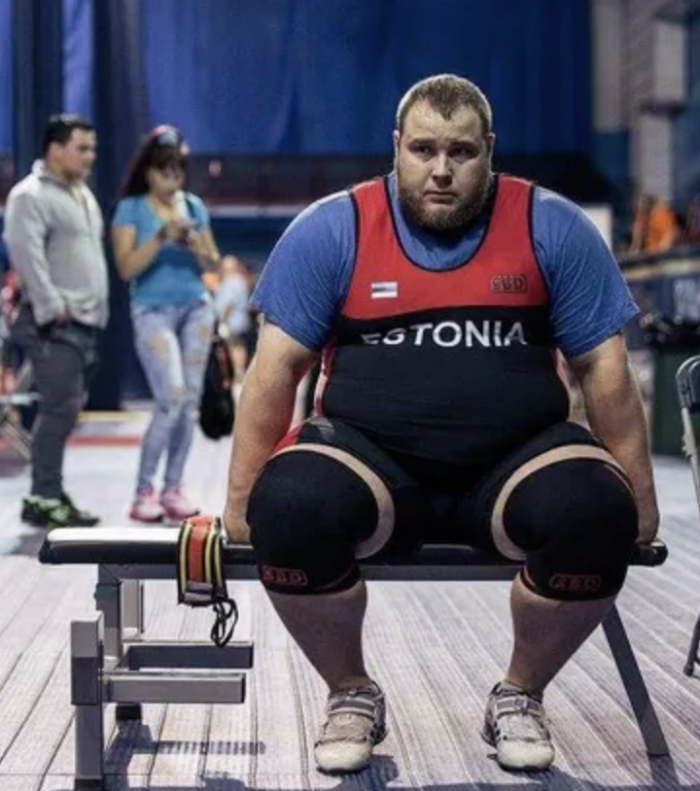
In Kunda, Siim Rast wrote a result into Estonian powerlifting history that you don’t see at the end of every competition season: 302.5 kg in the bench press. It wasn’t just one nice attempt on the results sheet, but a new all-time heaviest lift in Estonia and also his first Estonian absolute championship title.
Numbers like these stick in the mind, because the bench press is a powerlifting discipline where every extra kilo is earned through hard work, nerve and technique. When the bar moves, the audience sees only a few seconds. The real work was done long before that.
Siim Rast and what 302.5 kg means
Last weekend, the latest Estonian bench press championships took place in Kunda. Super heavyweight Siim Rast pressed 302.5 kg there, a new all-time heaviest lift. In the Estonian context this threshold matters, because 300 kilos is not just a nice round number. It is a line very few people cross.
Siim became only the second Estonian to break the magical 300-kilo barrier in the bench press. Kaido Leesmann had done it before, and this time he had to settle for second place. His 272.5 kg still won the -120 kg weight class and the overall veterans’ category.
Third was Tarmo Pärna, who locked out 252.5 kg. That result won him the -105 kg weight class in a tight battle. In the team standings, the Estonian championship title was once again defended by Sports Club Reval-Sport.
Why does Siim Rast’s result resonate?
To a spectator, the bench press looks simple: the athlete lies down on the bench, takes the bar, lowers it to the chest and presses it up. In reality, the result is decided by a collection of small details. Shoulder position, shoulder blade work, leg drive, grip, the pause on the chest and the judges’ commands all have to come together.
That is exactly why 302.5 kg is such a strong statement. It shows not only strength, but also the ability to keep a cool head on competition day. In the gym, a heavy weight can move quite differently than on the platform, where every attempt counts and the rules are stricter.
Honestly, bench press records in Estonian powerlifting have always carried a faint mythical aura. When someone crosses the 300-kilo mark, it isn’t only the results sheet that talks about it. Gyms, coaches and anyone who steps under the bar even once a week talk about it too.
Bench press: what did the competition show?
In the junior age class, Alex-Edward Raus once again became absolute Estonian champion with 227.5 kg. He was followed by Kristo Krõlov (205 kg) and Harri Olak (177.5 kg). These weights show that the next generation doesn’t come out of nowhere. Very serious work is already being done in the younger classes.
In the youth age class, the absolute top three were: Andri Eric Külaviir (140kg), Mihkel Ruut (140 kg) and Kristo Kaljumaa (105kg). When a young athlete can post a result like that in a competition setting, they have both a strength base and the ability to pull themselves together under pressure.
Also noteworthy was the result of Raigo Roots, who was severely injured while on a mission and lost both legs. In the weight class up to 74 kg, he pressed 140 kilos. This is a result that needs no big words. The number speaks for itself.
Among the veterans, the M1 age class was won by the already-mentioned Kaido Leesmann. In the M2 age class the best was Kalev Martsepp (190 kg), in M3 Raul Randmäe (185 kg), and among the oldest lifters, those over 70 (M4), the tireless Mihkel Laurits (140 kg).
In the women’s category, Johanna Lepp became absolute Estonian champion, recording 102.5 kg. Second was Carolin Siimenson with 95 kg and third Marianna Bogdanova with 80 kilograms. The level in the women’s category was clear, too: a decent attempt alone wasn’t enough to win, it took a genuinely strong result.
Bench press for first-time spectators
If you’re watching a competition like this for the first time, it’s worth looking at more than just the weight on the bar. Does the lifter keep the body tight? Does the bar pause on the chest under control? Does the press move smoothly or get stuck somewhere? These small moments often explain why one attempt counts and another doesn’t.
The simple truth: the bench press is not just a chest muscle exercise. The back, shoulders, triceps, legs and overall body tension are all involved. At competition level it becomes a technical discipline where a poor position can rob even a very strong lifter of several kilos.
Siim Rast’s record is therefore a good example. A big result isn’t born from one heroic workout. It comes from years of work, repetitions, recovery, and being able to deliver your best attempt at exactly the right moment on competition day.
FAQ
Who won the absolute title in Kunda?
The absolute Estonian championship title was won by Siim Rast, who pressed 302.5 kg in the bench press. It was also the heaviest bench press result in Estonian history.
Why is the 300-kilo mark so important?
300 kilos is a very rare mark in the bench press. Among Estonian athletes, Kaido Leesmann had done it before Siim Rast.
Is the bench press only a chest muscle exercise?
No. At competition level, the result also depends on the back, shoulders, triceps, legs and overall body tension. Technique is just as important as raw strength.
Author: EJTL
Source:Turg.Fitness.ee
Come and train! ArtGym