Male bodybuilders: how to assess stage condition
On stage, a male bodybuilder presents both an overall physique and a collection of individual details. Good judging means more than noticing big arms or sharply defined abs: it means assessing proportions, muscle quality and posing together as a whole.
When assessing a competitor, a judge needs to follow a consistent sequence. Otherwise, the eye starts jumping from muscle to muscle, and comparisons become inconsistent. The simple truth is that in bodybuilding, the most convincing overall package wins.
Why do male bodybuilders need precise judging?
Judging a bodybuilding competition is about more than deciding who looks biggest at first glance. A lot of muscle mass can look impressive, but if the shoulders, chest, back, midsection and legs do not work together, the overall physique falls short. That is why judges begin with the overall impression.
The overall impression comes from muscle mass, harmony and quality. Harmony reflects how well the body parts complement each other. Quality means muscle definition, separation and shape. On stage, it also matters whether competitors can show their strengths without immediately drawing attention to their weaker areas.
The assessment moves from the head down. From the front, the eye travels over the head, neck, shoulders, chest, arms, abdominals, the torso’s V-taper, waist, thighs, calves and feet. In rear poses, the back muscles, glutes and biceps femoris are also assessed. This system helps judges compare all competitors on equal terms.
How does a male bodybuilder stand out in the mandatory poses?
The mandatory poses form the basis of judging. They require competitors to display the same body part under the same conditions. This makes it easier for judges to see whose muscles are more developed, whose proportions are better balanced and whose condition holds up under tension.
- Front double biceps. Judges first assess the shape, size and proportion of the biceps. Separation between the different parts of the upper-arm musculature also matters. The assessment then follows the usual sequence from head to feet.
- Front lat spread. Here, judges look for a V-taper in the upper body. When posed correctly, the lats should create a broad, solid frame. Only then does the assessment move on to overall balance and the quality of the muscle groups.
- Side chest, also known as side biceps. This pose highlights the chest muscles, the arch of the rib cage, the biceps, the biceps femoris and the calf. The side view clearly shows whether the thigh and calf profiles complement the rest of the physique.
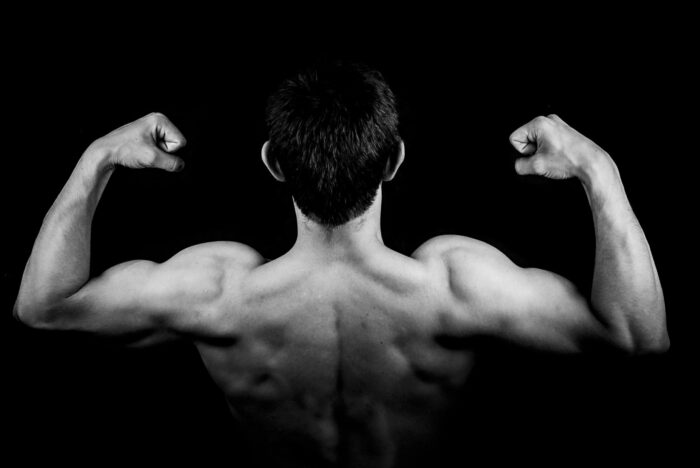
- Rear double biceps. This is one of the most revealing poses because it displays so many muscle groups. Judges assess the arm muscles, back, glutes, hamstrings and calves. Both good conditioning and poor proportions often become apparent here.
- Rear lat spread. The main focus is back width. Well-developed lats give the physique a strong frame, but the assessment does not stop at the back. The eye travels over the whole body again.
- Side triceps. Judges assess the triceps first. At the same time, the pose allows them to compare the thigh and calf profiles. It is a good example of how one pose reveals more than just one muscle.
- Abdominals and thighs. The focus here is on the abdominals and quadriceps. A sharply defined midsection, a strong thigh outline and controlled posing reveal a great deal about a competitor’s condition.
The male bodybuilder’s overall physique: what do judges look for?
Frankly, the audience’s attention can often settle on the most prominent muscle. Judges cannot afford that luxury. Their task is to compare body part with body part and competitor with competitor.
Muscle mass must not come at the expense of proportions. A very large upper body paired with underdeveloped legs undermines the overall physique. The reverse is also true: well-developed legs cannot make up for shoulders, a chest and a back that look narrow or soft.
The V-taper is especially important in men’s bodybuilding. Broad shoulders and a wide back, combined with a controlled waistline, create a strong impression on stage. Shape alone, however, is not enough. The muscles must be defined, flexed and visibly developed.
Posing also plays a major role. The same physique can look better or worse depending on how well a competitor presents it. An overly strained facial expression, shaking legs or poor positioning can spoil otherwise good conditioning. What is actually happening here? Judges see both the physique and the competitor’s control over it.
Practical signs to look for on stage
Good judging begins with calm observation. Start by looking at the overall silhouette: is the physique symmetrical, are the left and right sides balanced, and do the upper and lower body complement each other?
Then come the details. The shoulders should create width, the chest should look full and the back should be sufficiently developed. Arms are about more than biceps; the triceps account for much of the upper arm’s size. The midsection must be controlled, not just display visible abs. The thighs and calves reveal whether the whole body has been trained.
The feet are not an afterthought either. Poor foot placement weakens the entire pose. In bodybuilding, every part matters, even those that seem minor at first glance.
Ultimately, competitors must be compared on the same basis. If one man is stronger in the back poses and another in the front poses, the judge must decide who has the stronger overall package. That is the difficult part of judging bodybuilding.
FAQ
Does the biggest male bodybuilder always win?
No. Size helps, but only when it comes with proportion, muscle quality and good control on stage.
Why is the physique assessed from head to toe?
This gives the judge a consistent system. It ensures that no muscle group or proportion is overlooked and allows competitors to be compared more fairly.
Which pose shows condition best?
There is no single pose. Back poses reveal a great deal about muscle quality and proportions, but the final assessment is based on all the mandatory poses.
Translated by Mikk-Alvar Olle. IFBB Amateur Bodybuilding Rules
Author: https://kulturism.ee/
Source: WHO – physical activity.
Come and work out! ArtGym