Why are bodybuilders more muscular than powerlifters?
Why do bodybuilders and powerlifters differ in muscularity?
Bodybuilders and powerlifters both train with weights, but the results don’t always look the same. Many coaches and athletes themselves believe that muscle development is determined mainly by the duration of tension. That is partly true, but it is an oversimplified view. In reality, there are many factors that play a decisive role and must be taken into account. What kind of tension are we talking about? What duration of tension? At what frequency? What character of tension? Certainly, when we talk about muscle building, passive tension is not as effective as active tension.
Many people still believe that continuous progress in maximal strength is also the answer to building big muscles. In fact, although maximal strength and its growth are certainly linked to an increased muscle cross-sectional area, there are many other adaptations that specifically stimulate muscle mass growth. Moreover, the development of maximal strength is also determined by many adaptations that do not bring about any particular muscle mass development (Schoenfeld, 2010).
In the book “Neuromechanics of Human Movement”, Roger Enoka (Enoka, 2008) presents eight potential neurological aspects whose improvement leads to better strength performance without noticeable muscle hypertrophy:
- Improved performance of the supraspinal centers
- Reduced antagonist muscle activity
- More efficient activation of agonists and synergists
- Improved coordination between neurons
- Reduced bilateral deficit
- Improved synchronization of motor units
- Improved muscle fiber activation (EMG)
- Increased excitability of motoneurons and muscle fibers, and enhanced synapse function
Taken together, the improvement of all these mechanisms means better intermuscular and intramuscular coordination when performing strength exercises. It is the improvement of these coordination mechanisms that lies behind strength gains, and their development, without hypertrophy. Strength training also improves the properties of tendons and ligaments, which likewise contributes to strength gains without major hypertrophy.
Muscle fiber pennation angle. The angle at which muscle fibers attach appears to directly influence (and significantly so) the ability to generate force. The greater the angle at which the fibers attach (in pennate muscles), the more the muscle’s ability to generate force decreases (Kawakami et al., 1995). Interestingly, studies have found that bodybuilders generally have larger fiber attachment angles than powerlifters at the same level, presumably also as a result of training methodology (Ikegawa et al., 2008).
Translator’s note: so it seems this angle can be influenced to a certain degree through training.
Just as strength can increase without hypertrophy, there are also several ways to make muscles bigger without a significant improvement in maximal strength. One mechanism through which this can happen is the stimulation of growth in the non-contractile component and the elements it contains. Non-contractile hypertrophy means growth of collagen, glycogen and other organelles and substrates found in the cell’s sarcoplasm. We also know this phenomenon as “sarcoplasmic hypertrophy” (Siff and Verkhoshansky, 1999).
And since strength as a quality is produced directly through the sarcomeres, an increase in sarcoplasm volume does not noticeably improve 1RM. However, the muscle cell volume that comes from the growth of non-contractile components clearly shows up as an increase in muscle mass and size.
Likewise, growth in the mass of slow type I fibers causes hypertrophy without a noticeable gain in strength. These fibers are in fact endurance-oriented fibers and cannot produce high force (McCardle et al., 2010). However, what many people don’t know and underestimate is the fact that type I fibers are quite capable of hypertrophying when they are targeted with strength training. Even though their growth potential is about 50% lower than that of fast fibers, they are still able to hypertrophy successfully, and do hypertrophy, when the stimulus calls for it (Kosek et al., 2006; Staron et al., 1989). In many bodybuilders, the cross-sectional area of type I fibers is clearly larger than in powerlifters (Tesch and Larsson, 1982). This may also explain why Platz had noticeably greater endurance than Hatfield but was not as strong in terms of maximal strength as his competitor.
If maximal strength depended very heavily on muscle hypertrophy, powerlifters would probably be the biggest human beings on our planet. Likewise, bodybuilders would be “hunting” for maximal weights far more, rather than for the “pump”. Put simply, strong doesn’t always mean big, and the biggest isn’t always the strongest.
Still, why are bodybuilders more muscular than powerlifters?
It’s not about genetics…
People are generally drawn to doing what they are good at. In the world of strength training, individuals with unusually high strength tend to become powerlifters (or train like powerlifters), while those who build muscle mass more easily tend to become bodybuilders (or train like bodybuilders).
Powerlifting has a lot to do with limb (bone) length, joint angles, the nervous system and technique refinement. Bodybuilding, on the other hand, is aimed at aesthetics: the goal is symmetry, proportions and muscularity.
Strength depends on many factors, but one of the most decisive when producing maximal strength is where the tendons attach. Take biceps curls, for example. The biceps of two trainees can be equally large and equally strong in terms of muscle, yet purely because of the distance of the tendon attachment, one of them may be able to do biceps curls with possibly twice the weight. Likewise, in powerlifting, body height, the lengths of the upper arm, shin and thigh, and their proportions relative to each other are decisive.
Of course, the classic examples of professional bodybuilders and powerlifters are often somewhat unrepresentative. There is more money in bodybuilding, and a man like Ronnie Coleman could easily have been the best in the world in powerlifting too. Most likely, it was the bigger prize money and recognition that tipped Ronnie toward bodybuilding after all.
Still, this line of reasoning doesn’t yet explain why bodybuilders are more muscular than powerlifters. There is one important phenomenon that can’t be ignored: when powerlifters start training like bodybuilders, their muscles start growing too.
It’s not about substances…
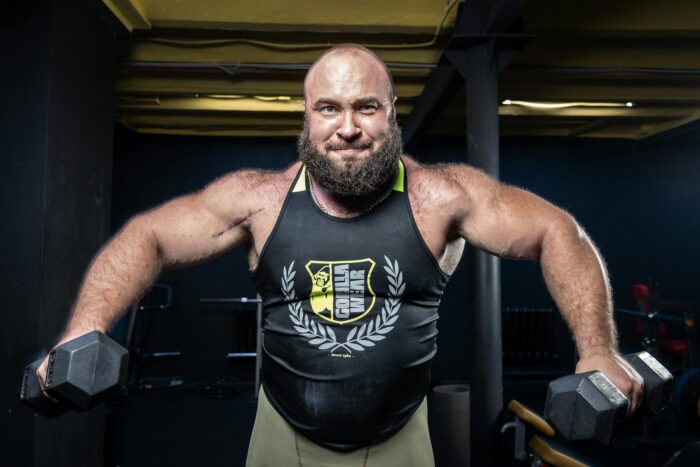
Layne Norton on the article’s cover image
Naturally, professional bodybuilders use anabolic steroids in large quantities, but so do powerlifters. Perhaps a wider arsenal of substances is used among bodybuilders, and they sometimes slip more easily into extreme doses, but that is still a minority. Most stay moderate. Whether and how much these substances may affect the difference between bodybuilders and powerlifters is also very hard to say.
We probably get closest when we compare a natural bodybuilder with a natural powerlifter. Next to natural bodybuilders of the same level, natural powerlifters of the same level are relatively small in size. Take Layne Norton versus John Lyras, for example.
To be continued…
Author: Janar Rückenberg (translation)
Source:Turg.Fitness.ee
Come and train! ArtGym