Growth phase: the 10 best mass-building exercises
The growth phase is the best time to get serious about muscle mass — but only if you choose the right exercises. Here are the ten most effective, proven mass-building exercises that every serious lifter should know.
What does the growth phase actually demand?
An effective mass-building exercise has three characteristics. First, it should load as many joints as possible — the more, the better. Second, it should activate several muscle groups at once. Third, it should be explosive — the harder you can push against the resistance, the faster the progress.
Lower-body exercises are divided into hip and thigh exercises. If the torso isn’t bent forward more than 45 degrees, the exercise counts as a leg exercise — the squat is a good example. If the body is bent forward more than 45 degrees, as in the deadlift, it is a hip-dominant exercise. Upper-body exercises are either pressing or pulling exercises: vertical (arms overhead) or horizontal (arms in front of the body). We don’t cover machines here — only free-weight exercises.
The best lower-body exercises for building mass
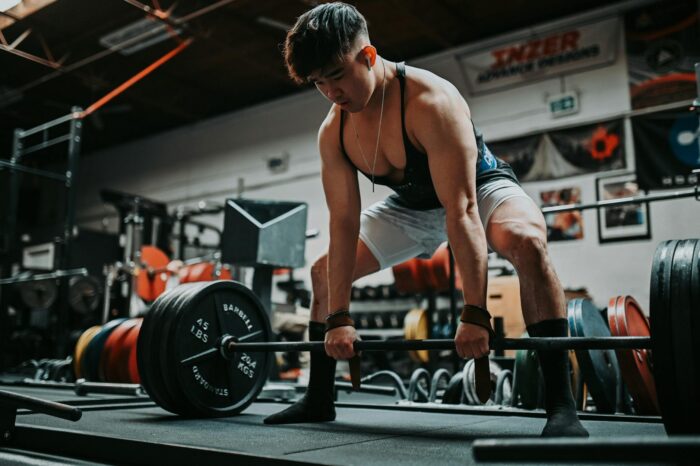
1. Deadlift activates most of the muscles in the body, except the chest muscles. Because so many muscle groups work at the same time, the body’s hormonal system also kicks in at full power — which is why the deadlift is probably the most anabolic exercise in the gym. The glutes and hamstrings do most of the work, along with the fronts of the thighs, the sacral area, the abs and the traps holding the shoulder blades together. It is the best exercise for the lower back — and the arm muscles get a solid load too.
2. Squats activate all the lower-body muscles, as well as the core and lower-back muscles. Successful powerlifters confirm that the force also acts strongly toward the rear — on the glutes and hamstrings. A study published in 2001 in the journal Medicine & Science in Sports & Exercise showed that the upper part of the thigh is activated most in the bottom position, right before standing up. A simple truth: squatting at a 90-degree angle or less limits the development of your thigh muscles. Want big thighs? Learn the deep squat.
3. Romanian deadlift became popular thanks to the Romanian powerlifting coach Dragomir Cioroslan, who introduced the exercise in North America. When you start the movement by pushing your hips back, with the barbell slightly below the knees, the hamstrings do most of the work. The knees should be slightly bent and the barbell should travel as close to the body as possible. The lower back is also involved; the glutes and inner thighs take load as well.
4. Standing calf raises — training the calves with a straight knee activates mainly the gastrocnemius. This way of performing the exercise is a must if your goal is calves that only fit into shorts. In a seated position with the knees bent, the soleus underneath is activated more — the ratio reverses completely.
The best upper-body exercises for the growth phase
5. Pull-ups — if the squat is No. 1 for the lower body, the pull-up is its counterpart for the upper body. It activates the entire back, the shoulders, the rear shoulders, the biceps and the grip muscles — the greatest load falls on the back muscles responsible for back width. It is also one of the most effective exercises for the biceps: the load is greater than in most other exercises aimed at the biceps. Most important: pull with your elbows, not with arm strength.
6. Bench press is a horizontal pressing exercise that needs no lengthy introduction. Its simplicity and the ability to use heavy weights make it the best pressing exercise for the upper body. It activates the chest, the fronts of the shoulders and the triceps. If you keep your elbows out and lower the barbell to the upper chest with a wide grip, it is easier to focus on the chest muscles rather than the shoulders and triceps.
7. Back row is a horizontal pulling exercise in which the arms are out in front — unlike the pull-up, where the hands are overhead. This means the middle part of the shoulder works much more, which makes the row a valuable exercise for anyone who wants to build back thickness. Performed with an underhand grip, it becomes the best of all biceps exercises.
8. Seated press — before the bench press took off in the 50s, the standing press was considered one of the ultimate tests of strength. It stimulates mainly the fronts of the shoulders, but also the upper traps and the triceps. It is also the best way to improve, over the long term, your overall shoulder shape and your strength for the bench press.
9. Close-grip bench press — when you hold the barbell at shoulder width with the elbows in, most of the load falls on the triceps. It activates all three heads of the triceps; the assisting muscle groups are the fronts of the shoulders and the chest muscles. The elbows should be directly below the wrists — a grip that is too narrow can injure the wrists. In all pressing exercises, the triceps are activated most in the top position.
10. Barbell arm curls — if your biceps don’t grow enough from pulling exercises, the best solution is bending the forearms with an underhand grip. The upper arms, the outer side of the forearms and the triceps are also involved to some extent. Keep your elbows back, in line with your body — if they move forward, the load on the shoulders, elbows and lower back increases.
FAQ — growth phase and mass-building exercises
What is the most anabolic exercise in the gym?
The deadlift — it activates the largest number of muscle groups at once and triggers the strongest hormonal response. If you can only do one basic exercise, make it the deadlift.
Does squat depth really matter?
Yes. Studies clearly show that the upper part of the thigh is activated most in the bottom position. Squats below a 90-degree angle limit thigh muscle growth — no matter how much weight is on the barbell.
Do I have to do all ten exercises?
Not necessarily. Choose one or two exercises from each movement pattern: pressing, pulling, lower-body posterior, lower-body anterior. The point of ten exercises is to give you freedom of choice — not a mandatory list.
Translated from Body magazine; Author: Joachim Bartoll
Author: Greta
Source: Mass gainer
Come and train! ArtGym