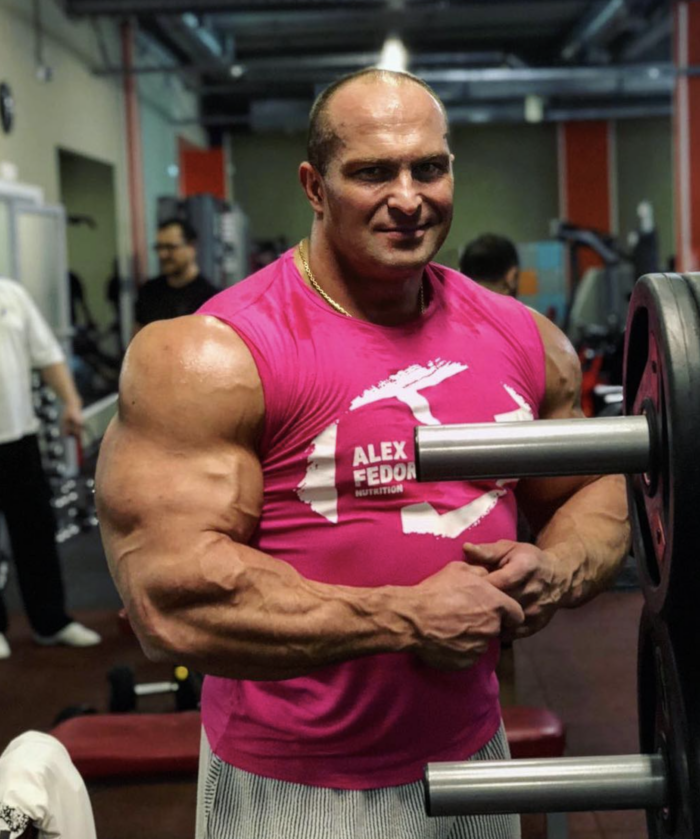
Fedorov’s diet: the logic of competition shape
Fedorov’s diet is a good example of how simple a plan can look on paper and how hard it is to actually stick to it. There is no miracle pill and no trendy menu here, just a strict rhythm: more carbohydrates early in the day, more protein late in the day.
Translated by Janar Rückenberg
Why is Fedorov’s diet so strict?
Alexander Fedorov is honest about his nutrition: he doesn’t try to hand everyone a rule that fits all. This is his experience, his body and his competition shape. That is exactly why it’s better read as an example than as an order.
Bodybuilding has one uncomfortable truth. Shape doesn’t come from good training alone. For the stage, body fat percentage has to drop very low, and food becomes just as important as the gym. For some people a moderate adjustment is enough. For an athlete at Fedorov’s level, though, the diet becomes very precise and at times harsh.
He says himself that he can’t fully explain all the key elements of his diet. Some things just work. That will be familiar to many trainees: you can read plans and formulas, but in the end you have to notice how your body actually responds.
Fedorov’s diet: the daily rhythm and nutrient split
When dieting, Fedorov spreads protein and carbohydrates across the day. In the first half of the day, before noon, the emphasis is on carbohydrate-rich foods. The ratio he describes is approx. 80% carbohydrates and 20% protein.
In the afternoon and early evening he flips that ratio. Fewer carbohydrates, more protein. The split is then 80% protein, 20% carbohydrates. A simple idea: fuel at the start of the day, drier and more protein-focused eating at the end of it.
When preparing for competitions, he cuts carbohydrates as low as possible. On some days he removes them from the menu completely. It is neither comfortable nor a method meant for everyone, but in his words it is sometimes the only formula that gets a man of his level into peak condition.
Let’s be honest here: this approach demands experience. If an average recreational lifter tries the same thing blindly, workouts can turn sluggish, mood can sour and recovery can slow down. What matters in Fedorov’s account is precisely that he knows his body and makes decisions accordingly.
Main foods and portions
Fedorov’s main protein sources are chicken, especially fillet, and egg whites. In the mass-gaining phase he also happily eats other meat and fish. The closer competitions get, the stricter the menu becomes, and in the end he prefers mainly chicken and egg whites.
He gives practical reasons for this too. In Russia, chicken and chicken products are easier to get. Fish wouldn’t be a problem in itself, but his feeling is that in the run-up to a competition fish doesn’t nourish him or support his training as well as chicken does.
In America, bodybuilders are often hooked on tuna. According to Fedorov, it’s hard to find tuna in Russia that has been prepared in a way that suits a bodybuilder. So he chooses foods that are available to him, simple and effective.
He has never counted his protein amounts in writing or down to the gram. Still, he gives very specific numbers for his pre-competition rhythm: before competitions he eats 4 – 5 meals a day, protein shakes excluded. In a day he gets through approx. 2 kg of chicken, i.e. chicken fillet, and approx. 40 egg whites.
Earlier he tried to get by on 3 – 4 meals. That meant bigger portions. In his experience, it was harder to get the last of the fat off the waist that way. Smaller, more frequent meals suited him better.
What does Fedorov’s diet really emphasize?
If you take one idea away from the text, it’s this: discipline counts. Fedorov says he has generally not had big problems with excess body fat or getting into shape. In his view, many bodybuilders miss out on peak shape because they give in to a strict diet exactly when they shouldn’t.
Honestly, it sounds simpler than it is. Hunger, fatigue and eating the same food day after day send your mind in a different direction. That is exactly where it shows whether a plan is merely pretty on paper or whether you can really stick to it.
At the same time, Fedorov doesn’t present himself as an athlete with a calculator. He says outright that he doesn’t count carbohydrates or keep gram-by-gram tabs on protein. His approach is intuitive. He watches his body, experiments with familiar foods and sticks to what has brought results before.
That doesn’t mean the numbers don’t matter. His own examples show the opposite: 80%, 20%, 4 – 5 meals, approx. 2 kg of chicken and approx. 40 egg whites are not random talk. He simply doesn’t build his diet around a spreadsheet, but relies on experience and how he feels.
A practical lesson for recreational lifters
An average trainee doesn’t have to copy Fedorov’s menu one to one. It’s better to look at the principles. First: keep your protein sources simple. Second: put carbohydrates in the part of the day where you need them most. Third: don’t change everything at once, because then you won’t be able to tell what actually works.
When workouts are hard and the goal is to lose fat, the timing of carbohydrates can make a big difference. Some people feel better when most of their carbohydrates come before training. For others, it works better to keep them for the morning. Fedorov’s description offers one possible model, not a universal law.
The strongest part of what he says is about listening to your body. That doesn’t mean eating on a whim. It means noticing your strength, recovery, hunger, what you see in the mirror and how your shape is changing. A simple truth: a diet has to work in your body, not just in somebody else’s article.
FAQ: Fedorov on a diet
Can you copy Fedorov’s diet one to one?
Mostly no. His amounts and his strictness suit the context of elite bodybuilding. A recreational lifter could take on the principles, not the whole menu.
Why does he cut carbohydrates in the evening?
His goal is competition shape. He uses more carbohydrates early in the day and shifts the emphasis to protein in the evening. This is how he tries to keep energy up for workouts while getting leaner at the same time.
What is the most important idea behind this diet?
Discipline and body awareness. Fedorov stresses that you need to listen to your body, but at the same time not break down at the moment a strict diet becomes uncomfortable.
Translated from the article: Fedorov on Dieting” (Alexander Fedorov)
Author: Janar Rückenberg
Source: WHO – physical activity.
Come train with us! ArtGym