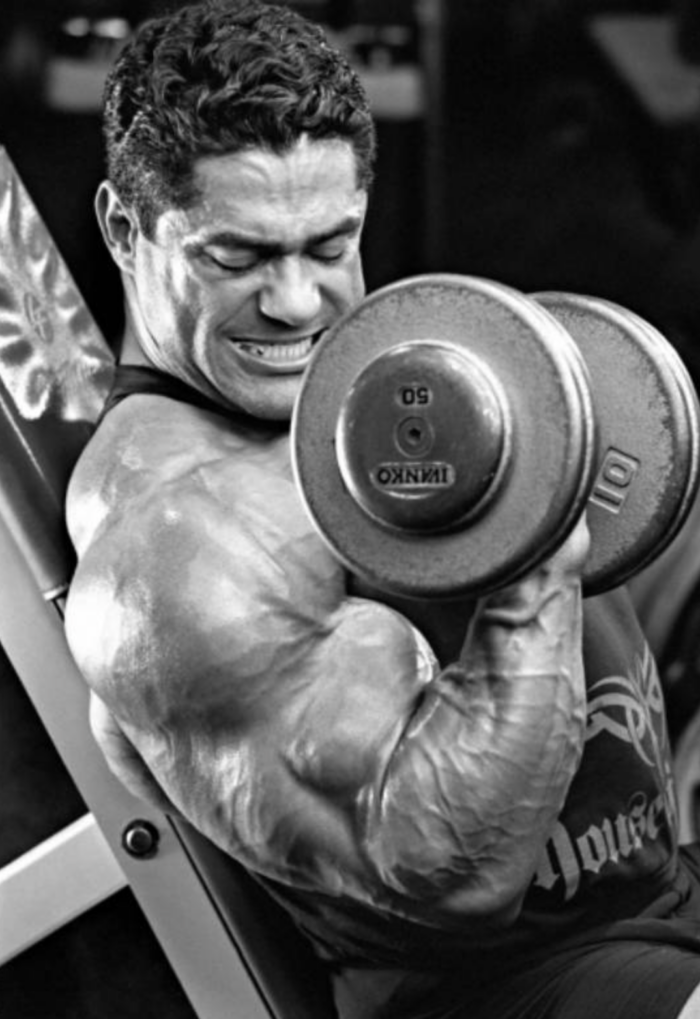
Thick arms: Gustavo Badell’s biceps workout
Big arms don’t come just from picking up a barbell and grinding out a set. In his biceps training, Gustavo Badell emphasized tension, the pump and control. It’s an old-school bodybuilding idea, but it still works in the gym today.
The message in the Flex story was simple: professional bodybuilding has many training styles, but they all share one thing. They’ve been thoroughly tested in practice. That’s why it makes sense to use them in phases rather than stay glued to a single routine forever.
Why thick arms need more than heavy weight
The biceps is a small muscle, but ego often turns training it into a big production. When the weight is too heavy, your shoulders, lower back and elbows swing along with it. The result is that the arm gets less work than you think.
Gustavo Badell approached it differently. Before every set, he posed his biceps for at least 15 seconds. The point wasn’t to show off in front of the mirror but to get the muscle ready for work. Flexing drew blood into the muscle and focused his attention where it needed to be.
Honestly, for many recreational lifters this is even more useful than adding yet another plate. If you can feel the muscle before the first repetition, it’s easier to keep tension throughout the whole set.
How did Gustavo Badell train his biceps?
The core of Badell’s system was the pump. He used higher reps, peak contraction and partial reps at the end of the set. That means the work didn’t stop at the moment a full range of motion was no longer possible. The muscle had to stay under tension.
High reps mattered to him for two reasons. First, they help direct the force into the biceps better, because a weight that’s too heavy drags other muscles into the work. Second, more blood in the muscle meant a better pump. It’s a simple truth: if you can’t feel the target muscle, the routine isn’t really under your control yet.
- Before every set, flex your biceps for at least 15 seconds.
- Perform your repetitions in a controlled way, without throwing the weight up with momentum.
- Hold the peak contraction on every repetition.
- When full reps run out, add partial reps at the end of the set.
- Train biceps at this intensity only 1x per week.
This isn’t a comfortable workout. The burn comes fast, and your arms may feel heavy already halfway through the routine. That’s exactly why it doesn’t suit every training day. Badell recommended using the program for a limited period only. Duration: two months.
Thick arms and a routine to try
The routine below is kept from the original story. Do it only if your technique is solid and your elbows aren’t signaling pain. If you’re a beginner, reduce the volume and first learn to make the movement clean.
- Barbell curls 7 x 10-15
- Seated alternating dumbbell curls 5 x 10-15
- Machine biceps curls as a superset
- Dumbbell concentration curls 5 x 10-15
One thing stands out right away when you read the routine: the volume is high. 7 x 10-15 barbell curls is not a warm-up. That’s serious work. If you add another 5 x 10-15 with dumbbells and a superset at the end, your recovery has to be in order.
In practice, this means your biceps day shouldn’t land right next to a heavy back training session. Pulldowns, pull-ups and rows also load the forearms and biceps. If your arms are already tired, both technique and muscle feel suffer.
What to watch when the goal is big arms
The first thing is elbow position. If your elbows drift forward and back on every repetition, part of the work shifts to the shoulder. Keep your body calm, let the forearm do the moving and squeeze consciously at the top.
The second thing is tempo. Dropping the weight quickly robs the biceps of part of the work. Lower the weight in a controlled way. You don’t have to do the movement in slow motion, but the weight shouldn’t fall.
The third thing is recovery. When the program is this intense, training biceps 1x per week is perfectly logical. More isn’t always better. Sometimes it’s better to do one sharp workout and let the muscle grow.
So what actually happens? You give the muscle several stimuli at once: a normal repetition, peak contraction, flexing while posing and partial reps at the end of the set. Badell essentially called it a layered pump. It sounds brutal, and it is.
FAQ: thick arms and biceps training
Can you do this routine more than 1x per week?
Probably not. The original recommendation was to train biceps only 1x a week, because the plan is very intense. If you add frequency, recovery may suffer.
Is 15 seconds of posing before a set necessary?
It was part of Badell’s method. 15 seconds of flexing helps you focus on the biceps and bring blood into the muscle. If it feels odd at first, try it for at least a few sets.
How long should you follow this program?
The original guidance was clear: use it for two months. After that, it’s worth taking a break, assessing your results and choosing either a lighter biceps plan or one with a different emphasis.
Author: joker
Source: WHO – physical activity.
Come and train! ArtGym