
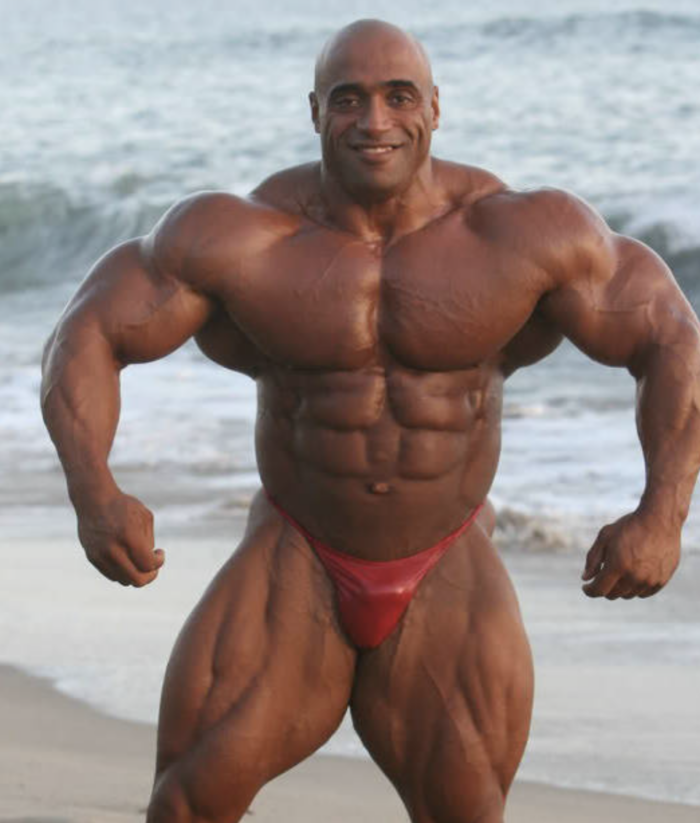
Big arms: Dennis James’s biceps plan
Big arms often start with something simple: your biceps actually recover, so you can work hard again in your next workout. Dennis James’s idea is clear: less flailing, more focus and one strong arm workout done 1x a week.
This is not a soft pump plan. It has two sharper exercises, a lower rep range and a 1-month plan in which WEEK 1 & 3 and WEEK 2 and 4 alternate.
Why big arms don’t grow from volume alone
Flex once made a simple observation: at the pro level of bodybuilding, there are almost as many training styles as there are competitors. That’s actually good news. If a style has been tried out at the highest level of bodybuilding, it has at least some practical reason behind it.
Dennis James’s angle here is quite specific. He isn’t saying you should grind your biceps endlessly from every angle. Quite the opposite. His recommendation is to train biceps only 1x a week, so the weights can go up and the reps don’t turn into empty swinging.
Honestly, this is a tough spot for many people. When arms are a priority, you want to train them all the time. But muscle doesn’t grow in the workout. The workout gives it a reason to grow. Growth comes when your body has time to recover, eat and come back stronger for the next session.
That’s why James recommends taking two weeks off before using the program. The point isn’t laziness. The break lets your energy stores recover and often clears your head, too. When you come back, the urge to grab a barbell is much stronger.
Big arms and the logic behind Dennis James’s exercises
Dennis James calls his two favorite exercises the ones for maximum biceps isolation. The first is concentrated prone curls: you lie face down on the bench and curl the dumbbells alternately, left-right, right-left, below the bench. The second is a close-grip, leaning-forward EZ barbell arm curl on a biceps machine.
Why this choice? According to James, these exercises help broaden the biceps peak and make it rounder. His description is quite vivid, in the language of old-school bodybuilding: by focusing on the peak at the end, you give the biceps a round baseball shape.
A simple truth: exercises like these work better when you do them not on a fresh ego but on a tired muscle. James recommends adding them to the end of a separate basic mass-building workout. First you do the main work, then you isolate the biceps and force out its last strong reps cleanly.
If you’re taking the maximum out of four reps, there’s no point adding ten sloppy reps just to make it feel tougher. A low rep range demands honest technique. The elbow doesn’t wander, your body doesn’t throw the weight up and the end of the movement doesn’t slip out of your control.
How to do this biceps plan
DURATION – 1 month. That’s long enough to work with heavy weights, but short enough not to get stuck in one pattern. After the 1 month is over, it’s worth checking whether your weights went up, whether your elbows stayed healthy and whether your biceps really gained a better feel for the work.
WEEK 1 & 3
- Standing barbell curls 3 x 4-8
- Seated alternating dumbbell curls 3 x 4-8
- Close-grip, leaning-forward EZ barbell curls 3 x 4-8
WEEK 2 and 4
- Standing EZ barbell curls (normal width) 3 x 4-8
- Seated alternating dumbbell curls 3 x 4-8
- Prone incline-bench concentrated dumbbell arm curls 3 x 4-8
So what actually happens? The first exercise provides the heavier main training load. The second keeps both arms working and helps you notice the weaker side. The third puts the emphasis on isolation, where the biceps has to do the work itself.
Big arms: what to watch in your workouts
Don’t turn the 3 x 4-8 sets into a quick march through the gym. Every set has to start with control. If the weight already demands a shoulder pull on the first rep, it’s too heavy. If you get 8 reps too easily, there’s reason to raise the training load in your next workout.
With biceps, feel is often deceptive. The pump can be big, but the work may be going to your lower back, shoulder or wrist instead. Keep your wrists strong, your elbows calm and lower the weight as deliberately as you lift it. It’s the lowering phase that reveals whether the control is really there.
One more practical thing: don’t compete with others in every workout. The idea of James’s plan is to use heavier weights than ever before, but that doesn’t mean random yanking. Big arms take hard work, but also a clear enough head for your joints to hold up.
If your arms are lagging behind the rest of your body, a 1-month plan like this can give you a clear focus. Run through the plan, write down your weights, and decide afterwards whether this style suits you. It makes sense to use different styles in phases, test them and then conclude what works best.
FAQ
Is it really enough to train biceps 1x a week?
With this plan, yes. The idea is to come to your workout recovered, use heavier weights and do strong repetitions in the 3 x 4-8 range, rather than piling up lots of tired sets.
Is a two-week break before the plan mandatory?
That was Dennis James’s recommendation before starting the program. If you’re already overtrained or your arms are constantly sore, taking it easier for two weeks may give you a better start.
What should you do if the 4 repetitions come out with poor technique?
Lower the weight. Going to your max on four repetitions doesn’t mean your form should break down. 4 clean repetitions are better than 8 repetitions where your body does half the work.
To be continued …
Author: joker
Source: WHO – physical activity.
Come and train! ArtGym




