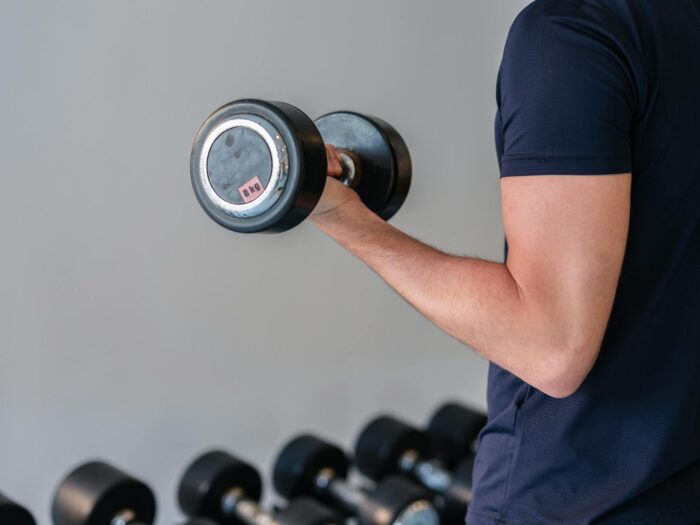
General training guidelines for every athlete
These training guidelines help you avoid the most common mistakes and get the most out of every session. The 16 principles are written for beginners and intermediate trainees alike — simple rules that actually work.
Why do general training guidelines matter?
Training without a clear direction often means burning energy without making progress. A training log changes that. Write down the exact facts about your training habits and changes in body weight — and review your notes every week. That way you will see a pattern: which exercises give you the best results and which have never worked for you.
Writing it all down isn’t bureaucracy — it’s your most honest training partner. Without data, it’s hard to decide when to increase the weight and what to drop.
Variety is critical too. After a certain amount of time, your muscles adapt to the same routine and progress slows to almost zero. Every now and then, change the exercise order, sets and rep count, and add new movements. This so-called muscle confusion forces your body to keep adapting and growing.
Nutrition and recovery
Eat several small meals a day. This gives your body a steady supply of nutrients for the most effective muscle growth. Many diets provide too few calories, which leads to a drop in the metabolic activity of muscle tissue — catabolism. In that case, the body starts breaking down muscle itself.
Protein intake is especially important. Aim to eat at least 2 grams of protein per kilogram of body weight per day. People who train at high intensity need even more to support muscle growth and recovery.
Rest isn’t laziness — it’s an integral part of training. Allow at least 72 hours of rest before training the same muscle group again. Some people need even more. Very few can get by with less.
Don’t forget the aerobic side. 20 minutes of aerobic exercise every day is usually enough — it’s necessary for health and also important for aesthetic reasons. Calculate your target heart rate like this: subtract your age from 220 and multiply the result by 70%.
Technique, breathing and focus
Good form is always more important than heavy weight. Lifting heavy weights with poor technique stands in the way of the best results and causes injuries. Always perform exercises through the full range of motion — don’t neglect either the top or the bottom end point. People make this mistake more often than you might think.
Breathe correctly: exhale as you lift the weight, inhale as you lower it. Proper breathing supplies your muscle cells with oxygen, which they need in order to contract and release energy.
Focus on the negative phase. Most of the muscle tissue damage — and the resulting benefit — occurs during the lowering of the weight. Lower the weight more slowly than you press it up. This eccentric control is one of the simplest yet most underrated techniques.
Don’t let yourself be distracted during training. Save the conversations for before or after — during your workout, focus only on yourself and the muscle you are working at that moment. By concentrating on a specific muscle, you automatically isolate it more. Don’t rely too much on machines either — free weights are more effective for building muscle.
Increase the weights as often as you can. This is the simplest and most important approach to muscle building. Only a steadily increasing training load signals to your muscles that they need to get bigger and stronger.
Train hard, not long. Heavy lifting shouldn’t last longer than 30 minutes. Cut the rep count in your sets and raise the intensity. The last, almost-failing repetition is the most productive — that is the one that stimulates real growth. Overtraining is a common and often disastrous mistake among both beginners and intermediate trainees.
Keep constant tension in the muscle throughout your training, from start to finish. And try to reach peak contraction on every repetition: instead of simply moving the weight up and down, push it to the maximum for a moment and feel the muscle contract fully.
FAQ — general training guidelines
How often should you change your training?
Change your exercises, sets or repetitions every four to eight weeks. Once your muscles get used to the same routine, progress slows noticeably.
Does more training mean better results?
Not always. Overtraining halts progress. Shorter, more intense workouts often deliver better results than long, scattered sessions. Heavy lifting shouldn’t last longer than 30 minutes.
How much protein do you need per day?
At least 2 grams of protein per kilogram of body weight per day. For people who train intensively, the same number is the absolute minimum — sometimes even more is needed.
Let’s train! ArtGym
Author: Sacatini
Source: WHO – physical activity.