Water and training: how much should athletes drink?
After oxygen, water is the one thing the body can’t function without. For athletes its role is even bigger: without enough fluid, performance drops after a loss of just a couple of percent. Here is a short, practical overview of how much to drink, when to drink, and why it affects your training results.
Why water matters for athletes
Water takes part in digestion, nutrient absorption and the distribution of nutrients throughout the body. It also acts as a thermoregulator and carries waste products out. During training, the body can burn up to 25 calories per minute. At that training load, body temperature rises quickly and the body needs water to avoid overheating.
Water turns over fast. About 2 liters of fluid leave the body each day through urine, breath and sweat. At least as much has to come back in — otherwise the whole machinery starts to stall. We get part of the amount we need from food, and the rest has to come from drinks.
How much water the body contains
About 60% of an adult man’s body and 55% of a woman’s is water. Of that, 55% is inside the cells and 45% between the cells. Muscular people carry more water, because muscle tissue binds it better than fat tissue does. That is one reason why a trained body tolerates heat and training load better.
Keeping the balance is no small matter. A water loss of just 2% brings on thirst and lowers performance. A 6% loss is a serious obstacle — weakness and irritability set in. A fluid loss of more than 18% is life-threatening.
Water during training: how much to drink and how
During intense training, fluid loss can reach up to 2 liters per hour. In endurance sports — long-distance running, cycling, skiing — it can reach 5–6 liters. You can’t drink that much back during a single workout, so you have to prepare for fluid loss the same way you do for carbohydrate stores.
Practical recommendations:
- Drink enough water before training so that your body starts working with a full tank.
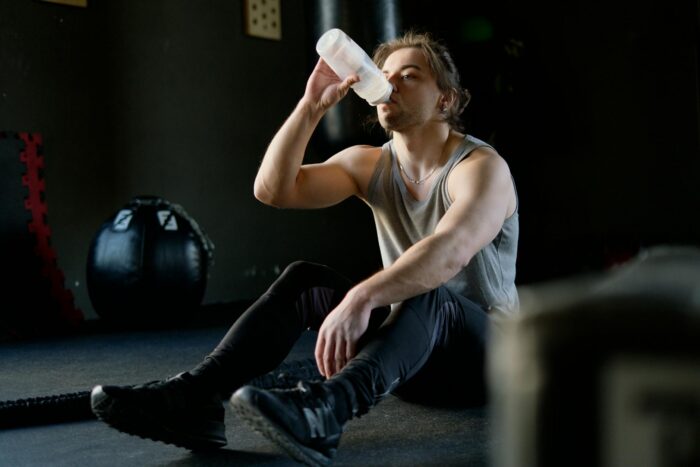
- During training, drink every now and then, in small sips. A large amount at once collects in the stomach, causes discomfort and interferes with the exercise — in the worst case it triggers vomiting.
- Choose cool water — it is absorbed faster than warm water.
- After your workout, keep drinking until your urine is light in color again.
How much you sweat depends on your body surface area, the intensity of the training and the temperature of the gym. Water drunk before training helps maintain the balance of water, salts and body temperature. Many athletes underestimate the importance of fluids and restrict their drinking — and then wonder why their workouts aren’t going well.
Water at the cellular and whole-body level
At the molecular level, water is a universal solvent: it breaks the bonds between salt and sugar molecules and surrounds them. Together with enzymes, it helps break larger polymers down into smaller parts (hydrophilicity).
At the cellular level, water has a high heat capacity — this protects against overheating and overcooling. Water creates the internal pressure of cells and keeps pH normal.
At the whole-body level, water has a protective function, keeps the circulatory system working and forms what is known as a hydrostatic skeleton — a drop in the body’s water shows up, for example, as wrinkles on the skin. It is in dissolved form in water that we also perceive tastes: salty, sweet, bitter.
FAQ
Does water make you fat?
No. Water contains no calories. A short-term weight gain after drinking a larger amount is simply the weight of the fluid, which leaves the body with urine.
Can you drink during training?
Yes, and often you should. Drink in small sips. A large amount at once collects in the stomach and interferes with exercising.
How much water should you drink per day?
An average person’s daily fluid loss is about 2 liters, and that has to be replaced. For someone who trains, the need grows by the amount lost in sweat — a couple of hours in the gym can add 1–2 liters, and in endurance sports even more.
Always the purest: https://www.tallinnavesi.ee/
Author: Eero Viik
Source: WHO – physical activity.
Come and train! ArtGym