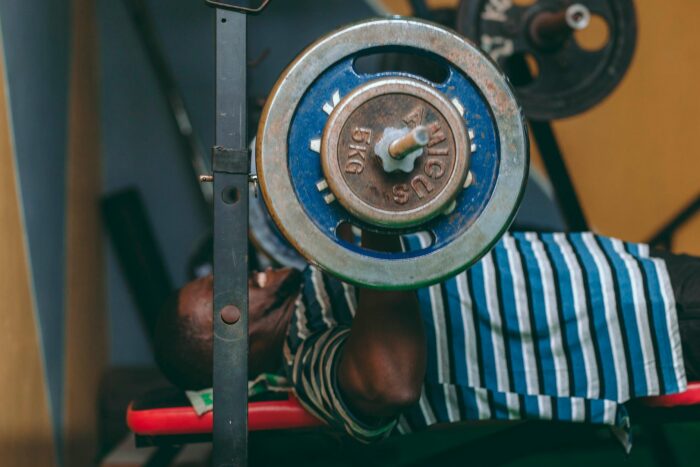
100 kg bench press: how to keep progressing
A 100kg bench press is the first major milestone for many. Once you can manage 1 rep, the next question immediately follows: where do you go from here when a standard pyramid no longer works so well?
This program is best suited to you if you like a structured approach. The weight is set for every workout, the increases are small, and the goal is simple: to turn a single bench press rep into a stronger set over time.
Why progress stalls after 100 kg
Progress on the bench press often comes quickly at first. Your technique improves, your nervous system learns the movement, and you can add weight to the barbell every week. But once you reach that first bench press milestone, things change.
The simple truth is that the stronger you get, the smaller your weight increases need to be. Add too much at once, and your technique breaks down or you fail to finish the set. Add too little without a system, and every workout can become the same routine: a warm-up, a pyramid, a heavy single attempt, and that’s it.
This is where a 5 x 5-style approach comes in. It is no miracle program. It is a framework that makes you work with a set weight and keeps the increases under control. Some people find it works very well. Others prefer to train by feel. Honestly, both have their place, but after 100 kg, a plan often gives you a clearer direction.
The 100 kg program: what you need before you start
Before you start, check one practical detail: your gym should have 1.25 kg plates. Without them, precise progression becomes difficult. The original plan calls for even smaller increments, so a simple trick comes in handy.
Go to a hardware store and buy some chain with thicker links. Make three 0.5 kg lengths from it. Weigh them in the store so that each piece weighs exactly 0.5 kg. Get some carabiners too, so you can fasten the ends of each chain together. You now have the equivalent of 3 half-kilogram add-on weights, just in chain form.
Why be so precise? Because the program was originally converted from pounds. If the conversion gives you 46.5 kg, for example, it makes little sense to round it up or down automatically. An increase of 1 kg or 1.5 kg is still an increase. Sometimes a small step is exactly what keeps progress going.
Here is a simple example. If your working weight is 55.5 kg, load the barbell to 55 kg and attach a 0.5 kg chain to the middle of the barbell. It might look a little funny, but it serves precisely the purpose this program was designed for: small, measurable increases.


How to fit the 100 kg program into your week
The weights should increase by about 15% from set to set. That 15% is not ideal for everyone, as some find the jump too large. Still, it gives you a clear framework to start with. Over time, you will learn whether your body needs a smaller or larger increment.
In the original version of the program, day I is Monday and day II is Friday. How you arrange the rest of the week is up to you. It would be sensible to keep your training days to between 4 and 5 per week. When pressing gets heavy, you need to leave room for recovery.
Training shoulders and triceps on Saturday immediately after chest day II, taking Sunday off, and then tackling chest day I again on Monday is a bad idea. Your shoulders and elbow joints will let you know fairly quickly.
A better option is to combine one chest day with shoulders and triceps. On that day, the bench press is your only chest exercise. On the other chest day, you can train chest alone or alongside another muscle group, but add more chest work after the bench press to bring the total to around 12 to 15 sets.
Practical bench press tips
Do not change everything at once. When you start bench pressing with this program, keep your other chest training moderate and monitor your recovery. If your shoulders are constantly sore or you are sleeping poorly, the program is not always the problem. Often, the training load is simply too high.
Your technique should stay the same on both light and heavy sets. Keep your feet on the floor, slight tension in your upper back, your shoulder blades together, and the barbell under control. If every heavy rep looks like a different exercise, the numbers will not tell you much.
So what actually happens if everything goes to plan? In the final week of the program, you should be able to do 5 reps with 100 kg. Logically, that could make 110 – 115 kg for 1 rep a realistic goal. There are no guarantees, because people recover and progress differently, but the direction is clear.
Those little chains will still come in handy afterwards. Small weight increases also work well in various arm training programs and exercises where a standard 2.5 kg jump may be too large.
And don’t forget to eat!!! Getting stronger takes more than time under the barbell. If your nutrition, sleep, and recovery are off, even the best table remains just a table.
100 kg bench press: FAQs
Is this program suitable for beginners?
Not really for complete beginners. The program assumes you have already bench pressed 100 kg for 1 rep and now need a structured approach to progress beyond that.
Can I round the weights?
You can, but that changes the nature of the program. The original idea is to keep the increases small and precise. That is why 0.5 kg chains are useful.
How many times a week should I train my chest?
This system includes two chest days: day I and day II. Schedule your other workouts so that you have a total of 4 5 training days per week without compromising recovery.
Author: Janar Rückenberg
Come train with us! ArtGym