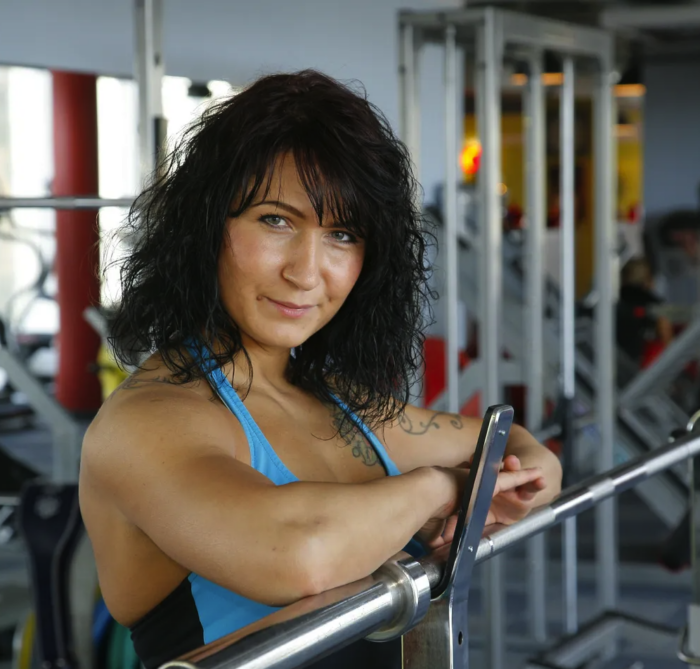
Christina Alev—a name that first appeared on the entry list for the Estonian Cup in 2008. Her category: bodyfitness +163 cm. Who is she? Christina came away from that first competition with a creditable 2nd place.
Back in the summer, coach Raivo Piiber, who is also the managing director of the Tervisex sports club in Pärnu, and I discussed joining Christina for one workout. I have to admit I had been curious for some time: after watching Christina backstage at the spring competitions and seeing several photos online, I wanted to find out who she was and how she trained.
One Monday in September, we meet at Tervisex, Christina’s home gym in Pärnu. Christina has already started preparing for the Estonian Championships in November, so coach Raivo warns us in advance that we are in for a long, tough workout: shoulders, back and abs.
We do a light warm-up on stationary bikes for about 10 minutes. Some quick stretches and warm-up movements follow before the serious work begins. We start with shoulders, choosing the seated machine shoulder press. Raivo immediately loads up the 10kg plates: “Right, ladies, get to work!” What else can we do? It is pretty tough, and it turns out that our left arms are a weak point for both of us, tiring much faster toward the end. “Press the right arm up first, then the left if you can’t manage both at once,” Raivo tells us. We use that advice for the final repetitions, when our strength is running out. We need to get around 12 repetitions even on the final, 3rd set. And we do.
The first exercise leaves us pretty exhausted. We move straight on to standing dumbbell lateral raises for 3 sets. Christina chooses 8kg dumbbells. We stick to around 12 repetitions. We rest only while our training partner does her set, so the pace is fairly intense.
With that exercise done, we move straight on to bent-over rear delt flyes for 4 sets, this time using 5kg dumbbells.
Back, back, back! One of the most important body parts for women, with its development assessed in competition. Christina considers her back one of her stronger body parts. Well, mine is not too bad either, but there is always room for improvement J So we both enjoy training back. There are 4 exercises in the program. Coach Raivo asks how we are feeling. We reply that we feel pretty good. At that, he announces that the REAL hard work is about to begin!
The first exercise is the seated wide-grip behind-the-neck lat pulldown. Christina sets the weight to 40 and says she PROBABLY cannot manage any more. So that is how we do the first set: 12 repetitions at 40. For the next set, I increase it to 45 and tell Christina she now has no choice but to match me. Raivo is beside us, urging us on. And Christina does it. She gets through the third set, too. Afterward, she says she might even increase the weight next time. She has more in reserve.
The second back exercise is the single-arm dumbbell row, pulling the weight toward the abdomen. Christina says she increased her weights quite substantially during her mass-building phase, but has now reduced them considerably again to put the finishing touches on her back before the competition. Today, she selects a 27.5kg dumbbell from the rack. We need to manage 4 sets with it. We get started. The first sets are fine, but from the 3rd set onward, things get a little tough. The movement requires real concentration; ideally, you should pause briefly at the top before lowering the weight back down as far as possible, so your back gets the maximum work and stretch. During this exercise, we gradually start letting out some serious grunts of effort, prompting a group of young men at the other end of the gym to forget their own workout and watch with interest. Coach Raivo grins: “That’s right, boys, watch and learn. The champions are training.”
Next, Christina loads 10kg plates onto the barbell, bringing the total to 40kg, and starts bent-over barbell rows, pulling the barbell toward her abdomen. By now, our backs are pretty tired and stiff, but we have to push through these 3 sets of 12 repetitions, with the end of the workout already in sight.
To finish off our backs, we head over to the back extension bench, where the body is horizontal to the floor in the starting position. Training the lower back this way also works the glutes. We take a 15kg plate for added weight. In the starting position, as mentioned, we squeeze the glutes hard as well as the lower back. It works. We do 3 sets to failure.
During contest preparation, it is also important to train your abs regularly. So we finish our workout with abdominal exercises. First up: lower abs on the leg raise station. Christina raises her legs, bending at the knees, and does around 25 repetitions, going to failure. We rest while our partner does her set. We do 3 sets in total, then immediately lie back on a bench to work the upper abs. We raise only our upper bodies and pause at the top. The pace is slow, and the exercise requires real concentration. Again, we do 3 sets of around 25 repetitions (to failure)
That is it for today. Our bodies are tired, and it has been a long workout: 2.15 hours! Today’s workout is followed by practice of the mandatory poses. This, too, needs to be done quite often during contest preparation. Although the body is tired after training, the muscles are pumped, giving us a good picture of our current condition. We take photos to record the results—it will be useful to look back and see whether and how our condition improves.
After a quick hot shower, we find a little more time to chat:
Aktivist: When did you consciously decide to pursue competitive sport?
Christina: Thinking back, I only consciously committed to competitive sport after my first trial by fire on stage. Until then, I had not really understood what it meant to train for competition. The whole thing was still new to me, and I was trying it out. I had to work out whether I was comfortable with all the stages leading up to competition and whether I enjoyed them. I was, and I did! And that is how it went.
Aktivist: How did your family, friends and acquaintances react?
Christina: Opinions have varied widely. I cannot deny, though, that negative opinions far outnumbered positive ones at first. That was probably because this level of dedication was new to my family, friends and acquaintances, too. Now that they have had a little time to get used to it, I get plenty of positive feedback as well, especially from my family and closest friends. My children are particularly positive about it, and their support matters most.
Aktivist: What was your previous experience with sport? Which sports did you do?
Christina: Everything I did before was recreational, and it was all quite a long time ago. At school I did athletics, with sprinting my favorite event, and I also enjoyed volleyball and basketball. Later came running in the forest and similar activities, plus a few years at the gym… that was a good 17 years ago.
Aktivist: Where do you train?
Christina: At Tervisex Sports Club in Pärnu.
Aktivist: What are your off-season and competition weights? Height? Age?
Christina: My off-season weight is somewhere around 63.8 kg, give or take a little, and my competition weight is around 58 kg. I’m 172cm tall and all of 33 years old.
Aktivist: What does a typical day look like for you—getting up, meals, daytime activities (work, etc.), training…?
Christina: My alarm goes off at 5.45, followed by a morning shower, then it’s straight to the kitchen to make breakfast for myself and the children. I do my beauty routine, get the children off to school and head to work with a bag full of food containers. After work I train, then make my way home again and take care of whatever needs doing.
Aktivist: How much does everyday life interfere with your focus on your athletic career, if at all?
Christina: So far, I haven’t found that everyday life has interfered with my focus on my athletic career. After all, I made this choice quite consciously and had already prepared myself mentally for the fact that it wouldn’t be easy. A sense of responsibility, the drive to get things done and determination have helped a lot.
Aktivist: How is your strength training structured? Do you divide your training into phases (building mass, improving definition, etc.)?
Christina: I’m fairly creative in the off-season—for variety, I change and swap exercises within my training program once or twice a month, and I generally work in the 8-12 rep range. The number of sets varies from three to five. About 2.5-3 months before a competition, I start what you might call contest prep: I train the key muscle groups (back, shoulders and legs) 2x per week, with 12 reps per set.
Aktivist: How many times a week do you train at the gym, both in the off-season and during contest prep?
Christina: Both my off-season and pre-contest training programs are split over four days. That’s quite enough: my muscles have time to recover, and the training load doesn’t start taking a mental toll.
Aktivist: What about cardio? How much do you do, when, and so on?
Christina: During the off-season, I average 1.5-2 h of cardio a week. I do it before weight training to warm up and afterward to cool down.
Aktivist: How does the amount of cardio change before a competition?
Christina: In the spring, before my first competition, I didn’t know what to expect, so I included cardio in my training program right from the first few days, bringing it up to six sessions a week. Each lasted an hour to an hour and a half, depending on how I felt. I’ve now increased my cardio to four hours a week, with the training load spread over five or six days again.
Aktivist: How do you unwind from training?
Christina: I grab my camera and head outdoors, whether it’s to practice photographing nature itself or my friends. The latter is better, of course, because you get good company as a bonus. Now and then I go to the theater, too… it’s a completely different setting that takes me away from everyday life. I also find myself behind the wheel quite often—it’s enjoyable and a good chance to gather my thoughts. Occasionally, I even spend time with the children. And good sex is definitely one of the best ways to unwind from training!
Aktivist: How often do you practice posing?
Christina: I have to say, really, really often. It used to be perhaps once a week, but as time goes on, it’s become several times a day, depending on where I happen to be. Definitely both morning and evening at home, and at least once or twice at the gym, if not more.
Aktivist: What principles guide your nutrition?
Christina: There’s one golden rule I’ve tried to follow: I don’t live to eat; I eat to live. I’ve always watched what I eat and how much. Now I simply make more informed choices, listening to what older, wiser and more experienced people who are dedicated to the subject have to say.
Aktivist: Favorite food and drink?
Christina: My absolute favorite is buckwheat porridge with corn, bell pepper, carrot, onion and beef (ground beef), served with all kinds of raw vegetable salads. For dessert, I prefer homemade quark doughnuts, and my favorite drink is a plum juice milkshake made with ice cream.
Aktivist: Alcohol, tobacco, parties?
Christina: At some point, I’ve been pretty well acquainted with all of them, but these days I don’t drink alcohol at all—and haven’t for at least 5 years—or use tobacco products. As for parties, I’ve never been a complete party animal. Relaxed get-togethers with friends are always welcome, though.
Aktivist: Do you have so-called refeed days, and how do you go about them? What do you eat?
Christina: I allow myself these refeed days more often in the off-season. Sometimes I snack on dried fruit after training, occasionally have plain vanilla dairy ice cream in the evening, and I’m particularly fond of Kalevi Kamatahvel. During contest prep, I’ve mostly stuck to plain dairy ice cream once a week, usually on Sundays—it’s fairly rich and sweet enough, too.
Aktivist: How do you change your diet when preparing for a competition? How long is your preparation period?
Christina: As I mentioned earlier, I’ve kept my diet fairly controlled for practically as long as I can remember, so I don’t need to make major changes. I only adjust my calorie intake, reducing it by about 5-10%, and that’s enough. I start adjusting my diet as soon as I begin contest prep.
Aktivist: Which supplements do you take?
Christina: Up to now, I’ve apparently been getting everything I need from regular food. What makes me think so? I’ve made noticeable progress in several areas, whether in strength, appearance or how I feel overall. The exceptions would perhaps be multivitamins and fish oil capsules from various manufacturers, bought at the pharmacy. I’ve only just started taking Eiselt Research’s CARBO FX carbohydrate supplement and PRO FX protein supplement as part of my preparation for the autumn competitions, because my training loads are higher and my workouts are several times more intense and higher in volume.
Aktivist: Appearance is especially important for a female competitor. How do you look after yours?
Christina: Three things definitely keep me looking good: 1) proper rest, 2) the right food and 3) fresh air. Everything else, from washing in the morning to using quality cosmetics, is simply part of my everyday routine.
Aktivist: What do you prefer to wear day to day?
Christina: Over time, I’ve come to value comfort more and more. My favorite outfit is usually jeans paired with accessories that are more or less feminine, depending on the occasion.
Aktivist: What feminine indulgences have you held on to as an athlete?
Christina: Oh, there are quite a few. I certainly haven’t given up high-heeled shoes/boots, stockings, miniskirts, jewelry, quality perfumes or nail polish.
Aktivist: How do you choose your stage jewelry, and what should you keep in mind? Any advice for first-time competitors?
Christina: When it comes to stage jewelry, individual personality probably plays an important role, as does how well you can carry off the pieces you like on stage. I decide what my competition bikini/one-piece will look like first, then use that as inspiration for choosing jewelry. Sometimes it can work the other way around, though; either approach is possible. First-time competitors should do their homework before the competition and find out what jewelry is allowed. Consulting specialists in the field also helps (between you and me, that’s what I did myself).
Aktivist: How do you plan your stage hairstyle, makeup and bikini so they all work together? Can you offer any tips?
Christina: Preparing for a competition is quite a long process, and since I make my competition outfits myself from start to finish, working on them also gives me time to think about makeup and hairstyles. You need to shine on stage, and a positive attitude toward yourself and a beautiful smile help a lot. You have to take the stage lighting into account: it simply washes out subtle daytime makeup. But it only takes a little too much makeup to spoil the overall look. It’s important to keep the colors of your competition outfit in mind when doing your makeup. When choosing hairstyles, I’ve sometimes dropped into a hair salon on a whim and had my hair styled for a special occasion, just to see how it looks and whether it suits me at all. Doing that every day probably wouldn’t be sensible, but once in a while, why not
Aktivist: Looking back and assessing your first competition, what do you expect from the next one? What did you experience, and what did you learn from it? Which mistakes would you like to avoid repeating?
Christina: Someone once told me (I can’t remember who anymore) that you have to get on stage for the first time before you really understand and feel what pre-competition nerves mean. The first time you go on stage, everything is so new that you don’t really know what to be afraid of. You just go out there and do it. Later, when you find time to reflect, you start noticing where you went wrong and to what extent, and naturally you want to do better next time, whether that’s making your entrance or leaving the stage. My biggest weakness was posing, which came down to a lack of experience. The more you practice and compete, the more polished it becomes.
Aktivist: What are your plans for the future? Where do you see yourself in, say, 10 years?
Christina: 10 years is quite a long time. It’s hard to predict who I’ll be or what I’ll be doing by then. If I’m still involved in the sport, we can talk about it again.
Aktivist: Who are your sporting role models—the athletes who inspire you to pursue this sport?
Christina: Natalia Nazarenko-Kiivikas and Katrin Kimber. There’s a lot to learn from them!
How the athletes train: Training program
Shoulders, back, abs
Seated dumbbell or machine shoulder press 3 x 10 12
Standing dumbbell lateral raise 3 x 10 12
Bent-over dumbbell reverse fly 4 x 12
Dumbbell row for the lats 4 x 10 12
Wide-grip behind-the-neck lat pulldown 3 x 10 12
Barbell row to the abdomen (or cable row) 3 x 10 12
Weighted back extension on a hyperextension bench 3 x 12
Hanging leg raise for the abs 3 x 20 25
Crunch on an ab bench 3 x 20 25
Weekly training program
Goal: Competition preparation (four-way split)
Day 1 shoulders, back, abs
Day 2 legs, chest
Day 3 cardio
Day 4 shoulders, back, abs
Day 5 legs, arms
Day 6 cardio
Day 7 rest
Come train with us! ArtGym