Martin Münz: His Athletic Fitness journey and goals
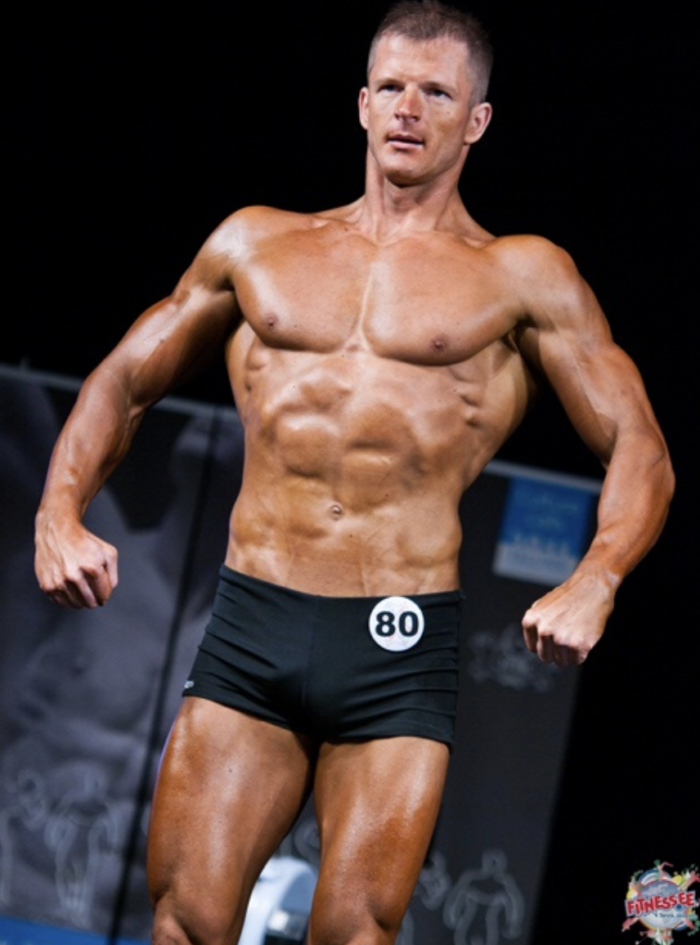
Martin Münz is a 35-year-old Athletic Fitness athlete with a competition weight of 90 kg and an off-season weight of 97-100 kg. He is 187 cm tall and currently lives just outside Tabasalu, although his usual home is Gothenburg, Sweden. In this interview, he talks about how he got into Athletic Fitness, why he kept believing in the sport and what keeps him going every day.
A brief introduction: Age: 35. Height: 187 cm. Weight: 90 kg during the competition season, 97-100 kg in the off-season. His pet Dalmatian, Bonita, is a faithful companion on almost every family outing. Family status: engaged and a father of 4, with a fifth on the way and the pregnancy at the halfway point. He has been involved in Athletic Fitness since 2006. He considers determination his greatest strength, one that has brought a lot of positivity into his life; his greatest weakness is probably being easygoing and kind toward almost everyone and everything. His motto in life: live every day as if it were your last.
What does Athletic Fitness mean to Martin Münz?
Athletic Fitness is not for people who are lazy or lack determination. The sport demands a great deal of commitment to both training and nutrition. It is also difficult to maintain maximum strength and endurance while dieting for a competition and achieving muscular symmetry at the same time. Your muscles need to be well developed, proportionate and well preserved. And I have proved to myself that this is very much possible.
As I approached the end of my first competition preparation, having reached my best condition at the time with maximum reserves of strength and endurance, I felt incredible. Stepping onto the stage and soaking up the tremendous energy flowing from the audience and your fellow competitors. Feeling everyone cheer you on as you stand on stage, counting every pull-up or triceps press repetition aloud, one by one—it is a truly extraordinary feeling, unlike anything else. That was when I realized that all the effort and every last drop of sweat had been worth it.
I would love you, reading these lines, to experience that for yourself. That is exactly what has led me to my next goal: giving Estonians the chance to take part in this exciting sport. For me, Athletic Fitness has many advantages over other bodybuilding and fitness disciplines. First, there is the variety: you can test yourself on your physique’s proportions and conditioning as well as your strength and endurance. It is incredibly exciting for the audience to cheer everyone on, and the suspense lasts until the very end for the competitors.
Martin Münz’s journey into Athletic Fitness
I have lived in Sweden for 7 years, and I first heard about Athletic Fitness while training at a gym there. I was immediately interested in the sport, but I was afraid I would not be good enough to compete against others. I wanted support and reassurance that I had what it took, so I went to speak to a personal trainer. He used skinfold calipers to measure my body fat percentage, which was 6.4 % at the time, and strongly encouraged me to give the sport a try. I also went to watch an Athletic Fitness competition, which confirmed that this was the sport I wanted to compete in.
I started reading about Athletic Fitness and looking for a coach with expertise in the sport. I found Keith Karlssa, who had already won two competitions and also worked as a personal trainer. He gave me plenty of useful information, and I began preparing for a competition that was half a year away. That is not a particularly long time, but with a solid physical foundation, a strong desire to succeed and determination, it is an entirely realistic goal.
My first competition was the December Cup 2008. I am currently preparing for the Swedish Championships, which take place on 04 September 2010, followed immediately by the inaugural Estonian Open Championships on 10.10.2010.
Goals and greatest achievement
My goals for this year are clear: to win both the Swedish and Estonian Championships in 2010 and discover the limits of my abilities. I also want to bring the Athletic Fitness bug to my home country and get plenty of people hooked.
When it comes to promoting Athletic Fitness in Estonia, I would say it is currently more like work that I do as a hobby. As a sport, though, I would replace the word “hobby” with “PASSION”—something that draws me back to gyms, recreational trails and sporting competitions time and again. It is a hobby I pursue with passion.
My greatest sporting achievement so far is fifth place at the 2008 December Cup, my first Athletic Fitness competition. The winner scored 11 points, the second- and third-place finishers each scored 12 points, and the fourth- and fifth-place finishers scored 13 points. It was an extremely close competition, but my lack of experience proved costly. I finished second in the strength and endurance rounds, but lost points in the physique comparisons. Today, I have that experience behind me and hope I can present my physique a little better.
Sporting background
I became interested in sport at just 6 years old and started taking tennis lessons. Road cycling, karate and kung fu followed. While practicing kung fu, I also took up paddling, which I stayed with for 8 years. Winter training for paddling consisted of gym workouts, and I believe that is where I caught the gym bug. I was 14 at the time.
I also went to volleyball practice for 3 days. But when the coach told me I couldn’t jump off one leg properly, it put me off the sport, and I never went back.
Motivation and support
Even as a boy, I knew I always felt better after a gym workout: stronger and, you could even say, like a better person. That kept me coming back to the gym. These days, every personal best gives me another boost and even more motivation. I owe a lot to my wife and children, who support me every step of the way. I want my children to be able to look at photos one day and see what their dad did — hopefully they’ll be proud and take inspiration from it.
My family and friends were supportive: my wife and children have been behind me 100 % from the start — helping with nutrition, training, applying competition tan and capturing the competition on camera. My mother, though, is still a little skeptical and worried — she says her heart stops when she watches her son doing triceps dips on the parallel bars onstage. She’s also afraid someone will fall off the rowing machine while rowing. Some people I know don’t understand what I get out of competing. The hardest thing to explain is why I have to keep such strict control over my body weight and diet.
Nutrition and family
I try to eat every 3 h, although I don’t always manage it. The summer heat makes this particularly difficult — I just don’t feel hungry under the blazing sun. I prepare my own meals at home and try to keep my diet as varied as possible. Of course, cravings sometimes send me to the fridge. Luckily, all it holds is fruit and vegetables, fresh berries, soured milk, yogurt, and chicken breast or beef fillet. I keep track of my calorie intake throughout the day so that I have a few calories left for the evening.
Fortunately, we didn’t have to make any major changes to family life. Healthy eating has always been our priority when preparing meals, and training has been part of our lives for many years. The children probably see sports clubs as their second home by now. That’s what happens when, just a couple of days after you’re born, Mum and Dad take you to the gym in your car seat or put you in the stroller to speed along on inline skates for twenty or so km.
As for supplements, I take 60 g of HT-R after training. My worst habit? Opening the fridge in the middle of the night and scoffing half a kg of strawberries or fresh bilberries. Sometimes I just can’t resist the temptation. And if a cake comes out of the oven and there are a few slices left over, they’re gone by morning — only I know where.
Childhood, role models and encounters
It’s been a long time since I dreamed about what I wanted to be when I grew up. But there were two jobs I had in mind — police officer and firefighter. Both save lives, are big and strong, and inspired a sense of awe in me.
My most vivid memory from school PE? I’m not sure it was a positive one, but one incident comes to mind. I was in grade VII when the teacher told us to do a pullover on the bar any way we could, and we’d get a grade of 5. All that mattered was getting it done. I was the only one in the class who managed it — but I got a 4. I was crushed. The teacher’s explanation was that I’d done my pullover using BRUTE STRENGTH. Even now, I remember how I felt when that 4 was written down.
For me, two people embody the ideal physique — Ako Rahim and Seth Ronland. They’re my biggest role models, as well as competitors I’d like to beat at this year’s Swedish championships if everything goes 100 % to plan. At least in terms of strength.
These days, I train at various clubs in Tallinn to find potential competitors with the right qualities for this sport. I’m available to anyone who has developed an interest in Athletic Fitness. We also run outdoor workouts during the summer with EKFL and Fitness.ee. Keep up with what’s happening through the Fitness.ee forums and the “Athletic Fitness” Facebook page.
A day in Martin Münz’s competition season
- 08:00 – wake up, walk the dog for 40 min
- 09:00 – breakfast: 2 eggs, 50 g oatmeal, Omega 3
- 10:50 – pre-workout fruit: a banana or an apple
- 11:00 – gym workout, averaging 1.5 h
- 12:30 – 60 g HT-R for post-workout recovery
- 14:00 – lunch: 400 g chicken breast, 300 g stewed vegetables, 50 g lentils, 230 g kefir
- 15:30 – family walk for 1.5 h
- 17:00 – snack: 400 g quark, 100 g fresh strawberries, 50 g milk
- 20:30 – dinner: 360 g Nopri yogurt, 36 g homemade brown bread
- 23:30 – go to bed
I drink plenty of water throughout the day and eat fruit as well. I prefer whole-grain products, brown sugar, unroasted buckwheat, organic lentils, and locally grown vegetables and fruit from my own garden. During the competition season, my daily calorie intake is 2700-3000 kCal, and I lose no more than 500 g per week. Losing weight faster would compromise my strength, endurance and muscle mass.
FAQ
When did Martin Münz start Athletic Fitness?
He started in 2006. His first competition was the December Cup 2008, where Martin Münz finished in V place.
What is Martin Münz’s competition weight?
90 kg during the competition season and 97-100 kg in the off-season. His height is 187 cm.
How many calories does he eat during the competition season?
His daily calorie intake is 2700-3000 kCal, and he loses no more than 500 g per week. Faster weight loss leads to a loss of strength, endurance and muscle mass.
Author:Turg.Fitness.ee
Come and train! ArtGym