From the pioneers to the international bodybuilding and fitness movement
Completed on October 3, 2026; status as of that morning. The overview covers the events known by that date. The results of the Estonian Championships scheduled for the same day are not included here. This is a historical overview that compares different sources, not a register of every competition protocol.
Sixty years of Estonian competitive bodybuilding span several quite different eras. At first, it had to be proven that building muscle and showing it on stage was a serious sport at all. In the Soviet period, the survival of the sport depended on the persistence of a small circle of leaders. After independence was restored, it became possible to represent Estonia under its own flag, but organizing competition trips and day-to-day work remained largely the responsibility of clubs and athletes. In the new century, a whole family of fitness disciplines grew up around bodybuilding.
In this story, bodybuilding means primarily a competitive sport judged on muscle mass, proportions, muscle definition and posing. Fitness covers, alongside it, disciplines with different requirements and judging criteria. The achievements in bikini fitness, bodyfitness, wellness, fitmodel and routine-based fitness belong to the history of the Estonian bodybuilding and fitness movement, but their titles must be named under the correct discipline. It is also important to distinguish a win in a weight or height class from an overall win, and adult achievements from results in the junior and masters age groups.
Background and the start in 1966
The background of Estonian bodybuilding reaches back to the tradition of strongmen, heavy athletics and physical culture. In the case of Georg Lurich and other early athletes, physique was judged in addition to strength, but they cannot be regarded retroactively as modern bodybuilding competitors. The more direct starting point was weightlifting and an interest in muscle training. Ervin Liebert later recalled how, in the late 1950s, a different understanding of developing the body began to spread through the few foreign magazines available. His 1965 diploma thesis already dealt with athletic gymnastics. [1]
The starting year of competitive bodybuilding in Estonia is considered to be 1966. In the spring, a competition was organized in Tartu under the leadership of Arne Heinlaid, who also won it himself. In the autumn, on November 12–13, a competition was held at the Tallinn Pedagogical Institute, and the historical record of the Estonian Championships begins with it. Heinlaid became the first champion, followed by Vjatšeslav Aleksejev and Mihhail Kartševski. [2, 3]
The early competition was not only a comparison of physiques. The program included strength tests and posing. This was a compromise dictated by the circumstances of the era: participants had to show that their developed muscles also produced real strength. In this way, the new sport initially sat on the border between weightlifting, strength training and stage-based physical culture.
Heinlaid was no random newcomer to strength sports. He had graduated from the Faculty of Physical Culture at Tartu State University in 1963, had become Estonian weightlifting champion three times and had set 18 Estonian records. He came to athletic gymnastics after an injury. Later he worked as both a weightlifting coach and an athletic gymnastics coach; his students included Ain Paavo. In this way, Heinlaid’s life story links the beginnings of Estonian bodybuilding with a later European champion. [55]
The strength event at the first competitions consisted of the bench press and the barbell squat. Heinlaid’s 157.5-kilogram press result from 1966 appears in the list of his achievements as a retroactively confirmed powerlifting record. This detail helps explain why “athletic gymnastics” of the time covered a wider range of activity than bodybuilding does today. [56]
Alongside Heinlaid, Ervin Liebert was important. He was himself a lifter, a coach and later a long-time sports organizer. His “Athletic Gymnastics,” published in 1968, and “The ABC of Athletic Gymnastics” from 1975 provided Estonian-language knowledge about training at a time when systematic information was scarce. Liebert’s contribution therefore lay at once in teaching, in justifying the sport and in maintaining organizational continuity. [4]
The circle of pioneers also included Einar Laigna and Mati Õun. Laigna represented the cultural and philosophical side of strength training; Õun was active around the competitions and later took part in preserving the history. The importance of this generation cannot be measured by medals alone: they created the environment in which the next generation could train and compete at all.
1967–1979: interruption, recovery and the sport’s survival
The first competitions were not immediately followed by a fixed annual cycle. No Estonian Championships were held in 1967–1969. In 1970, competition was resumed under the name of the Tallinn Open Athletic Gymnastics Competition. Arvo Mere took the win; in 1971 and 1972 the overall winner was Ülo Kurgpõld. In 1978, the championships switched from height classes to weight classes. These changes show how the local competition began to take on the structure of international bodybuilding. [5]
- The history of those years must be read through its political background. The official Soviet attitude toward bodybuilding was hostile, especially in the run-up to the middle of the decade. Later WFF historical accounts highlight the 1973 campaign against bodybuilding and Innar Mardo’s courage in organizing competitions. These retrospective writings must be read critically: the specific pressure and restrictions are part of the story, but one organization’s memoir-based account does not prove every generalization made about the whole Soviet Union. [6]
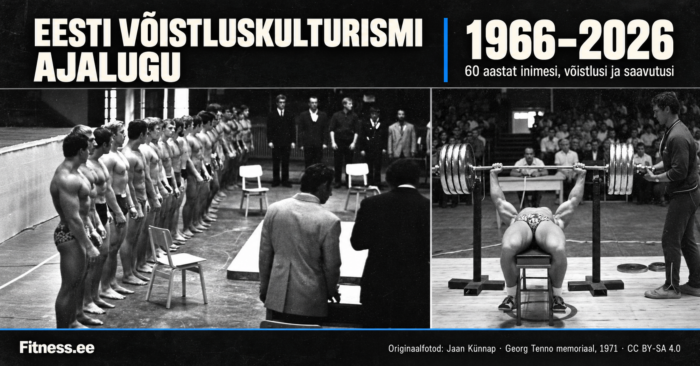
In Estonia, the Georg Tenno Memorial took on special significance, bringing local athletes together with athletes from other regions. Retrospectives give different starting years for the memorial. Jaan Künnap’s photo collection, however, includes pictures dated 1971 from a memorial held at the Kalev Sports Hall. We can therefore speak with confidence of visual evidence surviving from at least 1971, leaving the exact year of the first edition as a question for separate archival research. [7]
Central to the memorial, and more broadly to the survival of bodybuilding in Estonia, was Innar Mardo: a coach, organizer and driving force whose influence reached well beyond the circle of students. Mardo’s work gave rise to continuity in training and competing at a time when the sport had no institutional footing.
The story of Mardo’s student Erlend Lõwi shows that bodybuilding also valued stage skill. Lõwi trained with Mardo from 1975 to 1984 and won free posing at Estonian competitions six times. Lõwi was also a viola player in the Estonia orchestra. In Lõwi’s case, strength training, a musical sense and the performing arts came together in a very concrete way. [8]
Olev Annus: an Estonian-born athlete at the top of the world
- The standout competitor of that decade was Olev Annus. Between 1973 and 1979, Annus won seven consecutive Estonian overall titles. It was the first long reign at the top of Estonian bodybuilding. [9]
In Annus’s international career, origin and competing nation need to be told apart. Annus developed as an athlete in Estonia but continued the career in Finland, so the major international achievements cannot automatically be added to the Estonian national team’s medal tally.
- At the IFBB World Amateur Championships, Annus placed third in the heavyweight class, behind Mike Christian and Berry de Mey. The result is confirmed by the protocol that accompanies the surviving video recording of the competition. [10]
1987 was Annus’s big breakthrough at NABBA. Annus won the overall title at the World Amateur Championships and then the professional Mr. Universe. In the professional contest, Annus beat Jeff King, among others. Annus had thus reached a level where the opponents were well-known names in international bodybuilding. [11, 12]
- Annus won the NABBA World Professional Championships in Austria. This result has to be distinguished from that year’s professional Mr. Universe, which was won by Victor Terra, with Annus third. The claim of a 1991 Mr. Universe win that appears in Estonian retrospective texts does not match the competition result. [13, 14]
Annus’s historical importance lies both in domestic dominance and in showing that reaching world level was possible. Recognizing this does not require mixing up the world titles of different federations, or amateur and professional contests.
The 1980s: more centers and stronger competition
After Annus, domestic competition became more varied. Indrek Otsus won the overall title in 1980 and 1981. Arkadi Aju was the overall winner in 1982 and 1983, and Pavel Kossenko from 1984 to 1989. The participation of athletes from Kohtla-Järve, Narva and Sillamäe is a reminder that Estonian bodybuilding was not just a Tallinn and Tartu sport. The names Boriss Žitinski, Konstantin Zaster, Vladimir Jelufimov and Viktor Tkatšenko, among others, recur in the old protocols. [5, 15]
These competition protocols matter beyond the top places. They show the participation of clubs, towns and different age groups. A history that focused only on athletes who later became known to the public would leave much of the 1980s competition scene in the shadows.
- The Tartu Open was held, and it grew into the tradition of cup competitions. The name Estonian Cup was used in 1988, when Meelis Tõnisson won the overall title. This created a second important domestic competition alongside the championships. [5]
Otsus was one of the most versatile athletes of the era. Otsus began bodybuilding training in 1973, won the junior category at the Georg Tenno Memorial in 1976 and 1977 and the overall title in 1985. Otsus also did well at competitions in Budapest, Nitra and Zvolen. The Estonian championship titles span decades: eight category titles between 1978 and 2005, and three overall wins, the last of them in 1991. [16]
In Otsus’s case, though, the later work as a coach, judge and teacher is at least as important as the medals. Otsus helped turn training based on experience into knowledge that could be passed on to the next athletes and coaches.
The arrival of women: Merike Madar, Kersti Põder and Inna Uit
The start of women’s bodybuilding in Estonia cannot simply be placed in 1990. That was the year of the first Estonian women’s championships, but international competition had begun earlier.
Merike Madar had previously been a member of the Estonian artistic gymnastics team. In 1987 she won a bodybuilding competition in Kaunas in the women’s class up to 57 kg. At the 1989 European Championships in Oslo she placed 12th in her category; Kersti Põder was 14th in the class up to 52 kg. In 1990 Madar won a European Championships gold medal as part of the team free routine. It was an important achievement, but not an individual European bodybuilding title. [17]
In 1990, women’s bodybuilding was contested at the Estonian Championships for the first time, and Kersti Põder became the overall winner. That same year, the Soviet Union Championships were held in Tallinn. Among the Estonian athletes, Ain Paavo and Inna Uit were successful. [2]
Inna Uit came to muscle training from athletics and started bodybuilding in 1989. Her progress was rapid: in 1990 she won the overall Soviet Union title, in 1995 she won the IFBB European Championships, and in 1996 the World Championships. Later she competed as a professional at Jan Tana competitions. [18]
Uit’s world championship title is one of the most important achievements in Estonian bodybuilding. It was a win by an Estonian representative at the highest international level of women’s bodybuilding. Her career also shows that the later success of Estonian women in fitness was preceded by an earlier, powerful generation of women bodybuilders.
The story of these women should not be reduced to the remark that “women joined.” They brought their athletic experience to the sport, shaped stage culture and changed perceptions of who can do strength training and reach competition condition.
1989–1999: our own federation, our own flag and new clubs
- The Estonian Bodybuilders’ Federation was founded. With the restoration of independence, international representation also changed: according to the sports register’s overview of EOC membership, Estonia’s international membership begins in 1991. The founding date of the current organization is, according to the federation’s statutes, 27 November 1997. The organization was originally called the Estonian Bodybuilding Development Society (EKAS) and on 17 March 2002 was renamed the Estonian Bodybuilding and Fitness Federation. These dates must be distinguished from the activity of the earlier federation founded in 1989. The EOC membership overview also gives a date of 9 December for 1997; here, the federation’s statutes are used to determine the founding anniversary. [19, 60]
Ain Paavo embodies the link between the different strength sports. Before bodybuilding he was a successful weightlifter whose career took a new direction because of an injury. In 1990 he won both the individual and the team gold at the European Championships. That same year he became Estonian overall champion. Paavo’s later return to the competition stage at almost 60 gives his story a rare long perspective. [20]
- Indrek Otsus won the overall title at the Estonian Championships in Kuressaare. In 1992, Estonia took part in the European Championships in Ostrava as an independent national team. In the following years, Jaanus Mumm and Marek Kalmus came to the fore: Mumm was overall winner in 1993 and 1996, Kalmus in 1995. [2]
The development of the Elva gym Tonic Club gives a tangible picture of the transition period. According to Kalmus’s recollections, he and Tarmo Noop began renovating the basement rooms in 1991. The gym opened in the spring of 1992. Equipment had to be made by hand, and the club grew on the work of local driving forces. Among those who trained there were Jaanus and Urmas Mumm and Nikolai Krõstaljov. [21]
Kalmus became one of the most prominent competitors of the 1990s and the early years of the following decade. He won repeated Estonian heavyweight titles and overall wins at cup competitions. He also competed successfully in the WFF and NABBA. WFF European and world titles should indeed be named as WFF achievements, not turned into IFBB titles. Kalmus, who died in 2023, mattered to the sporting history of Elva in ways that went beyond his competition results. [22]
- Competitive life in those years had not shrunk into small circles. In 1996 the press covered a cup competition held in Tartu with 30 athletes from eight towns: Tallinn, Tartu, Pärnu, Kohtla-Järve, Narva, Sillamäe, Viljandi and Elva. This contemporary report supplements later recollections with concrete participation data. [23]
Ott Kiivikas and bodybuilding in the new century
Ott Kiivikas won his first Estonian overall title in 1999. A long period followed in which he became the most visible competitor in Estonian men’s bodybuilding. The international milestones of his career include fifth place at the 2004 World Championships, silver at the 2005 European Championships, and the 2016 European title and fourth place at the World Championships. [24]
Kiivikas’s success meant a repeated ability to reach the top in international competition, not just one successful contest. As a public figure and coach, he also made the sport easier to understand for people who had never attended a bodybuilding competition.
Domestic competition, including with Marek Kalmus, played an important role in his development. The rivalry pushed him to look for better condition, but the athletes’ later life paths and achievements must be assessed separately. There is no reason to reduce Kalmus’s role or Kiivikas’s work to their mutual rivalry alone.
The sport also needed organizers in order to grow. Arnold Tokko led the federation during 1997–2017 and was involved in organizing competitions, communication and the preservation of the sport’s history. Fitness.ee became an important platform for training information, competition results and discussion. [19, 25]
Innar Mardo’s memory was carried on by a competition bearing his name. In 2007, the second Innar Mardo Memorial took place in Tallinn, hosting a stage of the Euro Elite Champions Tour. Athletes from ten countries took part, and Dorian Yates attended as patron and judge. Competitions like this brought international bodybuilding in front of the Estonian audience. [26]
The 2000s: fitness grows alongside bodybuilding
The mix of competitive divisions changed in the new century. Women’s fitness joined the program of the Estonian championships in 2001, bodyfitness in 2003, bikini fitness in 2011 and men’s beach fitness in 2013. [27]
In 2001, the first doping tests were taken at the Estonian bodybuilding and fitness championships. This was an important milestone in the sport’s organizational development. Doping control added a practical verification mechanism to the competition rules and made the responsibility of athletes, coaches and the federation more concrete. Later ERR coverage confirms that the federation has carried out regular doping controls since 2001. 2026 marks 25 years since those first samples were taken. The beginning of the testing system should be highlighted in the sport’s history as an event in its own right, rather than treating doping only through later violations. [27, 54]
This change did not mean that bodybuilding disappeared. Athletes gained more options to choose the division that suited their physique, skills and goals. Routine-based fitness highlighted strength, flexibility, acrobatics and stage performance; bodyfitness and bikini fitness used judging emphases different from those of bodybuilding.
In the international system, classic bodybuilding emerged as a distinct division in 2005, with height-dependent body weight requirements limiting the extent of muscle mass. The competitive physique ideal thus gained a clearer framework of proportions and more moderate size. Historical limit formulas must not be presented as unchanging current rules. [28]
In Estonia, classic bodybuilding developed a strong circle of athletes: Taavi Koovit, Imre Vähi, Janar Rückenberg, Raigo and Rain Kuusnõmm and others. This direction broadened the base of men’s international success. The work of coaches, including Fred Antson and Indrek Otsus, helped shape a more systematic approach to preparation.
Koovit’s path helps connect the role models of the 1990s with the achievements of the following decade. The athlete from Kilingi-Nõmme was inspired by photos of Marek Kalmus and Jaanus Mumm in the magazine “Atleet”. He trained independently at Reval-Sport for a long time and began working with Fred Antson in 2007. In 2009 and 2010, Koovit won the European classic bodybuilding title. Team Koovit later formed around him, operating at Sparta and including the Kuusnõmm brothers. In this way, his success did not remain the result of one individual but created an opportunity for others to develop. [57]
In women’s fitness, Liisa Otsus, Kristina Koroljak, Endla Vaher and Natalia Nazarenko-Kiivikas, among others, rose to prominence. Their results must be judged precisely according to their own division: a fitness world championship title is not a women’s bodybuilding world championship title, even though both belong to the history of the same sporting movement. [29]
Tallinn in 2011 and the international peaks of fitness
On 18–21 November 2011, the men’s classic bodybuilding amateur world championships were held in Tallinn, together with the world cups of other divisions. Taavi Koovit won the classic bodybuilding category for up to 180 centimeters. This home title competition showed Estonia’s organizational capability and the level of its athletes. [30]
At the world cup events of the same competition, Ott Kiivikas was successful in men’s bodybuilding, Oleg Anissimov in men’s fitness and Esta Pilt in women’s athletic fitness. These first places must be distinguished from Koovit’s world championship title. The original protocol also notes that the results were awaiting doping control decisions; the preliminary table and the later confirmed final standings may not be one and the same. [30]
At the 2011 classic bodybuilding World Championships, the Estonian national team also won the team gold medal. The difference between the original competition-day scoring and the later confirmed result matters here: after the doping control results were taken into account, Janar Rückenberg moved from fifth place to bronze in the over-180-centimeter category, and Estonia rose to win the overall nations’ standings. The federation’s official medal list confirms the Estonian national team’s world championship gold. Koovit’s individual win and the team gold were two different achievements at the same home championship. 2026 marks 15 years since this team world title. The team’s coach was Indrek Otsus. [29, 61, 62]
Oleg Anissimov was the men’s fitness world champion in 2011. He became one of Estonia’s most successful routine-based fitness athletes and also won world championship gold in 2015 and 2016. Kristina Koroljak became the women’s fitness overall world champion in 2016. Endla Vaher won the European title in 2015. [29, 31]
- saw Estonian competitive bodybuilding mark its fiftieth anniversary. At the jubilee event, Mati Õun and Indrek Otsus presented their book “50 Years of Competitive Bodybuilding in Estonia, 1966–2016”. It was a landmark tribute to the people whose work had kept the sport alive and helped it grow. [32, 33]
The 2013 results also deserve a separate mention. Imre Vähi won the height category and the overall title in classic bodybuilding at the Nordic Championships and placed fourth at the World Championships. The federation named him male athlete of the year. In the same year, Koroljak won the adult fitness gold at the European Championships and the junior European overall title. Esta Pilt won silver in athletic fitness at both the European and World Championships. This picture shows that Estonia’s success was carried by several athletes of different ages competing in different disciplines. [58]
- The federation’s summary for that year shows that 55 athletes took part in the Estonian Championships, 19 of them in the youth or junior divisions; the Cup had 56 participants. Youth groups were active at Reval-Sport, Sparta and Tartu FitLife. These figures describe one specific competition season and are not the size of the whole recreational community. [58]
That same year, Kiivikas also won the Olympia Amateur. The similarity of the names can be misleading: the Olympia Amateur is not the professionals’ Mr. Olympia. Both are important competitions, but their status and field of competitors are different. [32]
Professional competition and new names
In 2014 in Lahti, Egle Eller-Nabi won the overall title in bikini fitness at the Nicole Wilkins competition and earned a pro card. Her first pro competition brought sixth place in Moscow. In 2016 she reached the Bikini Olympia stage. For Estonian bikini fitness, this was a new international dimension. [34–36]
Eller-Nabi was not the first professional bodybuilding or fitness athlete of Estonian origin: Annus and Uit had competed as professionals earlier. Her milestone lies specifically in the professional development story of bikini fitness.
- saw Raigo Kuusnõmm become European champion in men’s bodybuilding up to 75 kilograms. In the same year, Arida Muru won the bikini fitness world title among competitors up to 160 centimeters. These results show that international success was no longer concentrated around a single athlete or a single discipline. [37, 38]
2020–2025: women’s success, a younger generation and new disciplines
In 2020, Tiia Kaare became adult bodyfitness world champion in the category up to 158 centimeters. She also won the junior European title and junior World Championships silver. Her parallel studies in ship navigation at the Estonian Maritime Academy are a reminder that the lives of Estonia’s top athletes do not consist of only the gym and competitions. [39]
- At the Estonian Championships that year, winners included Andrei Abrossimov in men’s bodybuilding, Egert Oiov in classic bodybuilding and Kaspar Tõnisson in men’s beach fitness. Among the women, Tiia Kaare and Liis-Marian Toomse were successful. This is a necessary addition to the story of international medal success: at domestic championships, competition in men’s bodybuilding and related disciplines remained as strong as ever. [40]
- At that year’s fitness World Championships in South Korea, Lilija Utenko and Agne Kiviselg won bikini fitness world titles. Utenko was successful in both the junior and adult divisions and won the junior overall title. Regina Tselik earned silver in artistic fitness and Kaisa Lepik bronze in junior wellness. [41]
- saw Utenko take another step forward, winning the adult overall bikini fitness world title in Santa Susanna. Elisabeth Atamanski and Karoliina Liitmaa also won gold medals. In the junior taller height class, Liitmaa, Emma Haas and Susanna Piigli took the whole podium. [42]
Anastassia Toikka rose to become one of Estonia’s most important wellness competitors. In 2023 she won both the category and the overall world title in the masters division and earned bronze among the adults. The summary of that World Championships published for the Estonian team listed 17 medals. Such a number does not mean 17 different medal winners: the same athlete can compete in several age and competition divisions. [43]
- At that year’s European Championships, Olari Perlin became European champion in classic bodybuilding among men over 180 centimeters. In wellness, Toikka won both her adult height category and masters titles. These achievements indicate that classic bodybuilding and the new women’s disciplines developed side by side. [44]
- At that year’s competitions in Tokyo, Daisi Padumäe, Briana Korniltsev and Mia Mulenok were successful in youth bikini fitness. When reading the summaries of this event, bear in mind that the program included competitions of differing status, including the fitmodel World Cup. Not every medal earned there can be called a World Championships medal. [45]
- At that year’s European Championships, Mari Oks won the women’s physique category and the overall title. This is an important link to earlier women’s bodybuilding: Estonian women’s success is not limited to bikini fitness and fitmodel. Anastassia Toikka, Lyselle Toom, Marta Lember and Jelizaveta Fedotov were also successful. [46]
- saw Mia Mulenok become adult fitmodel world champion among competitors up to 166 centimeters. At the autumn fitness World Championships, Toikka and Susanna Piigli also won world titles, Toikka in wellness and Piigli in junior bikini fitness. [47, 48]
Another development in recent years is the fitness challenge, which measures how athletes perform exercises and their physical work capacity. It brings competitors into the federation’s activities whose results do not depend solely on the physique judged on stage. A historical parallel can be drawn with 1966, when the competition also included strength tests, although today’s rules and goals are different.
2026: the sixtieth year
- At the start of the year, Ott Kiivikas became president of the Estonian Bodybuilding and Fitness Federation again, and Andry Kõre became vice president. Kiivikas was preceded by Ergo Metsla, who led the federation in 2017–2025. The change of leadership once again tied a competitive athlete’s experience to the organization of the sport. [19, 49]
- At that year’s European Championships, 68 Estonian athletes competed and the national team won 31 medal placings. In the country standings, Estonia was second among adults and third among juniors. The new European champions included Anna Kalinina in bikini fitness, Diana Melnyk and Johanna Tilk in fitmodel, and Jonatan Rand in junior men’s fitmodel. In the fitness challenge, Priit Meier, René Laane and the Estonian team were successful. [50]
In the fitness challenge, “bronze level” refers, for example, to the level of the competition, not necessarily to an athlete’s medal. René Laane won the competition at that level. Wording details like this need watching when compiling a history, so that a correct result does not turn into a wrong one in the retelling.
- In September of that year, Christin-Amani Kiivikas won the bikini fitness category for up to 169 centimeters and the overall title in Prague, and earned an IFBB pro card. This can be considered an important milestone for the next generation. At the same time, not every organization’s pro card automatically entitles its holder to compete in the professional Olympia series; when mentioning pro status, the relevant system must always be named. [51]
At the Nordic Championships held in Espoo in September, Estonia collected 20 category medals: nine golds, five silvers and six bronzes. Ramil Lipp won the classic bodybuilding category for up to 180 centimeters and two masters categories, one of them in classic physique. Liis Mirjam Juvas won both the junior and the adult category in bodyfitness. Christin-Amani Kiivikas was successful in bikini fitness and fitmodel; Anita Leilop and Maria Eilonen added wins in the youth categories. This competition confirms that the achievements of 2026 included classic bodybuilding, bodyfitness and the newer fitness divisions side by side. [59]
The Estonian Championships were scheduled for 3 October 2026 at the Salme Cultural Center in Tallinn, marking at the same time the sixtieth anniversary of competitive bodybuilding. When this overview was compiled, the results of that day were not yet known. [52]
The growth in the number of recreational participants and coaches reported by the federation describes the wider environment of the sport, but gym-goers cannot be equated with competitive bodybuilders. Competitive sport is a much smaller part of the overall gym culture, with its own requirements, annual cycle and way of counting results.
The people behind the results
The history of Estonian bodybuilding is also the history of its coaches and organizers. Ervin Liebert and Innar Mardo created the earlier foundation. Indrek Otsus tied his competitive experience to coaching and teaching. Arnold Tokko helped keep the organization, the competitions and the flow of information going for a long time. Oleg Andla was involved in the competitions and in the federation’s day-to-day running. Many club managers, coaches and judges have carried on this work since.
Andla’s role deserves a closer look. In contemporary coverage of the 1996 Cup competition he appears as chief judge, and according to the sports register he was the federation’s secretary general or managing director in 1997–2005. His work thus combined judging competitions with the day-to-day management of the organization. Andla was succeeded in that post by Indrek Otsus in 2005–2017. [19, 23]
Ergo Metsla’s contribution did not begin with becoming president: according to the federation, he worked as vice president from 2002 and as president in 2017–2025. Janika Koch-Mäe was secretary general in 2017–2022 and returned to the post in 2026; in 2022–2025 the role was filled by Aleksandra Laer. Alongside the president, these people who ran the day-to-day work belong in the organization’s history as leading figures in their own right. [19, 49]
The organization’s functioning also includes the work of judges, the evaluation of coaches and children’s fitness. In the federation’s 2026 organizational chart, the judges’ committee is headed by Mari Pukk, the evaluation committee by Betti Trei and the children’s fitness committee by Marit Juurma. This chart describes who is responsible at a specific point in time; these posts are not used to automatically infer the extent of earlier decades’ contributions. Even so, when researching the history of the competitions and of the next generation, these areas of work are just as necessary as the national team’s medal results. [63]
In present-day educational work, Siim Kelner and Sten Põldsamm, for example, are active alongside Otsus. Here lies one of the most important forms of continuity: knowledge that was one athlete’s achievement becomes, through several coaches, other athletes’ skills. [53]
Clubs have played a notable part too. Alongside the earlier Tallinn athletic gymnastics club and Tartu’s competitive scene, Elva Tonic, Reval-Sport, Sparta and many other clubs have carried the sport at different times. Their role is to provide a place to train, spot new competitors, organize preparation and help athletes get to the stage. The federation awards of 2011 and 2016 show how closely international success was tied to specific coaches and clubs. [31, 32]
An honest account of history must also take doping control, disqualifications and later changes to results into account. For example, Estonia’s medal tally from the 2015 European Championships changed after doping proceedings: Oleg Anissimov’s silver was replaced by gold. So when assessing old achievements, the news report from competition day is not always enough. [54]
In sixty years, Estonian bodybuilding has moved from the legacy of strongmen and small athletic gymnastics circles to international competitive sport. The defining events of this story are the start in 1966, the revival in 1970, the overcoming of Soviet-era pressure, Annus reaching the world top, the women’s breakthrough, the chance to represent one’s own country, and the later growth of the fitness divisions.
The historical value lies not only in an ever longer list of medals. It is also carried by the people who taught others to train, built gyms, organized competitions, learned to judge and wrote the results down. Without them, Estonian bodybuilding would have had neither its start in 1966 nor its anniversary in 2026.
The 2026 anniversary year and the next organizational milestone
Alongside the 60th anniversary of Estonian competitive bodybuilding, two more important anniversaries fall in 2026. It is 25 years since the first doping tests at the Estonian Championships, and 15 years since the Estonian classic bodybuilding team won team gold at the World Championships. The first marks the formation of a control system, the second the national team’s shared international achievement. [27, 29, 54, 61]
On 27 November 2027, it will be 30 years since the founding of the current Estonian Bodybuilding and Fitness Federation. This milestone is based on the founding of the organization in 1997, not on the start of Estonian competitive bodybuilding in 1966 or the creation of the earlier Estonian Bodybuilders’ Federation in 1989. The organization began under the name Estonian Bodybuilding Development Society and has carried its current name since 2002. The sport’s anniversary in 2026 and the federation’s anniversary in 2027 can therefore complement each other. [19, 60]
Timeline of key events
| Year | Event or development |
|---|---|
| 1966 | The first contest in Tartu and the start of the Estonian Championships in Tallinn. Arne Heinlaid’s wins. [2, 3] |
| 1968 | Ervin Liebert’s “Athletic Gymnastics” is published. [4] |
| 1970 | Domestic championships resume. [5] |
| 1971 | Photos from the Georg Tenno Memorial are dated to this year. [7] |
| 1973–1979 | Olev Annus’s seven consecutive Estonian overall titles. [9] |
| 1978 | Weight categories are introduced at the championships. [5] |
| 1984–1989 | Pavel Kossenko’s repeated Estonian overall wins. [5] |
| 1987 | Annus’s wins at the NABBA World Championships and the professional Mr. Universe; Madar’s contest win in Kaunas. [11, 12, 17] |
| 1989 | The Estonian Bodybuilders’ Federation is founded. [19] |
| 1990 | The women’s Estonian Championships begin; Ain Paavo becomes European champion. [2, 20] |
| 1991–1992 | International membership is secured and an independent Estonian national team takes shape. [2, 19] |
| 1995–1996 | Inna Uit’s IFBB European and World Championship titles. [18] |
| 1997 | On 27 November the current federation is founded, originally named the Estonian Bodybuilding Development Society. [60] |
| 1999 | Ott Kiivikas’s first Estonian overall championship title. [24] |
| 2001 | The first doping tests at the Estonian Championships; women’s fitness is added to the program. [27, 54] |
| 2002–2003 | The organization takes its current name; bodyfitness is added to the competition program. [19, 27] |
| 2005 | Classic bodybuilding becomes a distinct division internationally. [28] |
| 2006–2007 | The Innar Mardo Memorial and Euro Elite Champions Tour competitions are held in Tallinn. [26] |
| 2009–2010 | Taavi Koovit’s European titles in classic bodybuilding. [57] |
| 2011 | Tallinn hosts the classic bodybuilding World Championships; Koovit wins category gold and the Estonian national team wins team gold. [29, 30, 61] |
| 2013 | Imre Vähi’s Nordic overall win and fourth place at the World Championships. [58] |
| 2014 | Egle Eller-Nabi earns a bikini fitness pro card. [34] |
| 2016 | The sport’s 50th anniversary; Kiivikas’s European title and Koroljak’s overall win at the World Championships. [32] |
| 2018 | Raigo Kuusnõmm becomes bodybuilding European champion and Arida Muru bikini fitness world champion. [37, 38] |
| 2020 | Tiia Kaare becomes bodyfitness world champion. [39] |
| 2022–2023 | World titles for Utenko and Kiviselg; Utenko’s overall win in the adult division in 2023. [41, 42] |
| 2024 | Olari Perlin becomes classic bodybuilding European champion. [44] |
| 2025 | Mari Oksi’s overall win at the European Championships in physique; World titles for Mulenok, Toikka and Piigli. [46–48] |
| 2026 | 31 medal places for the Estonian European Championships team; Christin-Amani Kiivikas’s pro card; the sport’s 60th anniversary. [50–52] |
| 2026 anniversaries | 25 years since the first doping tests at the Estonian Championships and 15 years since the national team’s World Championship gold. [27, 29, 54, 61] |
| 2027 milestone | On 27 November it will be 30 years since the founding of the current federation. [60] |
The timeline highlights selected milestones. It is not a complete medal register and does not replace the distinction between competition classes and organizations explained in the earlier chapters.
Sources and principles of use
This article was compiled by cross-checking historical overviews, competition protocols, biographical reference works, contemporary news reports, interviews, local memoir accounts and organizational materials. The sources used are listed below with web links. For some people the body of sources is considerably larger than for others, so this account is not an exhaustive biographical lexicon of every athlete.
Important clarifications.
- There are conflicting claims about the starting year of the Georg Tenno Memorial. The text treats a photo dated to 1971 as firm evidence, but does not declare it the undisputed first memorial.
- International competition for women began before the 1990 women’s Estonian championships.
- Annus’s 1991 NABBA professional world championship title and his third place at that year’s Mr. Universe are separate results.
- The titles of international federations, competing countries, age groups, categories and overall classifications are kept distinct.
- original protocol for that year was provisional pending doping control. Later coverage and the federation’s medal list confirm Estonia’s team gold.
- The founding date used for the federation is 27 November 1997, as stated in its charter. The 9 December 1997 found in the Estonian Olympic Committee membership overview is a different date entry, and it is not equated here with the charter’s founding date.
- book, a bibliographic record and coverage of its publication were used. The full text of that book was not available. For the earlier history, the 2012 overview available online was used.
- coverage does not include results that became known after the morning of 3 October.
- Ervin Liebert, “Athletic Gymnastics”: the author’s recollection and a description of the book.
- Sports Town Elva: an overview of the history of bodybuilding.
- Fitness.ee history archive: Estonian championships.
- Biographical Lexicon of Estonian Sport: Ervin Liebert.
- Historical overview by Mati Õun and Indrek Otsus, 2012; PDF.
- WFF retrospective article on Soviet-era bodybuilding.
- Jaan Künnap’s photo of the Georg Tenno Memorial, dated 1971.
- Erlend Lõwi: activities and sporting career.
- Fitness.ee history archive: Olev Annus.
- GMV: results and recording of the 1984 IFBB World Championships.
- GMV: 1987 NABBA amateur World Championships.
- GMV: 1987 NABBA professional Mr. Universe.
- GMV competition results archive.
- GMV: 1991 Mr. Universe results.
- Estonian championship results 1978–1989; PDF.
- Fitness.ee: Indrek Otsus’s life story and video interview.
- Indrek Otsus: “Merike Madar – Estonia’s first female bodybuilder”.
- Fitness.ee: an account of Inna Uidi’s life story.
- Estonian Sports Register: Estonian Bodybuilding and Fitness Federation.
- ERR: Ain Paavo’s return to the bodybuilding stage, 2013.
- Elva Elu: the story of how Tonic Club came to be, as recalled by Marek Kalmus.
- Visit Elva: Marek Kalmus’s memory and achievements.
- Postimees: 1996 competition coverage.
- Sport magazine: “Ott Kiivikas – the myth-buster of Estonian bodybuilding”, 2016.
- Fitness.ee: interview with Arnold Tokko.
- Äripäev: the Innar Mardo Memorial, 2007.
- Fitness.ee: historic moments in Estonian bodybuilding and fitness.
- ERR: the formation and development of bodybuilding, 2011.
- EKFL: summary table of athletes’ achievements.
- IFBB: original protocol of the 2011 Tallinn competition; PDF.
- ERR: the 2011 awards for the best athletes.
- ERR: the best of 2016 and the anniversary.
- “50 Years of Competitive Bodybuilding in Estonia, 1966–2016”: bibliographic and sales record.
- ERR: Egle Eller-Nabi’s win in Finland, 2014.
- ERR: Eller-Nabi’s first pro competition.
- Muscle & Fitness: Eller-Nabi at the 2016 Bikini Olympia.
- ERR: Raigo Kuusnõmm becomes European champion, 2018.
- Estonian Olympic Committee: recognition of world champions and coaches, 2018.
- TalTech: Tiia Kaare – ship navigation student and world champion.
- ERR: the Estonian champions of 2021.
- ERR: Utenko and Kiviselja’s 2022 World Championship titles.
- ERR: Estonia’s golds at the 2023 World Championships.
- ERR: Toikka’s 2023 World Championship titles and a medal summary.
- ERR: Toikka and Perlini’s 2024 European Championship titles.
- ERR: summary of the 2024 competition in Tokyo.
- ERR: the 2025 European Championships.
- ERR: Mia Mulenoki’s world championship title, 2025.
- ERR: Toikka and Piigli’s 2025 World Championship titles.
- EKFL: the new leadership in 2026.
- EKFL: results of the 2026 European Championships.
- ERR: Christin-Amani Kiivikas’s win in Prague and pro card, 2026.
- Information on the 2026 Estonian Championships.
- EKFL: instructors.
- ERR: how Estonia’s medals changed after doping proceedings, 2016.
- Biographical Lexicon of Estonian Sport: Arne Heinlaid.
- Fitness.ee history archive: Arne Heinlaid.
- ERR: Taavi Koovit’s training and life story, 2011.
- EKFL’s summary of 2013 results and activities on Fitness.ee.
- ERR: the 2026 Nordic Championships.
- EKFL charter: founding on 27 November 1997.
- Postimees: Janar Rückenberg’s World Championship bronze and Estonia’s team victory, 2013.
- ERR: Indrek Otsus, coach of the 2011 World Championship team.
- EKFL organization: leadership and committees.