Taurine in food: what athletes should know
Taurine in food is a simple topic only at first glance: it is found mainly in animal foods, but an athlete’s needs can change because of training. If you eat meat and fish, you get some of your taurine from your plate; if you are vegetarian or train a lot, it is worth thinking about replenishing your stores too.
Why does taurine in food matter for athletes?
Taurine is often talked about in connection with energy drinks, but it is actually a compound that occurs naturally in the body. The human body can synthesize taurine itself from amino acids such as cysteine and methionine. That does not always mean, however, that the amount is optimal for every person, especially when the training load is high.
The original article pointed out one interesting observation: one possible benefit of taurine for bodybuilders and other athletes was considered to be better heart function during training. This is not a promise that every capsule will make training easy. The point is rather that taurine may be part of a bigger picture that includes food, sleep, fluids and a sensible training plan.
A study was carried out only recently that tested the effect of Red Bull, an energy drink containing taurine, on 13 endurance-trained athletes. It was noted that Red Bull increased the amount of blood pumped by the heart by nearly 21%, while caffeine alone did not produce the same effect. This result should be read with caution: Red Bull is not the same thing as a pure taurine supplement, because the drink also contains other substances and a lot of sugar.
How does taurine work in the body?
During and after training, the amount of taurine in the body is linked to muscle work. Athletes lose taurine through sweat and urine. That sounds fairly mundane, but hard training does add work for the body’s internal environment.
If a taurine deficiency develops, it may disrupt fat metabolism. A simple truth: when the stores of some necessary compound in the body are low, recovery from training and energy use may not run as smoothly as you would like. That does not mean taurine in food is a cure-all. It means it has its place in sports nutrition.
In addition to supporting heart performance in trained athletes, taurine has also been linked to better competition results. According to the original text, the effective amount was 2-6 grams per day. It also mentioned enlarging muscle cells, but that claim should be treated with restraint: the foundation of muscle growth is still consistent strength training, adequate energy and protein.
Taurine in food: where do you actually get it?
Taurine is found only in meat and fish. According to the original article, it is not found in eggs or plant foods. This is exactly why taking taurine as a supplement is especially relevant for vegetarian athletes whose menus lack the main natural sources.
If you eat a normal mixed diet, taurine does not have to be the first thing you worry about. First check that your daily protein intake, meal rhythm and recovery from training are in order. If your menu is restricted or you have many training sessions, the taurine question becomes more practical.
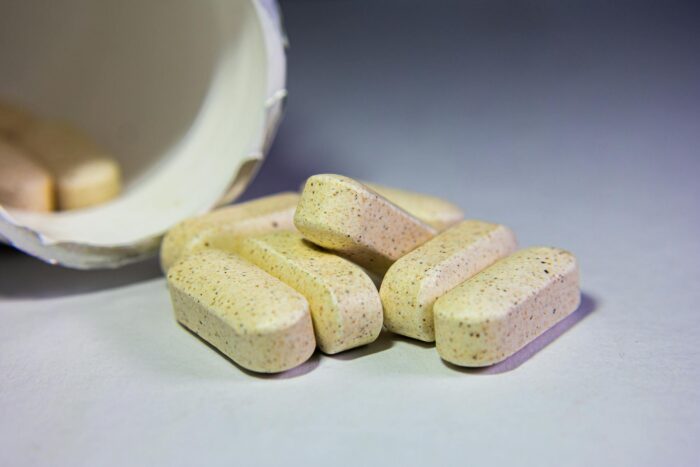
Taurine supplements are generally available in 500 mg capsules. It has also been added to many energy drinks. One laboratory study found that one can of Red Bull contains 983 mg of taurine, giving it a strong stimulating effect compared with caffeine, but it also contains a lot of sugar. That last part is important. If the goal is recovery or a better training rhythm, a sugary drink is not always the best solution.
Practical tips for using taurine
On dosing, the original article repeats the range of 2-6 g, i.e. 2-6 thousand mg of taurine per day, for achieving an energy-boosting effect. It also notes that as little as 500 mg – 1g may be enough to maintain good physical health. You should not keep raising these numbers on your own. More does not automatically mean better.
Honestly, the most sensible approach is simple: start with your menu. Once you train regularly, sleep enough, drink water and eat real food, only then does a supplement make sense. Taurine may suit those who do a lot of endurance training or strength training, or whose menu contains no meat or fish.
When using an energy drink, always look at the whole picture. It may contain taurine, but also caffeine and sugar. If you take Red Bull before training, you may feel energized, but that does not yet tell you whether your body got what it needed for recovery.
FAQ: taurine in food and as a supplement
Is taurine in food suitable for vegetarians?
According to the original article, taurine is not found in plant foods. A vegetarian athlete may therefore be one of those who should consider taurine as a supplement.
Is Red Bull a good source of taurine?
One can of Red Bull contains 983 mg of taurine, but the drink also contains caffeine and a lot of sugar. So it is not the same as a separate taurine capsule.
How much taurine should you take per day?
The original text mentions a range of 2-6 g per day, and a smaller amount, 500 mg – 1g, to support general physical health. If you have a health concern or take medication, ask a specialist for advice first.
Author: Muscle&Fitness, translated by K.Reial
Source: Turg.Fitness.ee
Come and train! ArtGym