At a glance:
- Adjustable dumbbells replace dozens of fixed-weight dumbbell pairs, saving both space and money.
- The weight range you need depends on your training experience: up to 20–30 kg for beginners, and 40 kg or more for more experienced lifters.
- The main adjustment mechanisms are dial systems (quick weight changes) and traditional plate-based systems (durable).
- ACSM recommends progressive overload to develop muscular strength — this is only possible if you can adjust the weight.
Adjustable dumbbells are the most space-efficient staple of a modern home gym — one pair can potentially replace up to 15 different pairs of fixed-weight dumbbells. Before buying, though, it is worth understanding which features actually affect your training results.
Why choose adjustable dumbbells over regular dumbbells?
Adjustable dumbbells give you the flexibility to move from light warm-up weights to heavy strength training loads with a single piece of equipment. According to the American College of Sports Medicine (ACSM) progression model, developing muscular strength and hypertrophy requires training load to increase systematically over successive training cycles — this is known as the principle of progressive overload (ACSM, 2009). Fixed-weight dumbbells cannot offer this flexibility without a substantial financial investment.
Practical advantages over fixed-weight dumbbells:
- Space: one base replaces an entire dumbbell rack
- Long-term cost: one adjustable set often costs less than 5–6 separate pairs of dumbbells
- Progression: you can increase the weight in small increments (usually 2.5–5 kg), a fundamental principle of strength training (Kraemer & Ratamess, 2004)
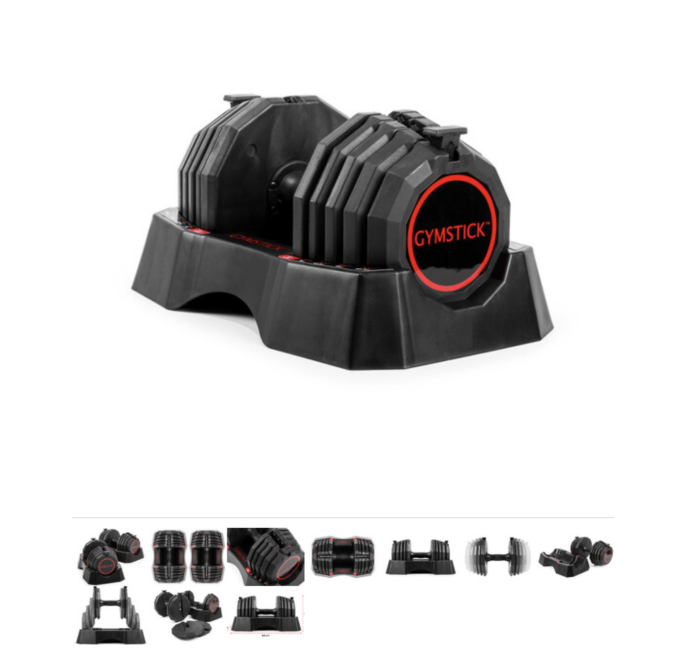
For an overview of specific products available in Estonia, read more here: https://www.popsport.ee/reguleeritav-hantel-gymstick-quick-lock-dumbbell-4-5-22-5kg
How much weight do you need in an adjustable dumbbell set?
Choosing the right weight range depends mainly on your training experience and goals. For general strength training progression, ACSM recommends 60–70% of one-repetition maximum (1RM) for beginners, 70–80% 1RM for intermediate lifters and up to 85%+ 1RM for experienced athletes (ACSM, 2009).
Practical guidelines for choosing a weight range:
| Training profile | Recommended maximum weight (one dumbbell) |
|---|---|
| Beginner (female) | up to 20 kg |
| Beginner (male) | up to 30 kg |
| Intermediate lifter | 24–40 kg |
| Experienced athlete | 40 kg or more |
The Estonian Health Board’s physical activity recommendations emphasize that adults should do muscular endurance training at least twice a week, targeting all major muscle groups. An adjustable dumbbell set with even a moderate weight range is enough to achieve this goal.
What types of adjustable dumbbells are available?
There are three main adjustment mechanisms on the market, each with its own strengths.
Dial system: You turn a dial at the end of the dumbbell to select the combination of weights that lifts out of the base. Advantages: quick weight changes (2–5 seconds), compact design. Disadvantages: mechanical complexity can lead to wear with intensive use; higher price.
Traditional plate system: Removable weight plates are secured to a bar with a locking collar. Advantages: very durable, easy to repair, lower price. Disadvantages: slower weight changes, less suitable for supersets.
Selectorized block system: The dumbbell sits on a base, and you select the desired weight using a pin. The most popular type for home use. Advantages: convenient, stable in its base. Disadvantages: a larger footprint requires more space.
How do you choose adjustable dumbbells for your training needs?
The buying decision comes down to five key criteria.
1. Weight range and increments. Ideally, weight increments should be 2–2.5 kg to allow steady progression. Research confirms that muscle mass increases most effectively when the training load is 67–85% of 1RM and the rep count is within the 6–12 range (Schoenfeld, 2010).
2. Materials and durability. Cast iron is the most durable option; rubber-coated plates protect the floor and reduce noise. The handle should have a textured surface — a secure grip when you are fatigued reduces the risk of injury.
3. Speed of weight changes. If you plan to do supersets or circuits, sets with a quick adjustment mechanism (dial type) are considerably more convenient than traditional plate systems.
4. Ergonomics. The dumbbell’s diameter and length should suit your hand size and range of motion. A dumbbell that is too long restricts the shoulder joint’s range of motion during lateral raises.
5. Budget and long-term value. A quality adjustable set costs 150–400 euros — often less than buying 8–10 separate fixed-weight pairs. For comprehensive training planning, we also recommend reading creating a training program: a complete guide to understand how to use dumbbells as part of a structured progression.
Are adjustable dumbbells suitable for every type of training?
Dumbbells are suitable for most strength and functional exercises: biceps curls, shoulder presses, chest presses, dumbbell squats, dumbbell bench presses and deadlifts. Research shows that free-weight exercises activate proprioceptive mechanisms more extensively than machine training, supporting the development of intermuscular coordination (Kraemer & Ratamess, 2004).
Dumbbell training is especially effective when combined with evidence-based nutrition. Find out more here: Supplements for athletes.
The World Health Organization’s (WHO) 2020 physical activity guidelines recommend that adults do muscular endurance exercises at moderate to vigorous intensity at least twice a week, targeting all major muscle groups — a goal that is entirely achievable with an adjustable dumbbell set at home.
References
- American College of Sports Medicine (2009). American College of Sports Medicine position stand. Progression models in resistance training for healthy adults. Medicine & Science in Sports & Exercise, 41(3), 687–708. PMID: 19204579
- Kraemer WJ, Ratamess NA (2004). Fundamentals of resistance training: progression and exercise prescription. Medicine & Science in Sports & Exercise, 36(4), 674–688. PMID: 15064596
- Schoenfeld BJ (2010). The mechanisms of muscle hypertrophy and their application to resistance training. Journal of Strength and Conditioning Research, 24(10), 2857–2872. PMID: 20847704
Frequently asked questions
What weight should beginners start with when using adjustable dumbbells?
If you’re a beginner, start with 5–10 kg dumbbells and increase the weight in 2–2.5 kg increments once you can complete three sets of 12 reps at your current weight with good form.
Are adjustable dumbbells safe?
Yes, provided the mechanism is in good working order and the weight is securely locked in place before you begin the exercise. Before each set, check that the plates or pin are in place, and do not use equipment with a worn locking mechanism.
How long do quality adjustable dumbbells last?
Plate-based sets last over ten years; dial mechanisms may wear out after 3–7 years of intensive use, depending on the quality of the materials used by the manufacturer.
Can you train your whole body with dumbbells?
Yes. Dumbbells are suitable for upper-body exercises (presses, rows, and exercises for your shoulder and arm muscles) and lower-body exercises (dumbbell squats, lunges, Romanian deadlifts), giving you a full-body workout.
How many dumbbell sets do you need for a home gym?
For most people, one adjustable dumbbell set with a wide weight range is enough to cover all the weights you need for both warm-ups and your main workout.
Order an adjustable dumbbell HERE
Come work out! ArtGym