Alcohol and training: what you need to know
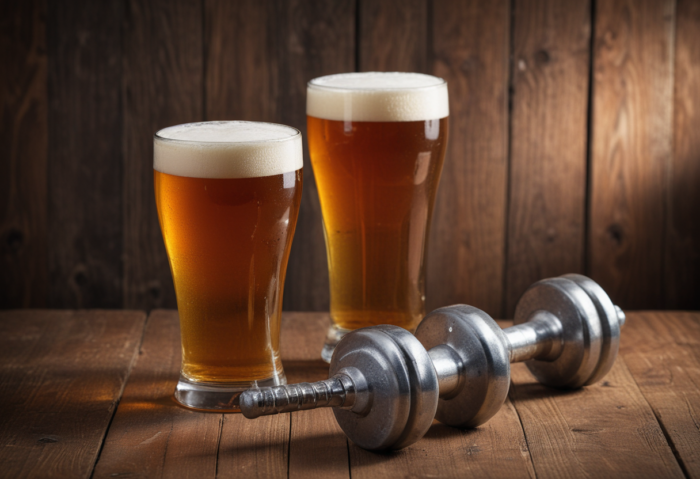
Alcohol is a constant source of debate among fitness enthusiasts. Is one beer after training okay? Does a weekend of partying undo all your hard work? The answer isn’t black and white — but there are a few facts worth knowing before you raise that glass again.
What does alcohol do to your body?
Alcohol affects the body on several levels — and not only the morning after. For an athlete, the most important is its hormonal effect, which begins within hours and continues for days after you’ve stopped drinking.
In both women and men, alcoholic drinks raise the level of estrogens — female sex hormones — in the body. Even a few sips are enough to make estrogen levels rise briefly. A single, rare occasion is not a problem. But drinking beer every evening keeps the body in constant hormonal stress: it starts to retain water, and fat accumulates differently than before. In some cases, fat begins to be stored in exactly the areas where it is typically found in women — the hips and thighs. For bodybuilders, this is clearly bad news.
That is why bodybuilders should avoid regular parties. Not because a single night out would be a catastrophe, but because the habit is what actually does the damage.
Alcohol and hormones: estrogen and testosterone
The rise in estrogen levels is only half the problem. At the same time, drinking alcohol lowers testosterone levels — through two mechanisms at once. First, alcohol increases the amount of testosterone-binding proteins in the blood, which means the free, active testosterone decreases. Second, alcohol reduces testosterone production overall.
Testosterone is the main hormone driving muscle mass growth. When its level drops, muscle progress slows too. Short-term spikes in estrogen — even after a single evening of drinking — can disrupt smooth muscle development. That doesn’t mean one drink wipes out a whole month of your work. But over the longer term, these short hormonal fluctuations add up and make themselves felt.
So what actually happens? Every time alcoholic drinks enter your system, your body has to deal with processing them — and hormones take time to recover. Regular drinking means your body never gets the chance to recover fully.
How much alcohol is too much for an athlete?
The Health Protection Agency recommends that women drink no more than one drink a day and men no more than two. These are general health recommendations, not sport-specific ones.
For a bodybuilder, the recommendation is stricter: no more than one alcoholic drink a day. That amount is still beneficial for the heart, yet harmless for muscles and hormonal processes. Beyond that level, you enter territory where the effect on muscle progress becomes noticeable.
A simple truth: if you can give up desserts, fatty fried dishes and other tasty foods that work against your bodybuilding goals, giving up alcohol — or keeping it within reason — shouldn’t be any harder.
Honestly: most people don’t lose muscle mass because of one party. They lose it when partying becomes a weekly habit, recovery drags on through the weekend and training gets skipped.
FAQ
Does drinking alcohol cancel out muscle growth completely?
Not once. Regular drinking every evening does, though — it keeps the ratio of testosterone to estrogen constantly out of balance, and your body can’t build muscle effectively.
Do men and women react to alcohol differently?
Both sexes experience a rise in estrogen levels and a drop in testosterone, but the strength of the effects varies. For men, the drop in testosterone is especially significant, since this hormone is more critical to their muscle progress. In both cases the same principle applies: rare, moderate drinking does little harm to the body.
Does a weekend party ruin a week of training?
As a one-off — no. But if the pattern is a night out on Friday, suffering on Saturday and recovering on Sunday, you end up with less effective training time every week. In the long run, it catches up with you.
Find good alcohol here: https://www.apricot.ee/
Author: Mikk-Alvar Olle (transl. Flex)
Source: WHO – physical activity.
Come and train! ArtGym