
Amino acid guide for training and food
The topic of amino acids gets confusing fast if you start straight in with powders and complicated names. The simple truth: protein is made up of amino acids, and for anyone who trains, what matters is understanding which ones you have to get from food and which ones the body can make itself.
Why does knowing about amino acids matter at all?
When you eat eggs, quark, fish, meat, beans or lentils, the body doesn’t use the protein as a whole. Digestion breaks it down into smaller pieces. Those pieces are amino acids.
The old-school explanation says protein is made up of 22 amino acids. Of these, 9 are essential, 11 are nonessential and 2 are conditionally essential. The most important difference is a simple one: essential amino acids must come from food. The body can make the others itself under the right conditions.
From an exerciser’s point of view, this isn’t just textbook knowledge. Amino acids are involved in muscle recovery and in building enzymes, hormones, antibodies, blood and connective tissue. If your protein intake is low or your diet is very one-sided, recovery can drag on. You get the workout done, but the body can’t get hold of the building materials.
Honestly, not every recreational exerciser needs to know all the names by heart. But knowing the basics does help you judge whether your plate has enough complete protein or whether it’s all just nice packaging.
How do the amino acid groups work?
Among the essential amino acids, the ones talked about most in the gym are the branched-chain amino acids, or BCAAs. These are isoleucine, leucine and valine. They are linked to muscle protein synthesis, and during training the muscle can also use them as an energy source.
The original article pointed out that as much as 40% of muscle is made up of these three amino acids. Take that figure as emphasis, not as a reason to overthink every bite. If you regularly eat protein-rich foods, you usually get BCAAs from them already.
Isoleucine is linked to hemoglobin production and tissue repair. Valine supports the cooperation between the nervous system and muscles. Leucine is well known in training circles because it gives the muscle-building process a strong signal. Together, these three are especially important while the body is recovering from training load, illness or injury.
The other essential amino acids are practical too, even though they get talked about less. Lysine helps with calcium use, collagen formation and the work of antibodies. Methionine is linked to fat metabolism, liver function and the condition of hair, skin and nails. From phenylalanine, the body can make tyrosine, which is used to produce substances involved in mood and metabolism.
Tryptophan is a precursor of serotonin and melatonin. That’s why it is associated with sleep, relaxation and appetite control. Histidine is especially important in children’s development, but in adults too it takes part in processes involving hemoglobin and red and white blood cells.
Nonessential amino acids are no less important
The word “nonessential” can sound like “unimportant”. In reality it only means that the body can make them itself. Alanine helps carry amino acids to the liver, where they can be turned into glucose when needed. Arginine is linked to nitric oxide, which affects the widening of blood vessels and blood flow.
Aspartic acid and glutamic acid affect nervous system function. Glutamine is one of the best-known amino acids tied to recovery, and according to the original text it makes up about a third of muscle protein. Glycine is a simple but very necessary amino acid, because among other things creatine and collagen depend on it.
Cysteine supports antioxidant defense and is important for skin and hair. Proline helps keep tendons and joints strong by way of collagen. Serine takes part in fatty acid metabolism and in protecting nerve cells. Taurine is linked to the rhythm of heart and muscle function. Tyrosine is a precursor of adrenaline, noradrenaline, dopamine and thyroxine.
Ornithine and citrulline are interesting in their own right, because they aren’t usually treated the same way as the amino acids you get from food. Put simply, they take part in protein metabolism and the urea cycle.
Sources of amino acids in everyday food
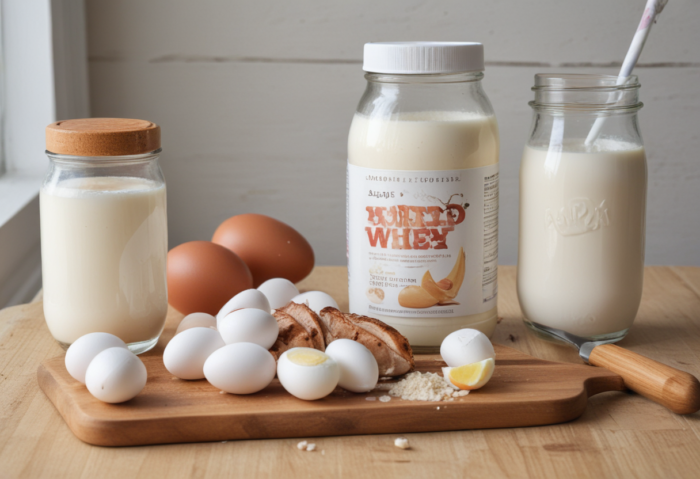
If your goal is to build muscle or recover better from workouts, start with ordinary food. Whey protein, dairy products, chicken eggs, meat and poultry are good sources of BCAAs. Soy protein, beans, lentils and peas work well for people who eat fewer animal-based foods.
You get lysine from soy protein, dairy products, beans and lentils. Methionine is found in cheese, meat, fish and beans. Phenylalanine comes from cheese, meat and poultry. Tryptophan is found in dairy products, turkey, seeds and nuts. Sources of histidine are soy protein, peas, beans and fish.
So what actually works? A plate with a decent protein source at every meal. For example, eggs or quark in the morning, fish or chicken at lunch, legumes or meat in the evening. If you eat more plant-based, combine different sources: beans, lentils, whole grains, soy and nuts together give you a much more complete amino acid profile than any single food.
Practical amino acid checklist
Don’t start with a single amino acid. Start with your daily protein intake and a varied diet. Once those are in place, your amino acid intake is usually taken care of too.
Look at recovery as well. If your sleep is poor, your eating is haphazard and your workouts keep getting harder, no single name on a tub will save you. Your body needs sleep, energy, protein and time all at once.
Supplements can be convenient, especially on a busy day or after a workout, but they don’t replace real food. If your menu is very limited, it’s worth checking whether you’re getting enough complete protein before you buy individual amino acids.
FAQ
Are amino acids the same as protein?
Not quite. Protein is made up of amino acids. During digestion, your body breaks protein down into smaller components and uses them for building muscle and other tissues, and for the work of enzymes, hormones and the immune system.
Do I need BCAAs if I eat enough protein?
If you eat enough high-quality protein every day, you usually get isoleucine, leucine and valine from food already. BCAAs can be convenient, but they aren’t the foundation your whole nutrition should be built on.
When should I think more about amino acids?
When your diet is restricted, your recovery is poor or your training load is high. First check your protein sources and meal rhythm. Only then does it make sense to look at individual amino acids.
Translated from Body magazine
Author: Greta
Source: Turg.Fitness.ee
Come and work out! ArtGym




