
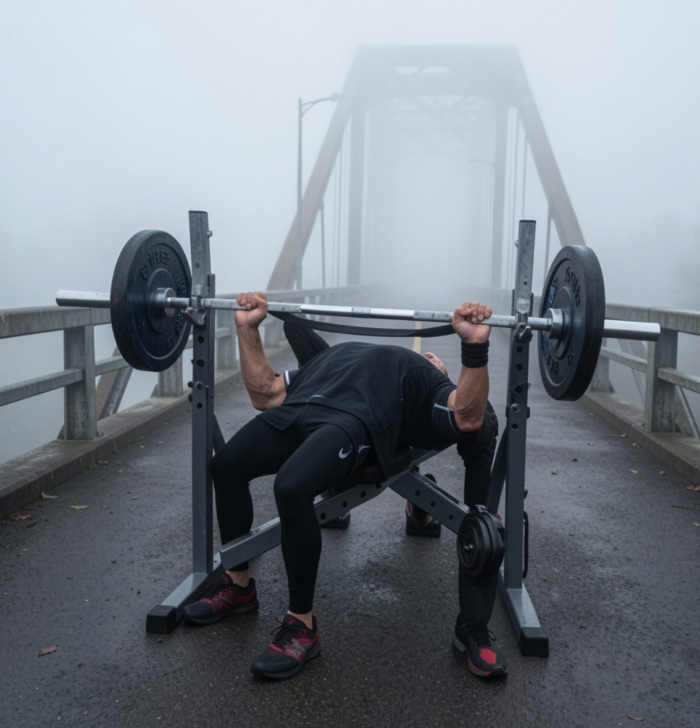
Bench press arch: should you use it?
The bench press arch is a topic that quickly divides opinion in the gym. One lifter says you can’t get a heavy barbell up without it. Another just wants to build chest muscle and honestly asks: do I need it at all?
Why does the bench press arch matter?
The question isn’t whether the arch is good or bad. The question is your goal. For a powerlifter, the bench press is a competition lift where what counts is the weight pressed up according to the rules. For a bodybuilder or a regular gym-goer, the same exercise is usually a tool for developing the chest muscles.
These are two different games. Each has its own logic.
If the goal is the biggest possible number on the barbell, the arch can be very useful. Your body position changes, your chest rises higher and the barbell path gets shorter. The shorter the range of motion, the easier it is to press a heavier weight under control.
But here’s the catch. The same technique can reduce the work the chest muscle does. More of the load shifts to the triceps, the shoulders and the top part of the press. That’s why a big bench press result doesn’t automatically mean big chest muscles. You see it in the gym all the time: some guy presses a lot, but his chest isn’t his strongest point. Someone else has a well-developed chest even though their max won’t make anyone gasp.
How does the arch change your technique?
The point of the arch is to make your body more rigid and the press more economical. The shoulder blades are pulled together on the bench, the chest rises, the legs help keep the body tight and the barbell travels a shorter path. A competing powerlifter uses this deliberately. The aim is to press so that the technique meets the rules and the weight goes up.
From the point of view of building chest muscle, the picture is different. The chest muscle usually gets more work when the range of motion is sufficient and the barbell moves down and up under control. When the arch becomes very big, the barbell reaches the chest by a shorter route. There is less of the lower phase. That is often exactly where the chest gets the most noticeable training load.
You can compare this to board presses. Powerlifters sometimes place boards (or blocks) on the chest to train a specific part of the press, such as the upper range, known as the lockout. That’s useful if the goal is to fix a weak point in the lift. But it’s not the same thing as loading the chest muscle fully and calmly.
A simple truth: the more you change an exercise in favor of moving the weight, the less it may serve the goal of building muscle.
The arch and building chest muscle
If you train mainly for chest muscle mass and shape, there’s no need to chase a big arch. A small natural curve in the lower back is normal. Your hips don’t need to fly off the bench and your back doesn’t need to be arched as if for a competition attempt.
Many regular gym-goers go wrong right here. They see that the arch lets them put more weight on the barbell. Then comes the feeling that more weight surely means better muscle growth. Not necessarily. If the movement gets shorter, control gets worse and the chest does less work, the weight may go up, but the point of the training is lost.
The same logic applies to other exercises. If you start swinging your body in pull-ups, you may get more repetitions, but your lats may not get better work. Squatting is the same story: a powerlifting-style squat helps you lift a big weight, but it isn’t always the best way to maximize leg muscle growth.
That doesn’t mean powerlifting technique is wrong. It means technique has to serve the goal.
Practical technique without an exaggerated arch
A regular gym-goer can take one very useful thing from powerlifters’ technique: protecting the shoulders. If the classic bodybuilding-style press, where the upper arms are flared wide to the sides and the barbell travels toward the neck, hurts your shoulders, keep your upper arms at roughly a 45-degree angle to your body.
This position is friendlier to many shoulders. You can still train the chest as long as you keep the movement under control and don’t turn the exercise into nothing more than a hunt for record weight.
A good starting point is simple. Pull your shoulder blades together on the bench. Keep your chest slightly raised. Keep your feet firmly on the floor. Lower the barbell under control. Don’t bounce it. Don’t lift your hips off the bench just to somehow rescue that last centimeter.
If you want to get better at powerlifting, learn the arch deliberately and within the rules. If you want to build chest muscle, keep the arch moderate and focus on whether your chest is really working.
FAQ
Is the bench press arch cheating?
No, not if it meets the rules of the sport. In powerlifting, the arch is a permitted part of the technique. In regular training, whether it makes sense depends on your goal.
Can you build your chest without an arch?
Yes. For building chest muscle, a controlled movement, sufficient training volume and consistent progress matter more than a very big arch.
When should I use an arch?
Use a bigger arch when you are deliberately training the powerlifting bench press. If you train for general fitness or for chest muscle, a small natural curve is usually enough.
Author: Janar Rückenberg
Source:Turg.Fitness.ee
Come and train! ArtGym




