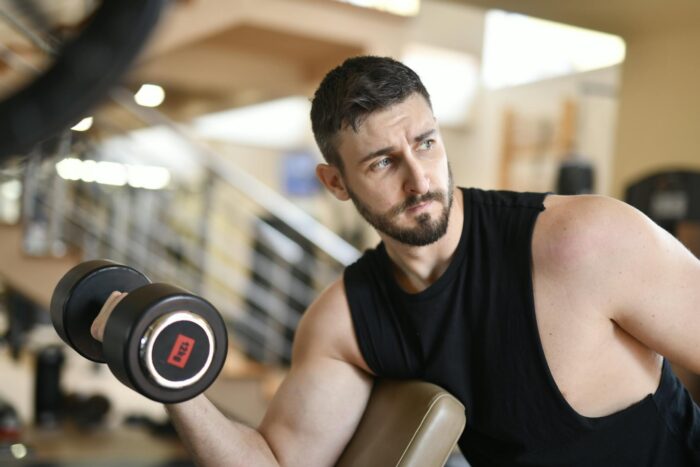
Big arms: Mark Dugdale’s biceps training
Big arms aren’t built by tossing in a couple of careless biceps sets at the end of every workout. Mark Dugdale’s idea is simple: the weight has to be heavy, every repetition controlled, and the set tough enough to genuinely put the muscle to work.
This article draws on an old FLEX piece in which pros talked about how they force their biceps to grow. Take it as a training idea, not a sacred rule. Experiment, pay attention to how it feels and keep your form honest.
Why big arms need a clear plan
The biceps is a small muscle, but it’s often trained with big mistakes. The weight is too heavy, the body starts to sway, and in the end the back, the shoulder or momentum does the work. In the mirror the exercise looks impressive, but the biceps doesn’t get the tension it needs to grow.
Mark Dugdale approached it differently. For him, heavy weight mattered, but not at any cost. Once the form of an exercise falls apart completely, the point is lost. That is exactly what separates hard training from simply throwing weights around.
Honestly, there’s a good lesson here for the ordinary gym-goer too. You don’t have to train like a pro bodybuilder, but you can use the same principle: choose an exercise, set the repetitions and do every set in a way that leaves the muscle nowhere to hide.
How big arms grow the Mark Dugdale way
Dugdale used the so-called “down-the-rack” style. In barbell biceps curls, he started with 200 pounds (approx. 90 kg) and dropped the weight in 20-pound steps. Rest was short: only as long as it took his training partner to strip the weight down.
So what actually happens? The muscle keeps receiving a new training load, but you never get to recover fully. That makes the set dense and painful. It doesn’t mean you can give up on technique, though. No matter how heavy the weight, clean execution of the exercise stays important.
As a second technique, he used the biceps machine. There he chose a weight so heavy that he could do only three repetitions on his own. During the last repetition, his training partner pushed the weight down to add extra resistance in the negative phase. This is an advanced technique, because the muscle and tendons are put under a heavy training load.
The third exercise was the cable crossover. Dugdale described it as if you were hitting a biceps pose. Both cables are pulled at the same time and heavy weights are used. In his view, it worked more deeply than simply chasing a high rep count.
Repetitions and tempo
Dugdale said that six repetitions is ideal for growth in his case. When the repetitions go much higher, other muscles start to do more of the work, he said, and the target muscle doesn’t get the same strong tension.
His shock training meant fast sets, heavy weights and low repetitions. Every repetition, whether strictly controlled or not, moved with the same intent: weight up fast, down slowly and with resistance. A simple truth: the lowering part isn’t a break, it’s work.
A practical biceps plan and what to watch for
The original plan was meant to be used for a limited period. The text said: USAGE PERIOD 3 MONTHS. That doesn’t mean you should chase the maximum with the same pain in every workout for 3 MONTHS straight. Rather, use it as a block during which you keep an eye on recovery, how your elbows feel and the quality of your performance.
- Down-the-rack barbell biceps curls 5 x 6-8
- Biceps machine 2 x 3
- Between two cables 2 x 6-8
If you try this plan, start sensibly. “Heavy” doesn’t mean the first time has to be the heaviest weight of your life. Find a level where you can keep the biceps under tension and your wrists don’t bend into an uncomfortable position.
A training partner is a big advantage here. They help take weight off, watch the tempo and keep you honest. If you train alone, use a safer option: reduce the weight with plates or dumbbells prepared in advance, and don’t push forced negative repetitions past your limit.
FAQ: big arms and biceps training
Is this plan suitable for beginners?
Not in this form, if you’re a true beginner. First you should be able to do curls without using body momentum. Once your technique is in place, you can use the same logic with a lighter weight.
Are six repetitions always best?
No. Dugdale found that six repetitions worked for him. For you, a slightly higher or lower rep count may work better. What matters is that the set is tense and controlled.
How often should you do this kind of shock training?
Use it in periods rather than every week all year round. If your elbows ache, your strength drops or recovery drags on, reduce the training load.
To be continued …
Author: joker
Source: WHO – physical activity.
Come and train! ArtGym