
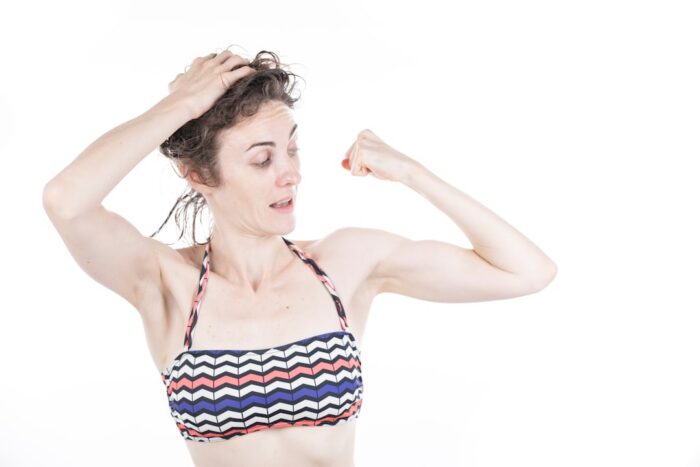
Bikini fitness: how to prepare for the stage
Over the past ten years, bikini fitness and beach fitness have become a sport in their own right in Estonia. If the idea of stepping onto a stage feels like a distant dream, the road there is actually clearer than many people think — all you need is a plan, patience and an honest look at yourself in the mirror.
This article sums up what the first competition season holds for a beginner: how long preparation takes, what changes in your training and on your plate, and when it’s worth bringing in a coach.
What is bikini fitness and who is it for?
Bikini fitness is a women’s category that rewards a soft, athletic look — visible abs, but without harsh vascularity. The goal is a feminine silhouette: light shoulders, a narrow waist, rounded glutes. Beach fitness is the men’s counterpart, where instead of a bulky bodybuilder look, an athletic and symmetrical physique is expected. In both cases your time on stage is short, but the judges’ gaze is merciless.
Who is it for? Honestly, anyone who is ready to live in a structured rhythm for half a year to a year. Genetics gives an advantage — someone with long legs and a naturally narrow waist can reach the same result with less effort. But discipline does most of the work. If you’ve never trained consistently in a gym before, it’s worth spending about half a year simply on base training before you think about competing. Without muscle mass, there’s nothing to shape later.
How to start preparing for bikini fitness
The first step is an honest assessment of your starting point. You measure your body composition (body fat percentage, muscle mass), take photos from the front, side and back, and mark the competition date in your calendar. From there you count backwards: 16–20 weeks before the competition the so-called diet phase — the final stage of getting into shape — begins, and the time before that is for building muscle mass.
Training plan
A typical beginner schedule looks something like this: 4–5 strength training sessions a week, with the emphasis on glutes, shoulders and back muscles. For women, this means plenty of variations of squats, sumo deadlifts, lunges and shoulder raises. Men’s beach fitness calls for a more balanced approach — a wide back, a solid chest and a visible midsection. In the main lifts (squat, deadlift, press) you do 4–6 repetitions with heavier weights, and in isolation exercises 10–15 repetitions.
Cardio is added gradually. At first, two 20-minute sessions a week are enough; in the final weeks this can rise to 5–6 sessions. Long cardio added too early eats into your muscle mass before the diet has even begun.
Nutrition
A simple truth: you don’t get into competition shape by starving yourself. Bikini fitness prep starts with enough protein (about 1.8–2.2 g per kilogram of body weight), carbohydrates are adjusted to your training volume, and fat is kept within a reasonable range. Calories come down gradually — a couple of hundred calories a month, not a thousand at once. Too harsh a deficit burns as much muscle as fat, and it shows clearly in the mirror.
The number of meals is a matter of taste. Some people prefer 5–6 smaller meals, while others do perfectly well on three larger ones. What really counts is the weekly total and consistency. Constant weighing and keeping a food diary, at least during your first prep, is almost mandatory — eating by eye stops working once your body fat percentage gets close to single digits.
Stage, posing and the final week
One thing beginners underestimate is posing. The judges see you for only a few minutes, and half a year of work can be undone by a single misplaced heel. It’s worth taking posing lessons no later than eight weeks before the competition, so the movements are in your muscle memory. In bikini fitness the movement is soft and feminine, in beach fitness it is laconic and linear — the two must not be mixed up.
The final week — the so-called peak week — is a science of its own. Water and salt manipulation, carbohydrate loading, applying tan. As a beginner, don’t experiment with this on your own. An experienced coach, or at least a mentor who has been on stage themselves, is invaluable in this phase.
The video below gives you a picture of what the stage looks like and what the judges are looking for:
https://www.youtube.com/watch?v=9bYqfn8IXRo
FAQ about bikini fitness
How long does preparation for a first competition take?
If you already have a couple of years of consistent training behind you, 16–20 weeks. If you’re starting from scratch, count on a year or more — the first months go into building muscle mass, and only then comes the shaping phase.
Can you compete in bikini fitness without a coach?
Technically, yes. In practice, a coach is almost essential in the first season — especially for the final weeks and for posing. Later on you can manage on your own, once the experience of the first time is clear.
How much does it all cost?
In Estonia, a realistic budget is several hundred euros a month: gym membership, coaching sessions, food costs and the competition entry fee. Tan, costume and shoes add another couple of hundred euros in the end.
Author: Sparta Spordiklubi
Come and train! ArtGym




