
Bikini fitness: what the sport really demands
Bikini fitness is more than simply “easier fitness” or a gentle introduction to bodybuilding. It is a discipline in its own right, where proportions, stage confidence, an overall healthy appearance and precisely honed conditioning all count.
You sometimes hear people in gyms suggesting that you should start competing in bodyfitness or bikini if you eventually want to move into classic bodybuilding or bodybuilding. Frankly, that comparison is on shaky ground. You might as well say that runners should start with the 100-meter sprint, then progress through 200, 400, 800 and 1500 meters to 5000 and 10000 meters, and finally a marathon. Yes, all these disciplines involve using your body. But the training goals and judging criteria are completely different.
Bikini fitness and why it is no stepping stone to bodybuilding
Bikini fitness is not about having the most muscle mass or the leanest physique. The aim is an athletic, healthy and balanced appearance. That sounds simpler than bodybuilding, but in practice it can be even tougher. Why? Because some of the requirements come down to your natural build.
The balance between your upper and lower body matters. Limb length, waist, hip shape, muscle mass distribution and overall posture all have a major impact on how you look on stage. More training can improve your physique, but it cannot change all your proportions. The simple truth is that a bikini competitor needs to look athletic, feminine and balanced on stage, rather than simply like a “less muscular bodybuilder.”
The original article also marked a specific milestone in Estonia: the first Estonian bikini fitness champions were crowned on 30.Oct.2011 at the Estonian Bodybuilding and Fitness Championships, held as part of the VI Innar Mardo Memorial at the Salme Cultural Centre in Tallinn. The discipline has grown since then, but the central question remains the same: do competitors understand what they are actually being judged on?
Pictured are Finnish competitors. From left: Anna Virmajoki, Kati Raatikainen and Suvi Iso-Kuusela.
What does bikini fitness demand of a competitor?
The first consideration is conditioning. Bikini competitors do not need to be as lean as bodyfitness or bodybuilding competitors. Even so, conditioning cannot be left to chance. If weight loss leaves the thighs and buttocks looking uneven or makes the abdominal muscles look too sharply defined, the overall impression can suffer.
Another major factor is presentation. Building your physique is not enough when you step on stage. You need to know how to show it off, move with composure and shine in front of the judges. Even if you have the “complete package,” a lack of confidence on stage will hold you back. That does not mean a shy person cannot improve. But you need to understand that stage presence matters just as much as training in this discipline.
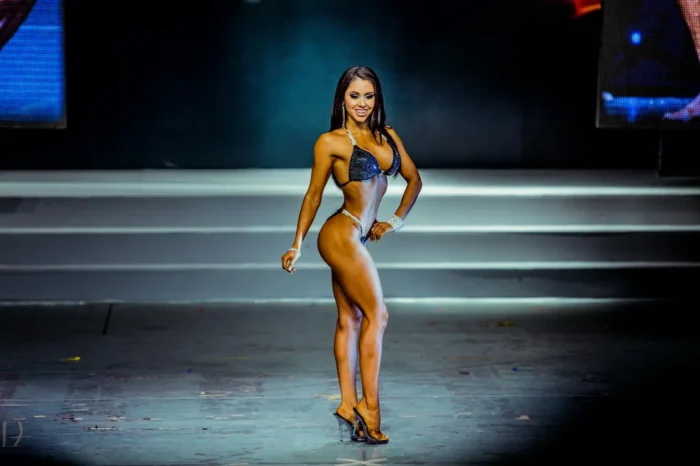
An example of stage presentation from Finnish bikini competitor Suvi Iso-Kuusela.
The third factor is the level of competition. Bikini competitions span several levels: novice events, local championships, then European and World Championships, as well as Arnold Amateur Bikini. At the very top are professional competitions, where only the best of the best qualify to compete.
Key points of the IFBB bikini fitness rules
According to the IFBB bikini fitness rules, the discipline is for women who take care of themselves and value a healthy lifestyle. Competitors must not have overly defined muscles, but their physiques must look athletic and healthy. Judges also consider the face, hair, skin tone, posture and overall presentation.
Bikini competitors cannot enter the bodybuilding, fitness, classic bodybuilding or bodyfitness categories at the same competition. This keeps the disciplines separate and makes judging fairer.
Competition attire
Competition attire consists of a two-piece bikini and high-heeled shoes.
- Competitors may wear store-bought bikinis.
- Bikinis must be appropriate and tasteful.
- Bikinis may be patterned, and competitors may choose their own color.
- Bikini bottoms must cover at least 1/3 of the buttocks. Thongs are prohibited.
- Competitors may choose the color and style of their shoes. Platform shoes are prohibited.
- Jewelry is permitted within reason.
Tanning and height categories
Competitors should have a natural, healthy-looking tan over their bodies. Height categories depend on the number of competitors, but the original rules summary listed these two:
- Up to 163 cm
- Over 163 cm
Bikini fitness on stage: the T-walk and judging
During the presentation round, competitors come on stage individually and perform a T-walk. It is a brief but important moment, giving the judges a chance to see how each competitor moves, poses and carries herself.
- The competitor walks onstage, stops at center stage and poses facing the audience.
- The competitor turns to face away from the audience and poses again.
- The competitor turns to face the audience, walks to one side of the stage, poses, then moves to the other side and poses again.
- The competitor returns to the lineup.
Round 1 is prejudging. The head judge calls competitors forward for comparisons in groups of 5, usually in numerical order. Competitors perform front and rear poses. After the comparisons, they stand in two lines at the back of the stage, leaving the center clear. The judges may call competitors forward again for comparisons in groups of 3-5.
Judging focuses primarily on two things:
- Physique balance and shape.
- The overall impression of the physique, including skin tone and tan, posture and overall stage presentation.
The judges select the 6 competitors they consider the best, but do not rank them at this stage. The 6 competitors selected most often advance to the final. In the final, the six finalists come onstage one at a time in numerical order, perform a T-walk and front and rear poses, and then the lineup is rearranged. There are no additional comparisons; finalists are judged on the initial comparison.
FAQ
Is bikini fitness suitable for beginners?
Yes, as long as you understand that it involves more than simply stepping onstage in a beautiful bikini. It takes training, control over your diet, posing and the courage to perform onstage.
Does bikini fitness require a lot of muscle?
You do not need a very large amount of muscle mass. Your physique should look athletic, proportionate and healthy. An overly dry or muscular physique may be at odds with the intent of the category.
What is the hardest part of a bikini competition?
For many, the hardest part is bringing everything together: your physique, posture, tan, attire, T-walk and confidence all need to work in harmony. One strong point cannot make up for a stage presentation that falls apart.
Additional text: Women Bikini Fitness; IFBB Universe.
Author: BODY; free translation by: Aire Lossmann
Source:Turg.Fitness.ee
Come train with us! ArtGym




