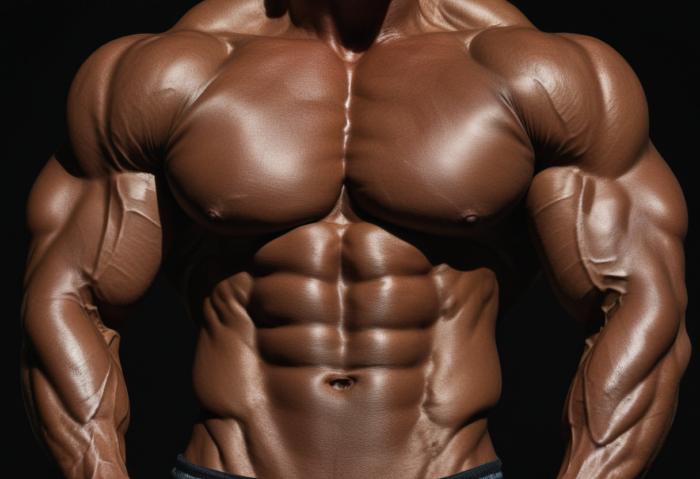
Of all athletes, bodybuilders follow and monitor their diets most closely. No other sport demands this level of discipline, routine and meticulous attention to nutrition.
Bodybuilders’ contest preparation is a subject in its own right: the strain and training loads, all endured on an insanely inhuman diet.
An already structured and tightly controlled diet becomes increasingly extreme as a competition approaches. It is not unusual for bodybuilders trying to lower their body fat percentage to spend 12 – 16 weeks eating essentially the same five or six foods every day. Day after day, it is chicken breast, tuna, rolled oats, rice, broccoli, eggs and perhaps the occasional potato, for 3 – 4 months straight before a competition. Fat intake can vary considerably: some bodybuilders try to reduce dietary fat to a minimum (a big mistake for several reasons), while others use nut butter to meet their daily fat requirements.
Alongside a restricted diet and limited food choices, contest preparation comes with a whole host of rules and beliefs that competitors try to follow blindly. No salty foods, no dairy products, no beef (this restriction is less common) and no fruit. There are undoubtedly more myths and beliefs like these, but much depends on who you get your advice from, the environment you are in and what you read.
Naturally, those promoting these beliefs point to bodybuilders who supposedly followed them and succeeded. Yet somehow, they never mention the many others who followed the same unfounded beliefs and looked like sausages onstage. They overlook a simple fact: people have achieved excellent physiques with virtually every kind of diet, whether high-carbohydrate/low-fat, high-fat/high-protein or moderate-carbohydrate/moderate-fat. Some approaches are simply unnecessary, and following many of these beliefs is more likely to slow your progress toward contest condition. I would now like to take you through some of these “rules” that are simply unnecessary during bodybuilding contest prep. Let’s talk about salt, eating unsalted foods and avoiding dairy products.
No salt…
One of the most deeply ingrained beliefs among bodybuilders and fitness competitors is that salt intake must also be kept low while dieting (or cut out altogether). This belief largely stems, of course, from the fact that salt makes the body retain water, including between the muscles and under the skin, causing a loss of definition. The body also needs sodium (salt), and a complete absence or deficiency of this element can have very negative effects on how we function. We all understand that. But let’s set that knowledge aside for a moment. Maximum muscle definition matters on competition day. My question would be: why should anyone be bothered if water retained because of salt blurs their definition 12 – 16 weeks before the competition? Here is another interesting fact: salt (sodium) starts causing substantial water retention in the body and under the skin when you suddenly switch from a very low salt intake to a very high one. This is also why even a small piece of pizza leaves you bloated and puffy during a typical diet. When you severely restrict salt, your body starts secreting aldosterone. This is a hormone that causes fluid retention. If you give your body a reasonable (normal) amount of salt, or even increase your salt intake slightly, it starts reducing aldosterone production. So, once again: salt causes problems when you suddenly move from a very low intake to a high one. Even then, after a few days of consuming salt, everything returns to normal, the “swelling” goes down and the bloated feeling subsides.
Both bodybuilders and fitness competitors should aim for low aldosterone levels on competition day. Removing salt from your diet 4 – 12 weeks before the competition causes more problems than it solves. In fact, more knowledgeable competitors tend to keep their dietary salt intake relatively high right up until close to competition day. This makes it much easier to shed water when they reduce their fluid intake 1 – 2 days before the competition.
Besides, what I have discussed so far has nothing whatsoever to do with fat burning. To explain the relationship between salt (sodium) and fat burning, I first need to introduce you to a hormone called ghrelin. This hormone is synthesized in the gut, and its levels rise when you are dieting. Conversely, when you can eat whatever you like, ghrelin levels fall. Along with leptin and other peptide hormones, ghrelin is involved in appetite and energy balance. When we become hungry or our cravings increase, ghrelin levels also rise, metabolic rate slows and fat storage increases (1). However, rising ghrelin levels alongside falling leptin levels are an inevitable part of dieting. Research shows that bodybuilders who are deficient in salt while dieting experience a greater increase in ghrelin levels (2). Extreme salt restriction therefore also complicates the processes involving ghrelin.
Beyond the effects on ghrelin, the body’s overall hydration status negatively affects protein turnover and reduces lipolysis (3). Normal fluid levels promote lipolysis and help spare the body’s protein. Animal studies have also produced findings suggesting that adequate hydration affects muscle metabolism at rest (4).
Interestingly, Scott Abel, a leading contest prep guru, also advises his athletes to season their food generously and not hold back on salt, for the very reasons outlined above. And Scott is well known for bringing his athletes to the stage looking dry and consistently in good condition. With this in mind, and in light of the discussion above, if you are preparing for a bodybuilding competition, you might want to rethink some of your existing beliefs about salt.
Author: Janar Rückenberg (translation)
Come train! ArtGym