
In short:
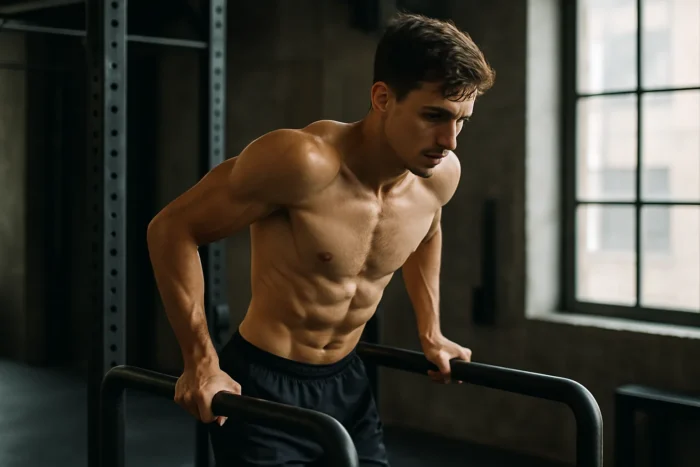
- Bodyweight training uses your own body weight as resistance and suits both beginners and people who train at home.
- The basic exercises are the squat, lunge, push-up, plank, glute bridge and pull-up.
- A simple plan consists of 5–6 exercises, 2–3 sets of each, two to three times per week.
Bodyweight training means building strength using your own body weight as resistance rather than a barbell or dumbbells. The classic Estonian athletic gymnastics system included a number of movements that can be performed with minimal equipment, and the same principle works at home today. In this guide, we look at which exercises make up a good bodyweight training program and how to put together a simple plan. The approach is free, flexible and needs very little space – which makes it a great fit for those who don’t want to or can’t go to the gym but still want to become stronger and more resilient.
What is bodyweight training and why does it work?
Bodyweight training puts your muscles to work against the mass of your own body – when you squat, press and pull, you overcome gravity and your own body weight. It develops strength as well as joint stability and coordination, because the movements are compound exercises in which several muscle groups work at once. The athletic gymnastics textbook included, for example, sit-ups, hanging leg raises and the body lever, all of which use nothing but the weight of your own body. Since no equipment is needed, it is perfect for beginners, travelers and people who train at home. Another advantage is that the movements are mostly natural and the whole body works together – so balance and body awareness improve as well. For muscle growth and strength, it matters that the muscle receives enough training load: if ten reps feel too easy, choose a harder variation or add reps. How this kind of approach, built on compound exercises, supports everyday mobility is explained well in the article What is functional training.
What are the best bodyweight exercises?
For each part of the body, choose one or two basic exercises. For the legs and glutes, the squat, lunge and glute bridge work well; if you want more training load on the glutes, add the hip thrust with your back supported on a bench. For the chest, shoulders and arms, the push-up is best, and beginners can do it from the knees. Pull-ups on a bar train the back and forearms, and they can be made easier with the help of a band. Planks and sit-ups strengthen the abdominal and core muscles. Check your technique on every rep: move through the full range of motion at a slow tempo and avoid swinging with momentum. Planks and sit-ups strengthen the abdominal and core muscles, keeping your midsection strong and stable. Keep your breathing calm – exhaling during the effort phase helps you control the movement. If you want to understand how training affects fat burning, read Fat burning and training.
How do you put together a simple plan?
A simple full-body plan for a beginner consists of 5–6 exercises: squat, lunge, push-up, glute bridge, pull-up (or band row) and plank. Do 2–3 sets of each exercise with 8–15 reps, and hold the plank for 20–40 seconds. Train two to three times per week, leaving at least one rest day in between. You progress by increasing the rep count, the number of sets or the difficulty of the exercise – for example, moving from knee push-ups to the full version. It also helps to keep an eye on rest between sets: 60–90 seconds is enough for a beginner to let the muscle partly recover. If you like, add a short, light warm-up round to the plan (jogging on the spot, squats without weights), which prepares the body and raises your heart rate. Keeping a training log helps you see whether your reps and difficulty level really increase over time. If you want an example with a ready-made structure, see Two two-day plans. The American College of Sports Medicine (ACSM) recommends muscle-strengthening training for adults at least two times per week, which this kind of plan meets well. If you have a health concern, consult a doctor before starting.
How do you avoid common mistakes?
The most common mistake is sacrificing technique for the sake of the rep count – it is better to do eight clean reps than fifteen sloppy ones. Another mistake is progressing too quickly: increase the training load in small steps and give your muscles time for recovery. Don’t skip the warm-up – a few minutes of light movement prepares the joints and reduces the risk of strains. A beginner who can’t yet do the full versions picks an easier form (for example, push-ups from the knees or band-assisted pull-ups) and moves on to the harder ones only when strength allows. If you train consistently and watch your technique, bodyweight training delivers visible results in both strength and posture within just a few months.
References
- Ervin Liebert. “Athletic Gymnastics” (1960s), illustrated by Edgar Valter.
- ACSM (2021). Resistance Training Guidelines for Healthy Adults.
- World Health Organization (2020). Physical activity recommendations.
Frequently asked questions
Can you build muscle with bodyweight training?
Yes, especially for beginner and intermediate trainees. To build muscle, gradually increase the rep count and choose harder exercise variations.
How many times per week should you do bodyweight training?
A full-body plan two to three times per week is a good start, leaving at least one rest day for your muscles in between.
Do you need equipment for bodyweight training?
The basic exercises can be done without equipment. A bar comes in handy for pull-ups, and a band can make pull-ups and rows easier.
How do you progress in bodyweight training?
Increase the rep or set count, slow down the tempo or choose a harder exercise variation, for example moving from knee push-ups to the full version.
Come and train! ArtGym