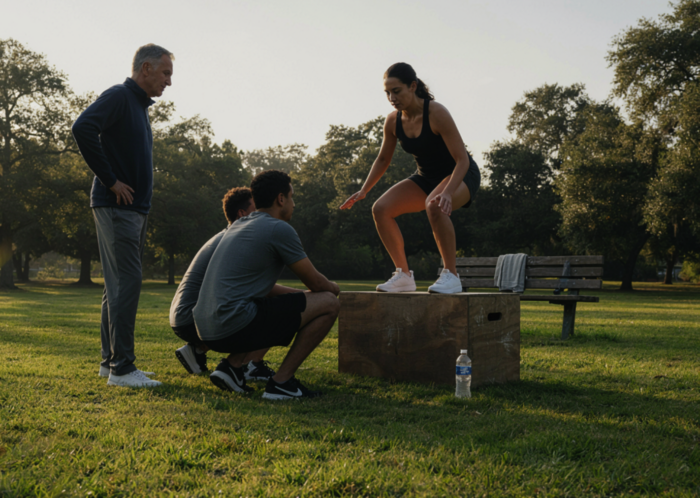
In short:
- The most common mistake is the knees collapsing inward on landing, which loads the cruciate ligaments and menisci.
- A 30–45 cm box suits beginners — a box that’s too high turns the jump into simply climbing.
- Box jumps shouldn’t be done when fatigued or without base strength and correct landing technique.
- Landing correctly on the midfoot with bent knees and hips is the most important element of the box jump.
The box jump is one of the most effective plyometric exercises for building explosive strength and neuromuscular coordination, yet box jump mistakes are surprisingly common among beginners and experienced trainees alike. Research confirms that plyometric training significantly improves lower-limb strength and jumping performance (Markovic & Mikulic, 2010), but only when it is performed with correct technique.
What are the most common box jump mistakes?
Box jump mistakes are often biomechanical and usually stem from insufficient base strength, poor technique control or an overly ambitious box height. The most common errors:
- Knees collapsing inward (valgus collapse) — the most dangerous mistake, creating excessive rotational forces on the knee joint on landing.
- Landing on the heels on top of the box — the correct way is to land on the midfoot with the knees slightly bent.
- A box that’s too high — the athlete climbs onto the box instead of jumping, which completely removes the plyometric effect of the exercise.
- Jumping back down off the box — the box is meant to be stepped down from, not jumped back from; on tired muscles this raises the risk of injury considerably.
- Skipping the warm-up — at least 5–10 minutes of dynamic warm-up is needed before box jumps, including hip mobility exercises and dynamic hamstring stretching.
- Training while fatigued — plyometric exercises shouldn’t be performed in an exhausted state, because neuromuscular control drops and the risk of injury rises noticeably.
If you want to understand how important a foundation of muscle strength is for box jumps, read the article So how do you actually grow those muscles.
Why is incorrect landing technique so dangerous?
The force generated on landing reaches several times your body weight and is distributed among the structures of the lower limbs. When the knees collapse inward on landing (valgus collapse), the muscles don’t absorb the impact optimally — the load shifts to the anterior cruciate ligament (ACL), the menisci and the cartilage of the patellofemoral joint. Hewett et al. (2006) found that dynamic knee valgus is one of the main independent predictors of ACL injury.
Correct landing means:
- Contact with the box surface on the midfoot, not the heels.
- Knees pointing over the second and third toes, not inward or outward.
- Hips slightly flexed — the body actively absorbs the impact through the muscles.
- Back in a neutral position, not rounded or in excessive lordosis.
Chimera et al. (2004) showed that systematic plyometric training improves muscle activation patterns on landing and reduces the forces loading the joints. Improving your technique is therefore possible, but it requires conscious and consistent practice.
A similar principle of developing control and body awareness applies to other bodyweight exercises — see the article Push-ups, tips and mistakes.
What is the right box height and how do you choose it?
The NSCA recommends a 30–45 cm box for beginners (Haff & Triplett, 2016). A box that’s too high turns the box jump into a climbing exercise — the desired plyometric effect, i.e. the fast stretch-shortening cycle, isn’t achieved and the exercise loses its main value.
Practical criteria for choosing box height:
- First perform a vertical jump without a box — the box should be roughly 50–70% of your vertical jump height.
- If you barely get your knees up on landing, the box is too high — lower the height before you refine your technique.
- If you land with completely straight legs, the box is too low.
- Raise the box height only when your technique is flawless across 3–5 consecutive repetitions.
The WHO physical activity guidelines recommend that adults do muscle-strengthening exercises at least 2 times per week — plyometrics, including box jumps, is well suited to this goal.
How do you improve box jump technique step by step?
Start with a lower rep count and box height, and increase the progression only once each step is clearly solid.
Step 1 — starting position: Stand 30–50 cm from the box, feet shoulder-width apart, toes turned slightly outward.
Step 2 — preparatory swing: Squat down slightly (a knee angle of roughly 70–90 degrees) and swing your arms back — you’re gathering momentum for the push that follows.
Step 3 — explosive rise: Swing your arms up quickly while simultaneously fully extending your hips, knees and ankles. At the peak of the jump, pull your knees slightly toward your chest to help your body land on the box.
Step 4 — landing on the box: Land on the midfoot with your knees and hips bent to absorb the impact. Keep your gaze forward, not down.
Step 5 — controlled step down: Step down calmly from the side of the box — don’t jump back. Rest 30–90 seconds before the next repetition to preserve explosive output.
When you start training, it helps to understand your overall fitness — see the articles FIT. What it is and how to earn them and, for nutrition support, here: 💊 Are supplements necessary? When to actually use them.
References
- Markovic G, Mikulic P. (2010). Neuro-musculoskeletal and performance adaptations to lower-extremity plyometric training. Sports Med. 40(10):859–895. PMID: 20836583
- Chimera NJ, Swanik KA, Swanik CB, Straub SJ. (2004). Effects of plyometric training on muscle-activation strategies and performance in female athletes. J Athl Train. 39(1):24–31. PMID: 15085219
- Hewett TE, Myer GD, Ford KR. (2006). Anterior cruciate ligament injuries in female athletes: Part 1, mechanisms and risk factors. Am J Sports Med. 34(2):299–311. PMID: 16382007
- Haff GG, Triplett NT (ed.). (2016). Essentials of Strength Training and Conditioning (4th edition). NSCA/Human Kinetics.
Frequently asked questions
How high should a box jump box be for a beginner?
A box 30–45 cm high suits beginners (Haff & Triplett, 2016). The box is the right height if you can land in control on your midfoot without tucking your knees excessively.
Why is knees caving inward dangerous in box jumps?
Knee valgus collapse on landing increases the load on the anterior cruciate ligament and the menisci, and it is one of the main risk factors for ACL injury (Hewett et al., 2006). Correct technique spreads the load across the muscles rather than the ligaments.
How often per week can you do box jumps?
The NSCA recommends plyometric training 2–3 times per week, with at least 48 hours of recovery between sessions. Beginners should start with 1–2 times per week.
Can you do box jumps without a proper box?
Yes — a sturdy, stable bench, a low step platform or a plyo box will work as a substitute. What matters is that the surface is non-slip, at least 20–30 cm high and able to support your body weight securely.
How do you know your technique is good enough to progress?
Your technique is ready for progression when you can perform 3–5 consecutive repetitions with a controlled landing: midfoot contact, knees tracking over the toes, back in a neutral position, and no loss of balance or knee valgus collapse.
Come and train! ArtGym