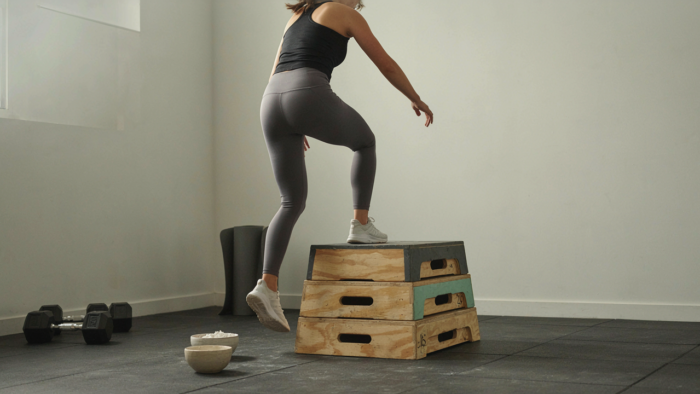
In short:
- The biggest injury risk in box jumps is jumping down from the box — always step down, never jump.
- A safe landing requires that your knees do not collapse inward and that your hips actively move backward.
- Start with a 30–40 cm box and raise the height only once your technique on the lower box is flawless.
- An adequate warm-up and progressive training load are the foundations of box jump safety.
Why does box jump safety deserve separate attention?
The box jump is a plyometric exercise that develops explosive strength, coordination and reactive athleticism. Box jump safety, however, is a topic that many exercisers only start to take seriously after their first injury. Poor landing technique, a box that is too high or an inadequate warm-up can lead to knee, ankle or tendon injuries that cost you weeks or months of training.
EMG and biomechanics studies confirm that the risk of lower-limb injury during plyometric training is directly tied to landing technique: the greater the medial collapse of the knee on landing, the higher the risk of anterior cruciate ligament (ACL) injury and ankle overload (Myer et al., 2006). In its core strength training textbook, the NSCA stresses that a technical foundation must be established before intensity is increased (Haff & Triplett, 2016).
What are the most common box jump injuries?
The following injuries occur most often with box jumps:
ACL injuries and knee problems. A sharp knee valgus collapse angle on landing is the main mechanistic risk factor for ACL tears. Hewett et al. (1996) showed that a plyometric training program that focused on landing technique significantly reduced the reaction forces acting on the lower limbs in female athletes.
Ankle sprains. An unstable landing base, fatigued muscle strength or a box that is too high often cause overstretching of the ankle ligaments.
Overuse injuries. Doing box jumps too often without adequate recovery leads to overuse injuries of the calf, the Achilles tendon and the patellar tendon. How to prevent overuse injuries covers this topic in more depth and offers concrete prevention strategies.
Skin abrasions. Landing on the edge of the box or slipping is painful but easy to avoid — use a box with a non-slip surface and wear long socks.
How do you ensure box jump safety with proper technique?
Starting position
Stand in front of the box in your usual athletic stance — feet shoulder-width apart, toes turned slightly outward. Keep your eyes on the box, not the floor. Your trunk is braced and your spine is in a neutral position.
Jump phase
Use an arm swing: swing your arms back and then quickly forward and up to generate extra momentum. Jump off both feet at the same time, driving forcefully into the floor through your feet. Don’t rise onto your toes — the force comes from the whole sole of the foot.
Landing phase — the most critical moment
The following biomechanical rules apply when landing on the box:
- Your knees must not turn inward — keep them in line with your feet or slightly outward.
- Your hips move actively backward — sit back into the hip joint, not the knees; this absorbs the impact in the large muscles rather than in the cartilage.
- Your ankles cushion the landing — don’t land in full plantar flexion or stiffly flat-footed.
- Your trunk stays braced — a neutral spine, not rounded or hyperlordotic.
EMG studies show that coordinated activation patterns of the lateral quadriceps fibers and the gluteal muscle complex are essential for performing the box jump safely (Chimera et al., 2004). If these muscles are weak or poorly activated, the load is transferred dangerously to the medial structures of the knee joint.
Coming down from the box — the injury hotspot
Many exercisers jump down off the box with the same momentum and energy with which they jumped up — this doubles the reaction force on the joints. The NSCA Essentials of Strength Training and Conditioning clearly recommends: step down from the box, don’t jump (Haff & Triplett, 2016). If you want to practice reactive landing (the depth jump), that is a separate exercise in a separate program — don’t mix it with the regular box jump.
What box height is right from a safety standpoint?
Box height should be based on technique, not ego:
- Beginners: 30–40 cm — learn clean technique
- Advanced: 50–60 cm — once your landing on the lower box is soft and controlled
- Elite athletes: 70–75 cm and above — only with perfect technique
Plyometric training is evidence-based and effective for improving vertical jump ability — a meta-analysis by Markovic (2007) showed an average improvement of 4.7 cm. However, the greatest benefit comes from progressive training load, not from jumping to the maximum height.
The rule: don’t raise the box height until you can land on the lower box with soft cushioning, aligned knees and a braced trunk. A high box with poor technique is a recipe for injury.
How do warm-up and recovery affect box jump safety?
Doing plyometrics with cold muscles is one of the most common mistakes. The recommended warm-up protocol before box jumps:
- 5–10 min dynamic cardio warm-up — light jogging, side steps, high knees
- Joint mobilization — hip, knee, ankle (dynamic, not static)
- Activation exercises — banded clamshell, single-leg balance, mini-band walking
- Progressive box jump warm-up — start with the lowest box for 2×5 repetitions before moving on to your working sets
Fatigue is the main catalyst that makes box jumps dangerous. The ACSM (2021) recommends placing plyometric exercises at the beginning of a workout, when your muscles are fresh. Don’t do box jumps at the end of a workout with exhausted muscles.
Recovery starts with proper nutrition — consuming protein and carbohydrates within 30–60 minutes after training supports muscle recovery and reduces the risk of injury at your next session. How to avoid feeling hungry offers practical advice on how to ensure sufficient energy availability on training days.
In its injury prevention guidelines, the NIH (National Institutes of Health) stresses that a progressive increase in training load and adequate recovery time are the cornerstone of preventing sports injuries (https://www.nih.gov/health-information).
The optimal frequency for box jumps is 2–3 times per week, with at least 48 hours of recovery between sessions. Athletes’ experiences of recovering from injuries show that returning to plyometric exercises too early prolongs recovery time significantly — Champions after injuries gives good examples of how professional athletes plan their comebacks in stages.
Balanced nutrition also helps prevent overuse injuries — avoiding overeating and binge eating ensures stable energy levels and hormonal balance, which directly affect how quickly your muscles recover. One-Minute Lecture: How to avoid overeating covers meal planning in a compact, practical way.
References
- Hewett TE, Stroupe AL, Nance TA, Noyes FR (1996). Plyometric training in female athletes. Am J Sports Med. 24(6):765–73. PMID: 8883674
- Chimera NJ, Swanik KA, Swanik CB, Straub SJ (2004). Effects of plyometric training on muscle-activation strategies and performance in female athletes. J Athl Train. 39(1):24–31. PMID: 15085218
- Markovic G (2007). Does plyometric training improve vertical jump height? A meta-analytic review. Br J Sports Med. 41(6):349–355. PMID: 17135581
- Myer GD, Ford KR, McLean SG, Hewett TE (2006). The effects of plyometric versus dynamic stabilization and balance training on lower extremity biomechanics. Am J Sports Med. 34(3):445–55. PMID: 16260468
- Haff GG, Triplett NT (2016). Essentials of Strength Training and Conditioning, 4th ed. NSCA / Human Kinetics.
- American College of Sports Medicine (2021). ACSM’s Guidelines for Exercise Testing and Prescription, 11th ed. Wolters Kluwer.
Frequently asked questions
Can you do box jumps every day?
No. Plyometric training requires 48–72 hours of muscle recovery. The NSCA recommends a maximum of 2–3 box jump sessions per week for beginners and up to 4 for advanced trainees, but sessions must be separated by adequate rest.
Is a soft box safer than a hard box?
A soft box reduces the risk of skin abrasions when you land on the edge of the box, but it doesn’t change landing biomechanics — knee and ankle injuries caused by poor technique are just as likely regardless of what the box is made of.
What box height should a beginner start with?
A box 30–40 cm high suits beginners. What matters is that your landing is soft and controlled and your knees are aligned — only then does it make sense to increase the height.
Do box jumps replace traditional squat training?
No. The box jump is a plyometric exercise that develops reactive strength and explosive speed, not maximal strength. Squat training and box jumps complement each other — both belong in a well-rounded training program.
How can you tell the box is too high?
If you have to pull yourself up with your hands after landing on the box, you land with a loud thud, or your knees collapse inward — the box is too high. Lower the height until your technique is clean.
Come and train! ArtGym