
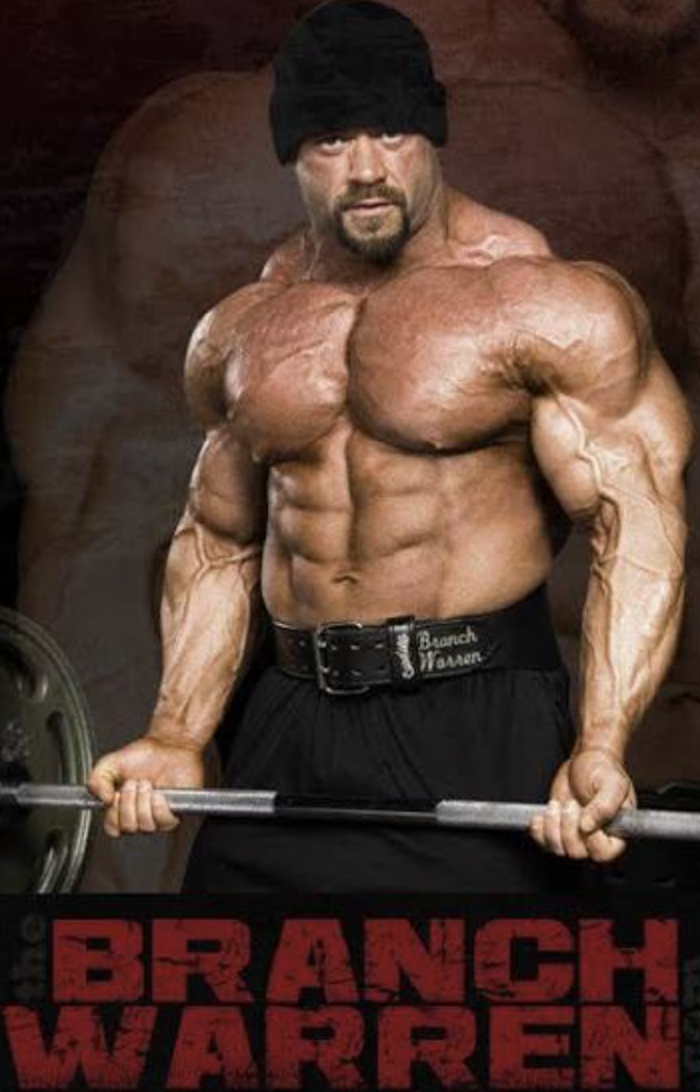
Thick arms: Branch Warren’s biceps workout
Thick arms don’t come simply from picking up a big dumbbell and hoping for the best. Branch Warren built his biceps with very heavy work that was exhausting even over a short time, but the whole idea was simple: the muscle has to get a strong signal, and the movement has to stay under control.
This isn’t a plan for a beginner’s first month. It’s more of a shock method for those who can already do biceps curls without swinging their body. If your technique falls apart, your biceps won’t get better work. Instead, you get a sore elbow or a pulled muscle.
Why do thick arms sometimes need a shock?
An old bodybuilding truth is fairly harsh: the same exercise, the same weight and the same rep count eventually give the same result. The body adapts. That’s why many pros occasionally used methods that forced the muscle to do more work than in a regular set.
Branch Warren was known for his hard-hitting training style. His biceps workout wasn’t a pretty scheme drawn up on paper but hard work in the gym. Still, he had one important principle: a heavy weight doesn’t mean a sloppy movement. If you want big arms, you have to be able to steer the weight, not let the weight steer you.
So what actually happens? If you take a set to failure and immediately reduce the weight, the muscle can keep working even after the first weight no longer moves. It’s intense. That’s why it doesn’t suit every workout or every week.
How did Branch Warren train biceps?
The original idea was to build the workout around three parts: dumbbell drop sets, barbell curls with a partner, and finally slow concentration work. All three hit the biceps from a slightly different angle.
- Branch Warren did “down-the-rack” dumbbell curls. He started with a pair of hundred-pound dumbbells, did as many repetitions as he could to failure, and dropped the weight by 20 pounds per set: 80, 60, 40 and 20. Each set again went to failure.
- For the partner barbell curls, the partner stood facing him. A 135-pound barbell was used. Branch Warren did 20 repetitions to failure, then the partner did their own 20 repetitions and handed the barbell back. Next came 19 repetitions, 19 from the partner as well, and so on down to 15 repetitions.
- Concentration curls were slow and controlled. In the top position, the peak contraction was held so that the biceps would do the work, not momentum.
- The movements had to be controlled as strictly as possible, because with heavy weights it’s very easy to injure the biceps.
- Workouts like this were done once every six weeks for six months.
A simple truth: this plan only works if your ego stays outside the door. If you have to jerk your back on every repetition, the weight is too heavy for you. The biceps doesn’t care what’s printed on the dumbbell. It responds to tension.
Order of exercises
Start with the hardest part, while your nervous system is fresh. “Down-the-rack” dumbbell curls: 5 x to failure. This is the main shock of the workout.
Then do barbell curls with a partner: 6 x 20-15. Here the partner helps keep the tempo, and rest periods stay short. Finally, do dumbbell concentration curls: 3 x 8. This finishes the work with a calmer, more precise feel.
Practical tips: thick arms with no nonsense
Don’t do this plan if your elbow, wrist or shoulder already hurts. This is not a recovery workout. It’s a heavy training load on the muscle and tendons. The warm-up has to be proper: a couple of light sets, get the wrists moving, warm up the shoulders.
Keep your elbows still. If they swing forward and back on every repetition, the exercise turns into a half-hearted body swing. Stand firm, brace your core and let the biceps do the work the exercise was chosen for.
For the partner set, agree beforehand on how the barbell will be handed over. A little confusion at the end, when you’re tired, is exactly where technique falls apart. The barbell doesn’t have to fly from hand to hand. A calm handover, a quick breath and the next set.
Recovery matters too. If you do a biceps workout like this, don’t plan a heavy back workout the next day where rows load the same area. Give your arms time. Otherwise, a good shock simply turns into excess wear and tear.
FAQ: big arms and Branch Warren’s plan
Is this plan suitable for a beginner?
Probably not. A beginner will get better results from regular technique training, moderate weight and consistency. This plan suits you better once the exercises are already clear to you.
How often should you do it?
In the original, the recommendation was once every six weeks for six months. It’s worth taking that seriously. This is not a recipe for a weekly biceps day.
What is the most important technical detail?
Control. If the weight moves cleanly and the biceps stays under tension, the set makes sense. If your whole body helps out, you’ve simply chosen too heavy a weight.
Author: joker
Source: WHO – physical activity.
Come and train! ArtGym




