
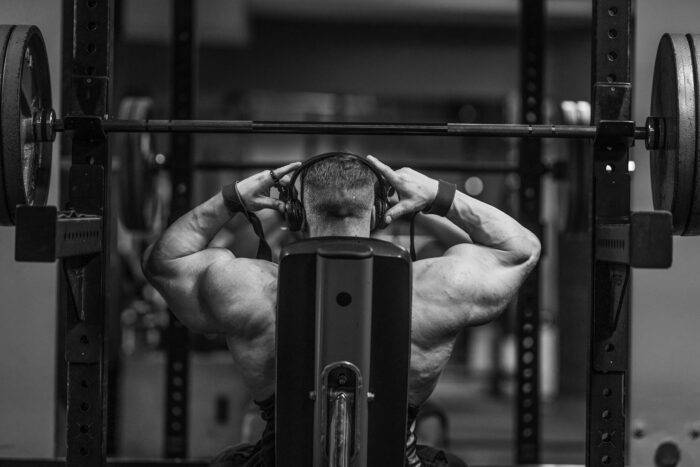
How to bring up lagging muscles: training weak muscles
Bringing up lagging muscles means targeted work in the gym on your weaker muscle groups — the ones that grow more slowly than the rest and fall behind in your overall physique. Done right, specialization produces a visible change within a couple of months, but it demands different logic than ordinary gym training.
Why some muscles grow more slowly
Every lifter has weak spots. For some it’s the shoulders that lag behind, for others the hamstrings or chest muscles. The cause is usually a combination of genetics, everyday posture and which exercises you’ve done more of over the years. The good news is that a muscle always responds to the right stimulus — you just have to find that stimulus and give the muscle room to recover.
The biggest mistake people make with weak muscles is a more-is-better mindset. You add ten more sets to your workout, train those muscles in every session, and wonder why nothing happens. In reality it’s the opposite: less volume, more focus.
Bringing up lagging muscles — 11 core rules
- In every training session, do fewer sets overall than you normally would. For weak muscles, reduce the number of sets by about 30%.
- Train intensively. Don’t rest longer than 90 seconds, or 60 seconds for smaller muscles.
- Use a wide variety of exercises to hit the muscle from different angles.
- Before every workout, set out clearly what you want to achieve and focus on it.
- For the muscle you’re focusing on, choose at least one compound exercise and two or three isolation exercises.
- To target lagging torso muscles (chest, back, shoulders, traps), use the pre-exhaustion method.
- After a thorough warm-up, use maximum resistance in every exercise, but not at the expense of technique.
- Maintain exemplary biomechanics. Lagging body parts need to be trained as intensely as possible, which you can’t do with sloppy form.
- Train to complete fatigue in every set. In many sets you can push past the normal point of fatigue by using forced reps.
- When developing lagging muscle groups, you have to keep pushing through the pain barrier. Before you start fearing it and cutting back on intensity, remind yourself that it is a sure sign of hard training, which is what causes muscle hypertrophy.
- Maintain a positive mental state.
Practical tips: bringing up lagging muscles in the gym
The rules are clear, but in real life they often stay on paper. Here are a few things that help you actually follow them.
Pick one body part at a time, not three. If you try to bring up your arms, calves and shoulders all at once, you can’t give any of them enough focus. Pick the weakest, work on it for 6–8 weeks, and only then move on to the next.
Put the weak muscle group at the start of your workout. A fresh central nervous system can activate a weak muscle far better than a tired nervous system can. It’s a simple trick that many people overlook because “that muscle is used to coming mid-workout”.
Keep a training log. Without measurable progress, you won’t be able to tell after six weeks whether your specialization worked at all. Write down weights, repetitions and rest times. The numbers show what is moving forward and what is stalling.
Don’t forget recovery. During a specialization period, your overall training stress goes up. Sleep at least 7–8 hours, eat enough protein and cut the volume for your other muscle groups to maintenance level. One hard chest workout a week keeps your chest in shape while you’re bringing up your calves.
FAQ: bringing up lagging muscles and weak muscles
How long should a specialization cycle last?
Six to eight weeks is optimal in practice. A shorter period isn’t long enough to produce lasting changes in the body, while a longer one leads to overtraining or staleness. After the cycle, return to normal balanced full-body training for at least four weeks.
Can you train other muscles at all during this time?
You can, and you should. The other body parts stay at maintenance level — one workout per week, moderate volume, no chasing personal records. The goal is to hold on to the shape you’ve built, not to develop several areas in parallel.
Is bringing up lagging muscles suitable for a beginner?
Not in the first year. In a beginner, all muscle groups grow at a relatively similar rate as long as they follow a basic program. Specialization is a tool for the advanced lifter who already has a clear picture of where their body’s real weak spots are.
Let’s bring those lagging muscles up! ArtGym
Author: Jaan Loko, from the knowledge base
Source: WHO – physical activity.




